

Embark on a Journey to Discover Kanagawa’s Diverse Charms
From sophisticated port cities where the sea and urban landscapes merge, venture slightly inland to discover deep greenery and clear, refreshing waterfalls. Kanagawa Prefecture’s tourist attractions showcase entirely different faces depending on the area.
For travelers visiting Kanagawa Prefecture, we’ve carefully selected five must-visit spots, ranging from classic popular destinations to hidden natural gems known only to a few. Beyond mere tourist information, we delve into their origins and history, as known by locals, and even share ‘practical local tips to be aware of.’ Use this as a reference for your next weekend outing.
Yamashita Park
📍 Address: 279 Yamashitacho, Naka Ward, Yokohama, Kanagawa 231-0023, Japan
Yamashita Park is a symbol of Yokohama, captivating visitors with its ‘urban x nature’ contrast, where the expansive sea and sky merge with a backdrop of high-rise buildings. This park actually has a profound history; it was created as Japan’s first seaside urban park in 1930, using rubble from the 1923 Great Kanto Earthquake for land reclamation. The park features the ‘Guardian of Water’ statue donated by San Diego City and the ‘Indian Water Tower’ from the Indian Association of Japan, allowing visitors to feel Yokohama’s journey as a stage for international exchange.
The vast park is exceptionally well-maintained, and during the day, sitting on a bench along the waterfront, enjoying the sea breeze, is simply the best. The ‘Future Rose Garden,’ boasting approximately 160 varieties and 1,900 roses, is an undeniably photogenic spot. However, we especially recommend visiting the ‘NYK Hikawa Maru,’ a nationally important cultural property moored in the park. For just 300 yen, you can explore every corner of the ship and be impressed by its history as a luxury liner from before the war and its splendid state of preservation.
As it’s a very spacious park, comfortable walking shoes are essential for exploring. During the bustling afternoon hours, when there are many tourists, there’s little shade, so bringing a parasol or hat is advisable. From evening to night, the Hikawa Maru and surrounding historical buildings are illuminated, allowing you to enjoy a romantic Yokohama night view entirely different from the daytime.
Yokohama Hakkeijima Sea Paradise
📍 Address: Hakkeijima, Kanazawa Ward, Yokohama, Kanagawa 236-0006, Japan
Opened in 1993 on an artificial island in Yokohama’s Kanazawa Ward, Yokohama Hakkeijima Sea Paradise is one of Japan’s largest marine leisure complexes, integrating four different-themed aquariums, various attractions, restaurants, and shops. While tickets are required to use the aquariums and attractions, entry to ‘Hakkeijima Island’ itself is free. Consequently, it’s a versatile spot where many locals visit just to enjoy a stroll along the seaside or dine at a restaurant.
At the main aquarium, ‘Aqua Museum,’ you can experience overwhelming immersion and excitement by riding an escalator directly through the center of a giant tank where 50,000 sardines swim in a massive school. Furthermore, there’s a wealth of experience-based content themed around ‘ocean education,’ such as limited-time events where you can touch deep-sea creatures and dolphin jump shows. If you want a good seat for the show, it’s a golden rule to head to the venue 15 minutes before it starts.
It’s a place where you can spend an entire day without getting bored, but sneakers are a must as you’ll be walking around a vast area. On holiday mornings, long queues form at the ticket counters, so purchasing web tickets in advance from sites like Asoview will allow for smoother entry. Also, when eating takeout snacks (like chili dogs) outdoors, please be mindful of kites sharply eyeing your food from above.
Tobioyama Observation Deck
📍 Address: Tanasawa, Atsugi, Kanagawa 243-0205, Japan
This observation deck stands at an altitude of approximately 235m, midway along the Tobioyama hiking trail, which is easily accessible from Atsugi city center. The mountain is imbued with historical significance, featuring one of Japan’s oldest ‘first-order triangulation stations’ nearby, and a quietly standing memorial to the Sino-Japanese War victims right next to the observation deck. You can reach it with a pleasant 20-30 minute hike starting from the entrance of Tenrandai Park.
The spiral staircase, a symbol of the observation deck, has no landings and offers a thrilling view of the ground through gaps underfoot, which might be a bit nerve-wracking for those with acrophobia. However, at the top, a grand panorama awaits, offering views of Atsugi city and the Sagami River, and on clear days, even Enoshima, Yokohama Landmark Tower, and Tokyo Skytree. The view on a clear winter’s day is exceptional.
While some media introduce it as one of Kanagawa’s premier night view spots, there are no streetlights whatsoever along the trail. Furthermore, there are sections of steep, moss-covered stairs that can be slippery, and unpaved, slightly rough paths, making a casual visit at night extremely dangerous. To safely enjoy the scenery, we strongly recommend wearing comfortable walking shoes like sneakers and enjoying it as a daytime hike.
Fudo-no-Taki Waterfall
📍 Address: Nanasawa, Atsugi, Kanagawa 243-0121, Japan
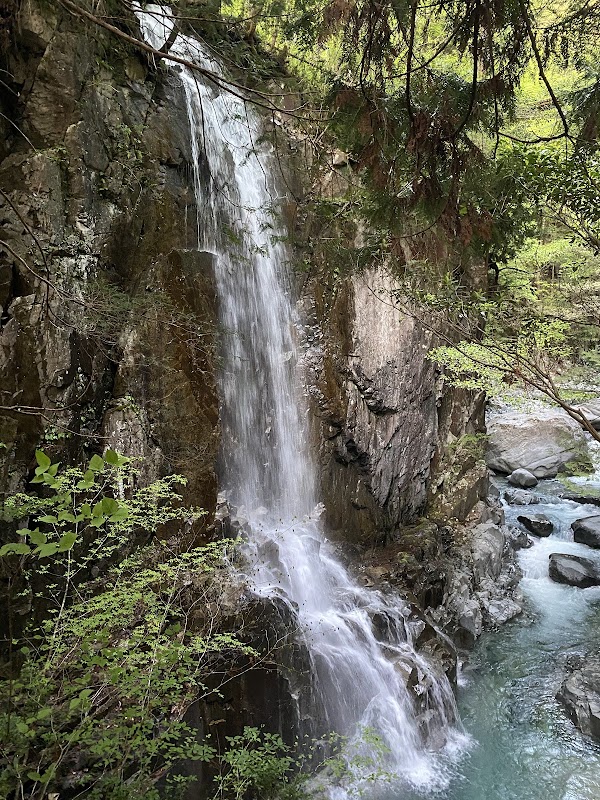
This is a secluded waterfall hidden deep within the Nanasawa area of Atsugi Onsen-kyo. After walking for about an hour along a relatively flat forest road from the Hirotakuji-mae parking lot, you’ll arrive at ‘Fudojiri Hiroba,’ a former campsite. The area around this clearing is known as a large habitat where yellow Mitsumata flowers bloom abundantly from mid-to-late March each year, attracting many hikers in spring. Further upstream from this clearing lies the ‘Fudo-no-Taki Waterfall.’
Though its drop is a modest few meters, the sight of clear water powerfully cascading down a massive single rock face is impressive, and combined with the surrounding tranquility, fills the air with a refreshing atmosphere. On the way to the waterfall, there’s an artificial weir (entei) which some mistake for the actual waterfall and turn back. However, if you rely on the chain handhold to the right of it and proceed further, the real waterfall will appear.
The forest road to Fudojiri Hiroba is paved, but the path from there to the waterfall is unpaved, overgrown with grass, and has fallen trees and slippery sections. Furthermore, from spring to early autumn, numerous land leeches appear in this area, so please ensure full protection: avoid exposing skin, carry leech repellent spray or salt, and be well-prepared with appropriate footwear and insect repellent measures.
Shiokawa-daki Waterfall
📍 Address: Tashiro Shiokawadaki, Aikawa, Aiko District, Kanagawa 243-0306, Japan
Located in Aikawa Town, next to Atsugi City, this magnificent waterfall is also selected as one of ‘Aikawa’s 10 Scenic Views.’ Its history is ancient, with legends stating that the monk Roben of Todai-ji Temple enshrined Seiryu Gongen during the Nara period (Jinki era). It was once a sacred place for Shugendo mountain asceticism, serving as the fifth practice site for Hassuga Shugen, where ascetics devoutly trained. Even today, you can occasionally see people performing waterfall asceticism (Takigyo) here.
The powerful sight of water majestically cascading approximately 15m down a sheer cliff, about 4m wide, is more impressive than one might imagine. Even in summer, a cool, refreshing air hangs around the waterfall basin, allowing you to immerse yourself in negative ions. If the timing is right, you might even encounter a fantastical scene where sunlight filtering through the trees creates a rainbow over the waterfall. Children often enjoy playing in the shallow waters, creating a peaceful atmosphere full of local charm.
‘Such a magnificent waterfall in such a place!’ is what you’ll exclaim about its surprisingly good access; from the free parking lot, it’s just a few minutes’ walk to a viewing platform where you can see the waterfall up close. However, the road leading to the parking lot is unpaved and quite bumpy, so drivers with low-clearance vehicles or those unfamiliar with driving on rough terrain should proceed slowly and with extreme caution to avoid punctures or undercarriage damage. Since parking spaces are limited, it’s a smart tip to enjoy your visit without overstaying, practicing a spirit of mutual consideration.
Conclusion: Embark on a Journey to Fully Experience Kanagawa Prefecture’s Multifaceted Charms
From the sophisticated urban and seaside scenery of ‘Yamashita Park’ and ‘Yokohama Hakkeijima Sea Paradise,’ to the tranquil, forest-enveloped ‘Fudo-no-Taki Waterfall’ and ‘Shiokawa-daki Waterfall,’ and the ‘Tobioyama Observation Deck’ where you earn a panoramic vista with your own efforts, Kanagawa Prefecture’s tourist attractions are incredibly diverse.
The true joy of Kanagawa tourism lies in the ability to immerse yourself in completely different worlds by driving or taking a train for just a few tens of minutes within the same prefecture. Knowing the local realities in advance (such as preparing comfortable shoes, arranging tickets beforehand, and taking leech precautions) will further enhance your trip. Please use this article as a reference to plan your perfect Kanagawa adventure.


'%3E%3Cpath%20stroke='%23000'%20stroke-width='4'%20d='m-35-37-13%2020m5%203%2013-20m5%203-13%2020m63%2042%206-9m1-2%206-9m5%203-6%209m-1%202-6%209m5%203%206-9m1-2%206-9m-96%200%2013%2020m5-3-6-9m-1-2-6-9m5-3%2013%2020m63-42-6-9m-1-2-6-9m5-3%2013%2020m5-3-6-9m-1-2-6-9'/%3E%3Ccircle%20r='24'%20fill='%23cd2e3a'/%3E%3Cpath%20fill='%230047a0'%20d='M0%200a12%2012%200%201%201%2020%2013%2024%2024%200%201%201-40-26A12%2012%200%201%200%200%200'/%3E%3C/g%3E%3C/svg%3E)
'/%3E%3Cpath%20fill='%23b2b2b2'%20d='M241%20382q0%2016%2017%2026%2017%2011%2042%2011t42-11q16-11%2017-26V269H241'/%3E%3Cpath%20fill='%239f7e00'%20d='M241%20379q0%2014%208%2023%209%209%2021%209%2014%200%2021-9%209-9%209-23V269h-59'/%3E%3Cpath%20d='M241%20339v-70h59v110q0%2014-9%2023l-6%205v-68h-15v72q-8%200-14-4v-68zm59%2040c0%2022%2015%2032%2029%2032%2021%200%2030-18%2030-32v-40h-59'/%3E%3Cpath%20fill='%239f7e00'%20d='M266%20277v5h2v12h-3v-5h2v-5h-9v5h2v5h-4v9h3v18h-5v10h34v-10h-5v-18h3v-9h-4v-5h2v-5h-9v5h2v5h-3v-12h2v-5zm42%20101q0%2010%206%2017%206%206%2015%207%2010-1%2016-7%206-7%206-17v-29h-43'/%3E%3Ccircle%20fill='%230044ad'%20cx='329.5'%20cy='372'%20r='6'/%3E%3Cellipse%20fill='%230044ad'%20cx='300'%20cy='340'%20rx='16'%20ry='21'/%3E%3C/svg%3E)


