

Tsunoshima Bridge
📍 Address: Kanda, Hōhoku-chō, Shimonoseki, Yamaguchi 759-5331, Japan
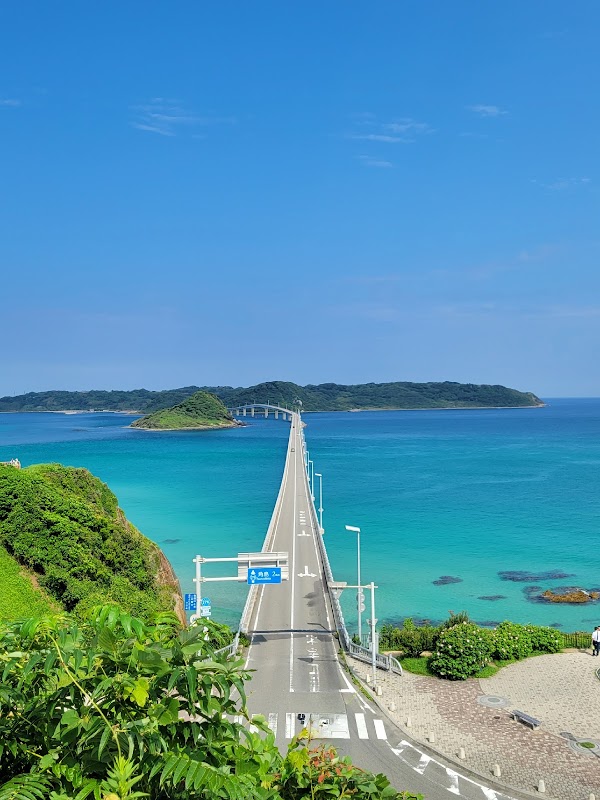
Tsunoshima Bridge, stretching 1,780m, connects the main island with Tsunoshima. It boasts one of Japan’s longest free general roads connecting to an isolated island and frequently appears as a filming location for car TV commercials, making it a scenic landmark representing Yamaguchi Prefecture.
The sight of the bridge extending over the emerald green Amagase Strait is reminiscent of a tropical resort. To protect this beautiful landscape, a route with a gentle curve was deliberately chosen to bypass the floating ‘Hatoshima’ island, rather than placing piers on it. This consideration for the scenery earned it the ‘Japan Society of Civil Engineers Design Award 2003’ Excellence Award.
The sea color is most vibrant on clear, sunny summer days with strong sunlight. Visiting in the early morning can help avoid crowds and allow you to capture a ‘miracle shot’ from the observation deck at ‘Amagase Park’. It’s recommended to drive slowly with windows open to feel the sea breeze, as the bridge may be closed during strong winds and has a speed limit of 40km/h.
Motonosumi Shrine
📍 Address: 498 Yuyatsuwazu, Nagato, Yamaguchi 759-4712, Japan
One hundred and twenty-three vermilion torii gates line up as if rushing down a cliff towards the Japan Sea. The striking contrast between the blue sea and sky and the red torii is a globally recognized breathtaking view, chosen by CNN as one of ‘Japan’s 31 Most Beautiful Places’.
The shrine’s history is surprisingly recent, established in 1955 (Showa 30) after a ‘white fox’ appeared in a local fisherman’s dream, delivering an oracle. Beyond the tunnel of torii gates, a panorama of rugged rocks and the Japan Sea unfolds. Depending on the wave conditions, you can also witness a natural spectacle called ‘Ryugu no Shiofuki’, where seawater can gush up to 30m high.
And one unmissable feature of this shrine is its offering box, said to be ‘Japan’s hardest to throw money into’. It’s positioned at the center of the upper part of a grand torii gate, approximately 6 meters high, requiring visitors to look up from below and toss coins – a truly rare style. It’s said that your wish will come true if you successfully throw a coin in, so be sure to give it a try.
Akiyoshido Cave
📍 Address: 3506-2 Akiyoshi, Shūhō-chō, Mine, Yamaguchi 754-0511, Japan
Spreading beneath the Akiyoshidai Plateau, ‘Akiyoshido Cave’ is one of Japan’s largest limestone caves, designated as a Special Natural Monument. The tourist route alone extends for about 1km (with a total length of approximately 11km), offering a subterranean exploration that takes about an hour and a half if you walk at a leisurely pace.
The roots of this gigantic space date back to a coral reef born near the equator about 350 million years ago. It then moved and uplifted due to crustal movements, and over many years, groundwater and rainwater dissolved the limestone, forming its present appearance. Inside the cave, a miraculous beauty of geological formations created over an immeasurable amount of time unfolds, including ‘Hyakumaizara’ (One Hundred Plates) where limestone has solidified like terraced rice fields, and the enormous ‘Ōgonbashira’ (Golden Pillar), a stalagmite column reaching 15m in height and 4m in width.
The cave’s temperature is maintained at around 17 degrees Celsius throughout the year, making it comfortable to visit in both summer and winter. If you enter from the main entrance, it’s a gentle uphill slope towards Kurotaniguchi, so wearing comfortable shoes is essential.
Kintai Bridge
📍 Address: 1 Chome-2 Iwakuni, Iwakuni, Yamaguchi 741-0062, Japan
Spanning the approximately 200m wide Nishiki River, ‘Kintai Bridge’ is a unique wooden five-arch bridge unparalleled worldwide. Counted as one of Japan’s Three Great Bridges, its appearance harmonizing beautifully with the seasonal nature of cherry blossoms and autumn leaves makes it an unmissable historical structure for Yamaguchi tourism.
In 1673 (Enpō 1), Hirokane Kikkawa, the 3rd feudal lord of the Iwakuni domain, built it with the ardent desire for a bridge that would not be washed away by floods, taking inspiration from an arch bridge depicted in ‘Xihu Youlan Zhi’ from China. It was constructed using a ‘wooden joint technique’ without a single nail, instead employing metal clamps and dog spikes, creating an intricate structure that gains strength as pressure is applied from above.
While gazing at Shiroyama Castle and the clear stream of the Nishiki River from the bridge is wonderful, try descending to the riverbed and looking up at the bridge’s framework from below. The beauty of the geometrically assembled timbers is stunning, allowing you to feel the high technical skill and passion of the ancestors. A classic way to enjoy the area is to taste the local specialty soft-serve ice cream around Kikkō Park after crossing the bridge.
Ruriko-ji Temple’s Five-Story Pagoda
📍 Address: 1-28 Kimachi, Yamaguchi, Yamaguchi 753-0095, Japan
The National Treasure ‘Ruriko-ji Temple’s Five-Story Pagoda’ stands as a testament to why Yamaguchi City is called ‘the Kyoto of the West’. It is counted among ‘Japan’s Three Great Pagodas,’ alongside Horyuji Temple in Nara Prefecture and Daigoji Temple in Kyoto Prefecture, an outstanding architectural marvel from the mid-Muromachi period.
It was built around 1442 (Kakitsu 2) by Ōuchi Morimi to mourn his brother, the 25th Ōuchi Yoshihiro. Standing 31.2m tall, its slender body, with eaves narrowing towards the upper tiers, and the beautiful curves of its cypress bark roof are highly regarded, making it a masterpiece of Ōuchi culture. The area around the pagoda is beautifully maintained as Kōzan Park, offering breathtaking seasonal scenery with cherry blossoms and plums in spring and autumn leaves.
Within the park, there are many highlights, such as ‘Chinryūtei’, where Takamori Saigo and Takayoshi Kido secretly discussed the Satsuma-Chōshū Alliance during the Bakumatsu period, and the ‘Uguisu-bari no Ishidatami’ (Nightingale Pavement) where clapping your hands produces an echo. It’s a superb healing spot where you can fully immerse yourself in the historical romance of Yamaguchi in a tranquil atmosphere.
Tips for Enjoying Yamaguchi Tourism 120%
Yamaguchi Prefecture is vast, stretching from the Japan Sea side to the Seto Inland Sea side, and each area has completely different characteristics: ‘sea’, ‘karst topography’, and ‘historical buildings’. The five spots introduced here are all representative landmarks of Yamaguchi, but a rental car or personal vehicle is essential to visit them efficiently due to their distances.
For example, to visit ‘Tsunoshima Bridge’ and ‘Motonosumi Shrine’ in the Nagato/Shimonoseki area, it’s best to aim for a sunny day during daytime to capture the contrast of the blue sea in your photos. On the other hand, ‘Kintai Bridge’ in the Iwakuni area and ‘Ruriko-ji Temple’ in the Yamaguchi area can be enjoyed for their historical significance and atmosphere regardless of season or weather.
For your travel base, we recommend choosing ‘Yuda Onsen Town’, known for its skin-beautifying hot springs. Enjoy a footbath tour to soothe your travel fatigue and prepare for the next day’s scenic drive… We invite you to experience such a luxurious local experience in Yamaguchi.


'%3E%3Cpath%20stroke='%23000'%20stroke-width='4'%20d='m-35-37-13%2020m5%203%2013-20m5%203-13%2020m63%2042%206-9m1-2%206-9m5%203-6%209m-1%202-6%209m5%203%206-9m1-2%206-9m-96%200%2013%2020m5-3-6-9m-1-2-6-9m5-3%2013%2020m63-42-6-9m-1-2-6-9m5-3%2013%2020m5-3-6-9m-1-2-6-9'/%3E%3Ccircle%20r='24'%20fill='%23cd2e3a'/%3E%3Cpath%20fill='%230047a0'%20d='M0%200a12%2012%200%201%201%2020%2013%2024%2024%200%201%201-40-26A12%2012%200%201%200%200%200'/%3E%3C/g%3E%3C/svg%3E)
'/%3E%3Cpath%20fill='%23b2b2b2'%20d='M241%20382q0%2016%2017%2026%2017%2011%2042%2011t42-11q16-11%2017-26V269H241'/%3E%3Cpath%20fill='%239f7e00'%20d='M241%20379q0%2014%208%2023%209%209%2021%209%2014%200%2021-9%209-9%209-23V269h-59'/%3E%3Cpath%20d='M241%20339v-70h59v110q0%2014-9%2023l-6%205v-68h-15v72q-8%200-14-4v-68zm59%2040c0%2022%2015%2032%2029%2032%2021%200%2030-18%2030-32v-40h-59'/%3E%3Cpath%20fill='%239f7e00'%20d='M266%20277v5h2v12h-3v-5h2v-5h-9v5h2v5h-4v9h3v18h-5v10h34v-10h-5v-18h3v-9h-4v-5h2v-5h-9v5h2v5h-3v-12h2v-5zm42%20101q0%2010%206%2017%206%206%2015%207%2010-1%2016-7%206-7%206-17v-29h-43'/%3E%3Ccircle%20fill='%230044ad'%20cx='329.5'%20cy='372'%20r='6'/%3E%3Cellipse%20fill='%230044ad'%20cx='300'%20cy='340'%20rx='16'%20ry='21'/%3E%3C/svg%3E)


