

The ‘Lake Kawaguchiko and Fuji Five Lakes area’ is one of Japan’s leading tourist destinations, easily accessible from the city center and attracting many visitors throughout the year. Everywhere you look, the majestic Mt. Fuji appears, allowing you to enjoy the changing seasons and unique local culture.
However, with so many attractions, many travelers wonder, ‘How should I plan my itinerary with limited time?’ or ‘Is it true that popular spots get heavily crowded?’ That’s why we’ve carefully selected five essential tourist spots around Lake Kawaguchiko that you absolutely can’t miss. This isn’t just a simple catalog; we provide a thorough explanation, infused with the local atmosphere, covering the best visiting times, overlooked deep attractions, and even common crowd traps for travelers and how to avoid them.
Kawaguchiko Maple Corridor
📍 Address: Kawaguchi, Fujikawaguchiko Town, Minamitsuru District, Yamanashi Prefecture 401-0304, Japan
Without a doubt, the ‘Kawaguchiko Maple Corridor’ is the quintessential spot for breathtaking autumn scenery in Lake Kawaguchiko. Typically, from early to mid-November, about 400 to 500 brightly colored maple trees line the road, creating a tunnel of fiery red and orange. During the day, you can enjoy the contrast of Mt. Fuji against the clear autumn sky and the vibrant foliage. At night, the scenery transforms into a magical illuminated space. The sight of the maples glowing with light, reflecting on the river and pathways, is so beautiful it will take your breath away.
However, as one of Japan’s top tourist destinations, you should prepare for crowds far greater than you might imagine during the ‘Fujikawaguchiko Autumn Leaves Festival’ on weekends. Especially from evening until the illumination begins, surrounding roads can become severely congested, and finding parking can often be a struggle. We highly recommend visiting in the ‘early morning.’ The experience of having the maples, shrouded in morning mist, all to yourself in the quiet solitude, will be a lifelong memory. If you’re aiming for a nighttime visit, it’s essential to arrive on-site before the illuminations start to secure free or coin-operated parking.
During the festival, numerous craft markets and food stalls (kitchen cars) set up shop, allowing you to enjoy tasting local ‘B-grade gourmet’ treats. The area around Lake Kawaguchiko gets surprisingly cold at night, so please dress warmly with items like down jackets and scarves.
Kawaguchiko Natural Living Center (Blueberry Village)
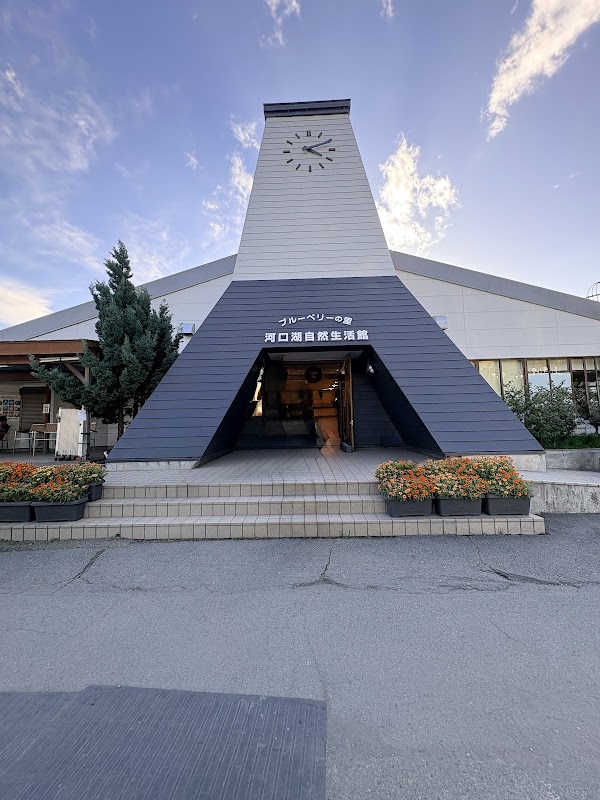
📍 Address: 2585 Oishi, Fujikawaguchiko Town, Minamitsuru District, Yamanashi Prefecture 401-0305, Japan
Located within Oishi Park on the north shore of Lake Kawaguchiko, the ‘Kawaguchiko Natural Living Center (Blueberry Village)’ offers an unobstructed panoramic view of Mt. Fuji and Lake Kawaguchiko. Don’t underestimate this spot as just a souvenir shop or resting area. In early summer, it becomes the main venue for a popular herb festival where purple lavender blooms in profusion, attracting travelers from all over the world eager to capture the perfect ‘Mt. Fuji and flowers’ composition.
Inside, the center boasts a top-class selection of goods, even compared to nearby ‘Michi-no-Eki’ (roadside stations). With homemade blueberry jam and unique Mt. Fuji-related merchandise, your souvenir shopping can easily be completed here. The famous ‘Blueberry Soft Serve’ is particularly delightful, offering a perfect balance of refreshing tartness and sweetness, a classic treat to enjoy while gazing at Mt. Fuji.
From the second-floor cafe restaurant ‘KITCHEN FUJIYAMA VIEW,’ you can enjoy an elevated view of Lake Kawaguchiko, and there’s a unique photo spot where you can capture Mt. Fuji through a torii gate object by the window. Currently, it’s incredibly popular with international tourists, so there might be a wait at the cash register or for a cafe seat. It’s advisable to allow a little extra time in your travel schedule.
Oshino Hakkai
📍 Address: Shibokusa, Oshino Village, Minamitsuru District, Yamanashi Prefecture 401-0511, Japan
Even if it means a slight detour from the Lake Kawaguchiko area, ‘Oshino Hakkai’ is an absolute must-visit tourist spot, also a component of a World Cultural Heritage site. It’s a collective term for eight ponds fed by meltwater from Mt. Fuji, filtered for over 20 years through underground lava layers, continuously gushing forth. The particularly famous ‘Waku-ike’ (Spring Pond) boasts an astonishing clarity, shimmering with an emerald green glow that seems to draw you in, allowing you to clearly see coins at the bottom, swimming fish, and swaying water plants despite being 8 meters deep.
Once a sacred spiritual site where devotees of the Fuji-ko cult purified themselves before climbing Mt. Fuji, the scenery with traditional thatched-roof houses set against Mt. Fuji is truly Japan’s quintessential landscape. However, due to its beauty, it gets heavily crowded with domestic and international tourists during the day. If you want to capture the ‘inverted Fuji’ reflected on the mirror-like water surface or the deep blue of the ponds in detail, the best times are either in the morning when the light is optimal, or early morning when there are fewer people.
Around the area, there are numerous restaurants and stalls offering soba noodles, tofu, and kusamochi (mugwort rice cakes) made with the famous spring water, but be aware that many close before evening. For parking, many unmanned ‘300 yen per visit’ post-box style parking lots are scattered in residents’ yards within walking distance, making car access surprisingly smooth. To preserve the beautiful scenery and water quality, please absolutely refrain from throwing coins into the ponds. Enjoy this miraculous nature while adhering to the rules.
Itchiku Kubota Art Museum
📍 Address: 2255 Kawaguchi, Fujikawaguchiko Town, Minamitsuru District, Yamanashi Prefecture 401-0304, Japan
Suddenly appearing in the forest by Lake Kawaguchiko is a truly unique, otherworldly space: the ‘Itchiku Kubota Art Museum,’ which has been awarded three stars by the Michelin Green Guide Japan. This private museum showcases the works of a genius textile artist who single-handedly revived a lost dyeing technique from the Muromachi period, completing it as ‘Itchiku Tsujigahana.’ Even travelers unfamiliar with kimono will undoubtedly be overwhelmed by its distinctive world from the moment they step inside.
The highlights are not limited to the exhibition rooms. Passing through a heavy, carved wooden gate that once belonged to an ancient Indian castle, you’ll discover an eccentric corridor reminiscent of Gaudí’s architecture (like Park Güell), skillfully incorporating Ryukyu limestone and Fuji lava rock. The complex intertwining of Japanese and Western elements creates an immersive experience, as if you’ve stumbled into a dungeon from an anime or fantasy movie.
From the tea room annexed to the back of the exhibition hall, you can gaze upon a beautiful moss garden crafted by a Kyoto landscape architect, with Mt. Fuji framed perfectly like a painting beyond it. This is not merely a place to admire artworks; it’s the most profound and moving tourist spot in the Lake Kawaguchiko area, where the ‘entire space itself is a single work of art,’ meticulously designed to incorporate architecture, nature, and the borrowed scenery of Mt. Fuji.
Rokkaku-do (Hexagonal Hall)
📍 Address: Kodachi, Fujikawaguchiko Town, Minamitsuru District, Yamanashi Prefecture 401-0302, Japan
Finally, we introduce ‘Rokkaku-do’ (Hexagonal Hall), an experience only possible under very specific conditions on Lake Kawaguchiko. Normally, this hall floats solitarily about 200m offshore from Yagisaki Park and can only be approached by boat. However, only during periods of low rainfall and significantly reduced lake levels does a ‘phantom path’ emerge from the lakebed, allowing you to walk across to it.
This spot originally housed a hall called Kawakubo-ji Yashiki, built in 1274, but it was washed away by heavy rains in the 1550s. For a long time, only its foundations lay submerged at the bottom of the lake, until the current Rokkaku-do was rebuilt in 1995 to pass on its history to future generations. When you visit during a period when you can walk across, you’ll find fine lava stones and ancient seashells underfoot, allowing you to feel a ‘Bura Tamori’-esque historical romance—the realization that ‘this was the bottom of the lake just a short while ago’—through the soles of your feet.
Not only can you view the hall up close, but looking back, the magnificent Lake Kawaguchiko and Mt. Fuji stretch out behind, offering an unparalleled panoramic view with no obstructions. Especially in the evening, the silhouette of Rokkaku-do against the sky transforming from crimson to pale blue is an irresistible sight for photography enthusiasts. If you happen to hear news of ‘low water levels’ during your trip, this miraculous tourist spot is definitely worth a visit.
Summary: Making the Most of Your Kawaguchiko Trip
The Lake Kawaguchiko and Oshino area is a rare tourist destination where World Heritage-class nature, historical structures, and the overwhelming presence of Mt. Fuji are seamlessly connected. With so many attractions, trying to see everything in one day will leave you constantly rushing between locations.
Tips for maximizing your satisfaction include ‘visiting your top priority spot first thing in the morning (especially crowded places like Oshino Hakkai or the Maple Corridor)’ and ‘leaving some flexibility in your schedule.’ If you have extra time, you can enjoy the luxury of slowly admiring the garden from the tea room at the Itchiku Kubota Art Museum, or waiting until dusk to witness the mystical appearance of Rokkaku-do. Using the in-depth information from this article, please find your own unique Lake Kawaguchiko journey.


'%3E%3Cpath%20stroke='%23000'%20stroke-width='4'%20d='m-35-37-13%2020m5%203%2013-20m5%203-13%2020m63%2042%206-9m1-2%206-9m5%203-6%209m-1%202-6%209m5%203%206-9m1-2%206-9m-96%200%2013%2020m5-3-6-9m-1-2-6-9m5-3%2013%2020m63-42-6-9m-1-2-6-9m5-3%2013%2020m5-3-6-9m-1-2-6-9'/%3E%3Ccircle%20r='24'%20fill='%23cd2e3a'/%3E%3Cpath%20fill='%230047a0'%20d='M0%200a12%2012%200%201%201%2020%2013%2024%2024%200%201%201-40-26A12%2012%200%201%200%200%200'/%3E%3C/g%3E%3C/svg%3E)
'/%3E%3Cpath%20fill='%23b2b2b2'%20d='M241%20382q0%2016%2017%2026%2017%2011%2042%2011t42-11q16-11%2017-26V269H241'/%3E%3Cpath%20fill='%239f7e00'%20d='M241%20379q0%2014%208%2023%209%209%2021%209%2014%200%2021-9%209-9%209-23V269h-59'/%3E%3Cpath%20d='M241%20339v-70h59v110q0%2014-9%2023l-6%205v-68h-15v72q-8%200-14-4v-68zm59%2040c0%2022%2015%2032%2029%2032%2021%200%2030-18%2030-32v-40h-59'/%3E%3Cpath%20fill='%239f7e00'%20d='M266%20277v5h2v12h-3v-5h2v-5h-9v5h2v5h-4v9h3v18h-5v10h34v-10h-5v-18h3v-9h-4v-5h2v-5h-9v5h2v5h-3v-12h2v-5zm42%20101q0%2010%206%2017%206%206%2015%207%2010-1%2016-7%206-7%206-17v-29h-43'/%3E%3Ccircle%20fill='%230044ad'%20cx='329.5'%20cy='372'%20r='6'/%3E%3Cellipse%20fill='%230044ad'%20cx='300'%20cy='340'%20rx='16'%20ry='21'/%3E%3C/svg%3E)


