

Park Güell
📍 Address: Gràcia, Barcelona 08024, Spain
Perched on a hill with panoramic views of Barcelona, ‘Park Güell’ was inscribed as a UNESCO World Heritage Site in 1984. While its charm lies in its colorful, fairy-tale-like fantasy world, this spot was originally envisioned by Count Güell, Gaudi’s greatest patron, as an ‘English-style garden city housing estate.’ Due to strict regulations allowing construction on only one-sixth of the land and poor access, only a single house was sold at the time. The dream development plan collapsed in 1914, but it was later acquired by the Barcelona City Council and is now a hugely popular tourist attraction, second only to the Sagrada Familia, captivating people worldwide.
Undoubtedly, the highlights are the ‘Serpentine Bench’ with its beautiful undulating curves and the globally famous ‘Lizard (Salamander) Fountain’ adorned with mosaic tiles. Despite the vast grounds, these photo spots are always crowded with people. If you want to capture enchanting photos with fewer crowds, an early morning visit is your best bet. Also, the park and surrounding areas are extremely hilly and uneven, so be sure to wear comfortable walking shoes or sneakers.
On-site ticket sales are not available, so advance online booking (admission fee approx. 18 euros) is essential, ideally before departing Japan. While there are no children’s play facilities, it’s a unique art space perfect for enjoying a leisurely stroll while admiring Gaudi’s nature-integrated designs and beautiful tile patterns.
Casa Batlló
📍 Address: Pg. de Gràcia, 43, Eixample, 08007 Barcelona, Spain
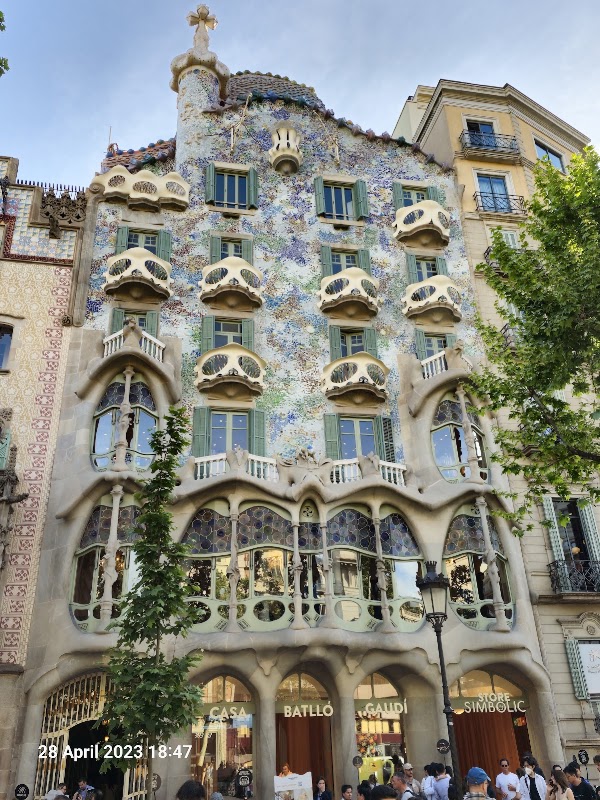
Emerging dramatically on Passeig de Gràcia in the heart of Barcelona, ‘Casa Batlló’ is a sensual and vibrant remodelled building by Gaudi. Locally known as the ‘House of Bones,’ its facade features balconies resembling skull masks, columns like animal leg bones, and a roof representing the ‘dragon’s back’ from the legend of Saint George, the patron saint of Catalonia. Its organic design, which minimizes straight lines to the extreme, exudes an overwhelming presence more akin to a ‘moving sculpture’ than a mere building.
Stepping inside reveals another world where even the way light enters is meticulously calculated. The central atrium (patio), in particular, features a beautiful gradient of tiles, dark blue at the top and light blue at the bottom, enveloping you in a fantastical blue as if looking up at the surface from the bottom of the sea. What you absolutely cannot miss is the latest ’10D Experience,’ utilizing AI and projection mapping. The visual experience in the ‘Gaudi Cube,’ surrounded by 360-degree LEDs, offers an immersive journey into Gaudi’s mind, a quality that is sure to impress any art lover.
When visiting, time-slot specific booking on the official website is mandatory. There are several ticket types, but for a full enjoyment of the visit, plans including the 10D Experience and rooftop access (such as Silver or Gold) are highly recommended. On the rooftop terrace, you can enjoy a blissful time with beer or wine while seeing the dragon’s back up close. Since its appearance changes dramatically between day and night, a visit in the late afternoon or evening, when the illumination is beautiful, is also worth considering.
Sagrada Familia
📍 Address: Carrer de Mallorca, 401, Eixample, 08013 Barcelona, Spain
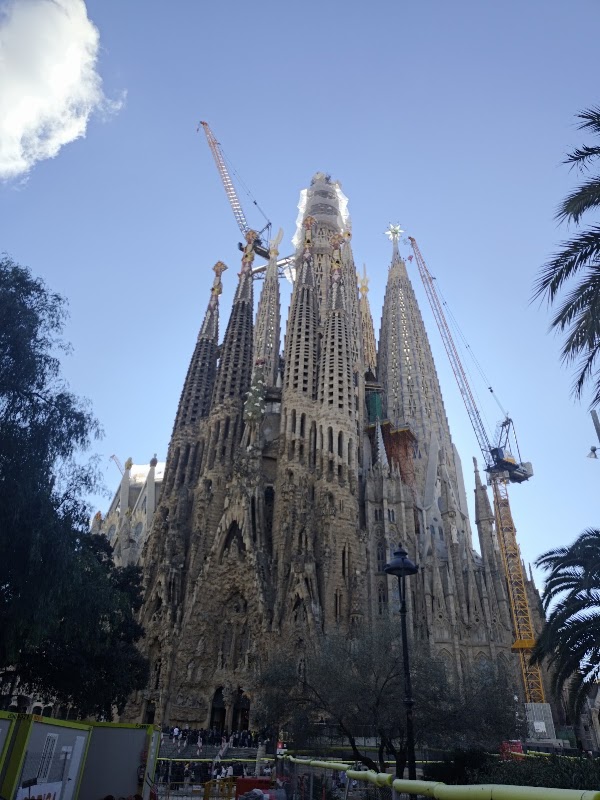
The highlight of Spain’s tourism and a place everyone dreams of visiting at least once in their lifetime, the ‘Sagrada Familia.’ Since its groundbreaking in 1882, this ‘unfinished World Heritage site’ has overcome numerous difficulties, including financial struggles and the loss of blueprints. However, in 2026, marking 100 years since Gaudi’s death, the main tower, the ‘Tower of Jesus,’ is finally scheduled for completion (the overall final completion is expected around 2034). Witnessing its magnificent form as it nears completion is truly a special experience available only now.
Highlights include the elaborate ‘Nativity Façade,’ sculpted by Japanese artist Etsuro Sotoo, and the ‘Mystical Forest’ that extends throughout the interior. The tree-like columns reaching towards the ceiling, and the shower of light from the stained-glass windows that change color moment by moment with the sunlight, create an unimaginable divinity. To fully appreciate the beauty of the stained glass, a visit in the afternoon, when the light shines most vividly, is recommended.
For your visit, advance ticket booking (recommended one month prior) is absolutely essential. When you book on the official website, your ticket is stored in the official app, which also offers an excellent audio guide, so be sure to bring a ‘mobile battery’ for your smartphone. Upon entry, there are strict security checks comparable to an airport, and large suitcases are not permitted. If climbing the towers, you must store your luggage in a locker (coin-refundable) and wear comfortable shoes to prepare for the narrow, steep spiral staircases on the way down. Additionally, the international mass held on Sunday mornings is free to enter, but even queuing from 7 AM can result in being turned away due to capacity limits, so be prepared to arrive very early in winter with ample cold weather protection.
Palau Güell
📍 Address: Carrer Nou de la Rambla, 3-5, Ciutat Vella, 08001 Barcelona, Spain
Nestled quietly near Barcelona’s bustling La Rambla, ‘Palau Güell’ is an early masterpiece by Gaudi, constructed between 1886 and 1890. Built as the main residence for his greatest patron, the wealthy Eusebi Güell, no expense was spared in its lavish construction. While its exterior appears more stately and subdued compared to works like the Sagrada Familia, stepping inside reveals an overwhelming display of luxurious and flamboyant interiors.
The main highlight is Gaudi’s originality, scattered throughout every part of the building, from the underground stables to the chimneys on the rooftop. Particularly breathtaking are the gold-leafed open-plan salon and the beautiful parabolic ceiling dome. Ascending to the rooftop, you’ll find a whimsical, pop-art space with 20 chimneys and ventilation shafts adorned with finely crushed, colorful tiles (trencadís technique), as if you’ve wandered into a fairy tale. It’s an irresistible spot for architecture enthusiasts, offering a glimpse into the lifestyle of the upper class of that era and the origins of Gaudi’s designs that would later fully blossom.
Admission numbers are controlled through a reservation system, which is a welcome feature, allowing visitors to appreciate it at their own pace, unlike other Gaudi buildings bustling with tourists. The regular admission fee is 15 euros, but on the first Sunday of every month, free entry slots are available with advance web booking. Exploring with the audio guide on your smartphone, learning about the historical background of each room, the density of information is such that over 1.5 hours can easily fly by.
Alhambra Palace
📍 Address: C. Real de la Alhambra, s/n, Centro, 18009 Granada, Spain
If you extend your trip from Barcelona and visit Granada in Andalusia, the ‘Alhambra Palace’ is an absolute must-see. This palace, which conveys the glory of the Nasrid Dynasty, an Islamic kingdom, was built over approximately 170 years starting in 1238. Known as the ‘Water Palace,’ it is registered as a World Heritage Site and stands as the pinnacle of Islamic architecture. Within its vast grounds, incredibly delicate decorations remain, such as intricate arabesque patterns and stalactite-like ‘muqarnas,’ so fine they seem beyond human craftsmanship.
Among its highlights, the ‘Court of the Lions’ in the Palace of the Lions, which was the king’s private quarters, is a must-see. The fountain supported by 12 lion statues is not only beautiful but also served as a sophisticated water clock of its time. Furthermore, the fountains in each room of the palace are said to have incorporated an alert system that would stop the water flow at the source to signal danger if invaders entered, offering a glimpse into Islamic wisdom that transcends mere decoration.
This palace is one of the most visited sites in Spain, and it’s not uncommon for tickets (especially for entry to the Nasrid Palaces) to sell out several months in advance. It’s a golden rule to book your palace tickets online as soon as you arrange your travel flights. The grounds are extremely vast, and even a quick tour can take 2-4 hours, so visit with comfortable walking shoes. Toilets within the grounds are limited to areas near the entrance, so using them before your visit is an important tip. Given its rich history and numerous intricate features, taking a guided tour is also highly recommended for a deeper understanding.
Essential Ticket Booking Tips for Spain’s Top Attractions
For Spain’s major tourist attractions, especially Gaudi’s architectural works and the Alhambra Palace, you should assume that it’s almost impossible to ‘just show up and get in’ due to the influx of tourists from around the world. For places like Sagrada Familia and Casa Batlló, time-slot specific advance online booking is mandatory.
It’s best to complete your ticket bookings at least one month before your visit. Additionally, some facilities require you to download their official app or have a system where you listen to audio guides using your own smartphone and earphones. Therefore, always carrying a ‘mobile battery’ and ‘familiar earphones’ throughout your trip is a crucial tip for enjoying your Spain sightseeing experience stress-free.


'%3E%3Cpath%20stroke='%23000'%20stroke-width='4'%20d='m-35-37-13%2020m5%203%2013-20m5%203-13%2020m63%2042%206-9m1-2%206-9m5%203-6%209m-1%202-6%209m5%203%206-9m1-2%206-9m-96%200%2013%2020m5-3-6-9m-1-2-6-9m5-3%2013%2020m63-42-6-9m-1-2-6-9m5-3%2013%2020m5-3-6-9m-1-2-6-9'/%3E%3Ccircle%20r='24'%20fill='%23cd2e3a'/%3E%3Cpath%20fill='%230047a0'%20d='M0%200a12%2012%200%201%201%2020%2013%2024%2024%200%201%201-40-26A12%2012%200%201%200%200%200'/%3E%3C/g%3E%3C/svg%3E)
'/%3E%3Cpath%20fill='%23b2b2b2'%20d='M241%20382q0%2016%2017%2026%2017%2011%2042%2011t42-11q16-11%2017-26V269H241'/%3E%3Cpath%20fill='%239f7e00'%20d='M241%20379q0%2014%208%2023%209%209%2021%209%2014%200%2021-9%209-9%209-23V269h-59'/%3E%3Cpath%20d='M241%20339v-70h59v110q0%2014-9%2023l-6%205v-68h-15v72q-8%200-14-4v-68zm59%2040c0%2022%2015%2032%2029%2032%2021%200%2030-18%2030-32v-40h-59'/%3E%3Cpath%20fill='%239f7e00'%20d='M266%20277v5h2v12h-3v-5h2v-5h-9v5h2v5h-4v9h3v18h-5v10h34v-10h-5v-18h3v-9h-4v-5h2v-5h-9v5h2v5h-3v-12h2v-5zm42%20101q0%2010%206%2017%206%206%2015%207%2010-1%2016-7%206-7%206-17v-29h-43'/%3E%3Ccircle%20fill='%230044ad'%20cx='329.5'%20cy='372'%20r='6'/%3E%3Cellipse%20fill='%230044ad'%20cx='300'%20cy='340'%20rx='16'%20ry='21'/%3E%3C/svg%3E)


