

The Belfry of Bruges
📍 Address: Markt 7, 8000 Brugge, Belgium
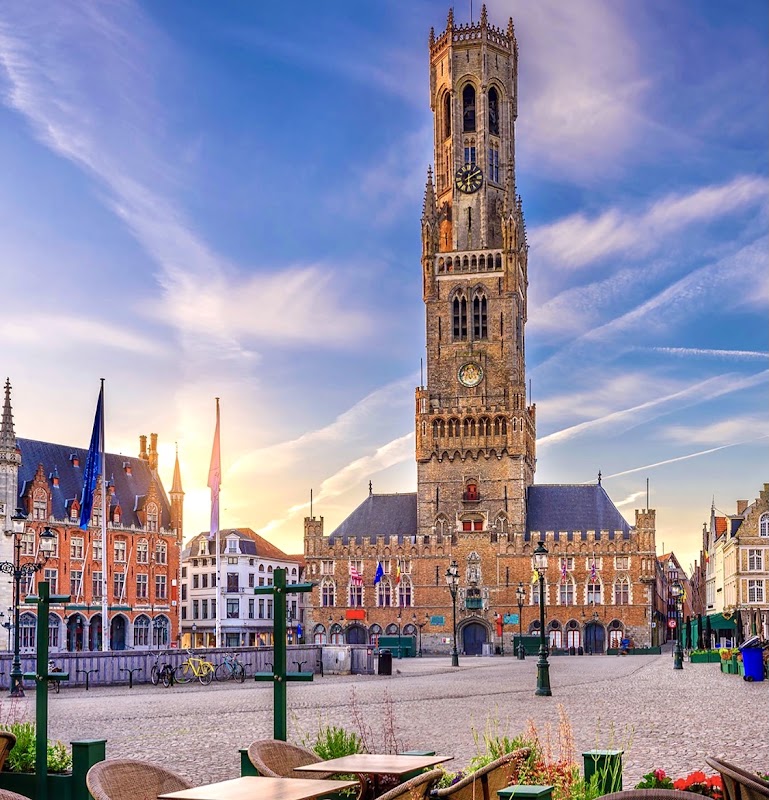
Bruges, often called the ‘Venice of the North’, retains a strong medieval charm. Dominating its central Markt square, the 83-meter-tall tower is none other than the Belfry of Bruges (Belfort van Brugge).
Construction of this belfry began in the 13th century, not as a symbol of church or lordly power, but as a ‘symbol of freedom and prosperity’ for the citizens who amassed vast wealth through the wool trade. It has been destroyed and rebuilt several times due to lightning strikes and fires, settling into its current silhouette in the 18th century. Today, it is recognized as a UNESCO World Heritage site, part of the ‘Belfries of Belgium and France’ and the ‘Historic Centre of Bruges’.
In the past, it served as a repository for important city charters, public documents, and treasures, and also functioned as a watchtower to alert the city to fires or approaching enemies. Inside the tower, you can still explore exhibits that tell the story of medieval Bruges’ prosperity. Visible from almost anywhere in the city, this tower is an absolute must-see highlight of any Bruges visit.
Don’t Miss It! The 366 Spiral Steps and the Reward at the Top
The greatest appeal of this belfry is undoubtedly the panoramic view of Bruges from its summit observation deck. However, to reach it, you must ascend all 366 spiral steps on your own; as a historical building, there is no elevator.
While many travelers might hesitate at the thought of ‘over 300 steps’, you’ll find unexpected discoveries along the way. Rest stops are strategically placed, allowing you to see the treasure chamber and the carillon’s intricate mechanism. Many find that if they proceed at their own pace, catching their breath, it’s ‘not as tough as they thought’. The sight that greets you upon reaching the top – a medieval cityscape of red gabled roofs stretching into the distance and the sprawling Flemish countryside – is a supreme reward reserved for those who conquer the climb.
A word of caution: as you ascend to the upper levels, the staircase narrows to barely allow one person to pass. When encountering those descending, a ‘spirit of consideration’ is essential, yielding to one another in the slightly wider sections. Furthermore, as you’ll be climbing in a rather confined space, those with claustrophobia, acrophobia, or mobility concerns should not push themselves. Enjoying the magnificent exterior from a bench in the Markt square is also a wonderful choice.
Best Time to Visit and the Pitfall of Advance Booking
The Belfry of Bruges is an incredibly popular spot, attracting visitors from all over the world. Due to safety regulations, there are strict limits on the number of people allowed inside the tower. It’s a common tragedy for visitors to arrive spontaneously only to find that tickets for the day are already sold out. To avoid wasting precious travel time, it’s absolutely crucial to purchase advance tickets (time-slot specific) via the official website as soon as your travel dates are set.
The ‘earliest morning slot’ is especially recommended for your visit. Immediately after opening, you’ll encounter fewer tourists on the narrow stairs, allowing for a relatively smooth ascent. Furthermore, the Bruges cityscape bathed in the morning sun, with crisp, clear air, is exceptional and ideal for photography.
A Deeper Experience: The Carillon’s Melodies and When to Descend
From the summit observation deck, you can enjoy not only stunning views but also ‘sound’. The tower houses a massive carillon composed of 47 bells, chiming beautiful melodies throughout the city every 15 minutes. Witnessing the giant gears and clockwork-like mechanisms in actual motion up close is a deep highlight, irresistible to mechanics enthusiasts and history buffs alike.
Here’s an interesting ‘unspoken rule’ unique to the local experience: While there’s no strict time limit for staying on the observation deck, given the confined space, many tourists tend to be satisfied ‘after hearing the carillon’s melody twice’ and then collectively begin their descent. By joining the descending queue with the flow of others, you can smartly avoid significant congestion with those ascending. Immerse yourself in the romantic history evoked by the bells’ melodies, and enjoy Bruges’ iconic symbol with a considerate spirit.


'%3E%3Cpath%20stroke='%23000'%20stroke-width='4'%20d='m-35-37-13%2020m5%203%2013-20m5%203-13%2020m63%2042%206-9m1-2%206-9m5%203-6%209m-1%202-6%209m5%203%206-9m1-2%206-9m-96%200%2013%2020m5-3-6-9m-1-2-6-9m5-3%2013%2020m63-42-6-9m-1-2-6-9m5-3%2013%2020m5-3-6-9m-1-2-6-9'/%3E%3Ccircle%20r='24'%20fill='%23cd2e3a'/%3E%3Cpath%20fill='%230047a0'%20d='M0%200a12%2012%200%201%201%2020%2013%2024%2024%200%201%201-40-26A12%2012%200%201%200%200%200'/%3E%3C/g%3E%3C/svg%3E)
'/%3E%3Cpath%20fill='%23b2b2b2'%20d='M241%20382q0%2016%2017%2026%2017%2011%2042%2011t42-11q16-11%2017-26V269H241'/%3E%3Cpath%20fill='%239f7e00'%20d='M241%20379q0%2014%208%2023%209%209%2021%209%2014%200%2021-9%209-9%209-23V269h-59'/%3E%3Cpath%20d='M241%20339v-70h59v110q0%2014-9%2023l-6%205v-68h-15v72q-8%200-14-4v-68zm59%2040c0%2022%2015%2032%2029%2032%2021%200%2030-18%2030-32v-40h-59'/%3E%3Cpath%20fill='%239f7e00'%20d='M266%20277v5h2v12h-3v-5h2v-5h-9v5h2v5h-4v9h3v18h-5v10h34v-10h-5v-18h3v-9h-4v-5h2v-5h-9v5h2v5h-3v-12h2v-5zm42%20101q0%2010%206%2017%206%206%2015%207%2010-1%2016-7%206-7%206-17v-29h-43'/%3E%3Ccircle%20fill='%230044ad'%20cx='329.5'%20cy='372'%20r='6'/%3E%3Cellipse%20fill='%230044ad'%20cx='300'%20cy='340'%20rx='16'%20ry='21'/%3E%3C/svg%3E)


