

Yogyakarta, Indonesia’s ancient capital, often called the ‘Soul of Java’, is a city brimming with irresistible charm for travelers. Everywhere you look, the splendor of ancient dynasties comes to life, and you can feel the miraculous history of Buddhism and Hinduism peacefully coexisting.
In this article, we’ll introduce a carefully selected list of must-visit attractions in Yogyakarta. Beyond textbook history, we’ll provide in-depth explanations of the real local atmosphere and essential tips for getting around, such as ‘advance tickets are required for ascent’, ‘it’s incredibly hot with no shade’, and ‘the true highlight of that ruin is during sunset’. We offer deep insights to help even short-term travelers efficiently and profoundly experience Yogyakarta.
Borobudur Temple
📍 Address: Jl. Badrawati, Kw. Candi Borobudur, Borobudur, Kec. Borobudur, Kabupaten Magelang, Jawa Tengah, Indonesia
Approximately 40km northwest of Yogyakarta city. Borobudur Temple, which suddenly appears from amidst the dense jungle, is one of the world’s largest Buddhist monuments, built by the Shailendra Dynasty between the 8th and 9th centuries. Boasting an overwhelming scale of about 123m per side and 35m in height, its entire structure resembles a mandala representing the Buddhist ‘Three Realms’ (Desire, Form, and Formless Realms) cosmology. It is a highly philosophical ruin where visitors can experience the journey of being freed from worldly desires and attaining enlightenment as they ascend to the upper levels.
The most crucial point travelers must know is that ‘advance booking is mandatory for tickets to ascend the temple structure (Temple Structure tickets)’. Due to conservation efforts, the number of daily ascents is strictly limited, and without securing an e-ticket, you’ll be left simply gazing at it from the perimeter. Be sure to book your time slot early through the official website or travel booking sites.
Furthermore, when entering the ascent area, you must remove your shoes and change into specially provided sandals called ‘Upanat’. This measure is to prevent wear and tear on the stone, and surprisingly, you can take these sandals home as a souvenir after your visit. Inside the monument, guides will lead you to the top, explaining the history and stories depicted in the reliefs. Peeking at the Buddha statues through the gaps of the bell-shaped stupas and gazing out at Java’s magnificent nature is truly an experience of a lifetime.
Prambanan Temple Compounds
📍 Address: Jl. Raya Solo – Yogyakarta, Kranggan, Bokoharjo, Kec. Prambanan, Kabupaten Sleman, Daerah Istimewa Yogyakarta 55571, Indonesia
In Indonesia, where the majority of the population practices Islam, the Prambanan Temple Compounds stand tall as Southeast Asia’s largest Hindu archaeological site. This World Heritage site, built by the Ancient Mataram Kingdom in the 9th century, is dedicated to the three principal Hindu deities: Shiva, Brahma, and Vishnu. The central 47-meter-tall Shiva Temple (Loro Jonggrang Temple) features a sharp, sky-piercing silhouette, possessing a rugged beauty that contrasts completely with the sturdy atmosphere of Borobudur.
The intricate reliefs of the ‘Ramayana’ meticulously carved across the temple walls and apotropaic decorations demonstrate an unparalleled level of artistry that you’ll never tire of admiring. When visiting, we recommend not only focusing on the three main towers but also exploring the extensive, well-maintained park to visit Lumpang Temple, Bubrah Temple, and even the Buddhist temple, Sewu Temple. Renting a bicycle and cycling through the temple complex is also an exhilarating experience.
However, during the day, there is very little shade, so expect to explore under a scorching sun with temperatures exceeding 32°C. For heatstroke prevention, carrying drinking water, a parasol, and a hat is essential. To fully enjoy the ruins at a leisurely pace, it’s best to aim for the cooler early morning hours. Also, some areas might be closed on Mondays, so plan your visit accordingly.
Ratu Boko Temple
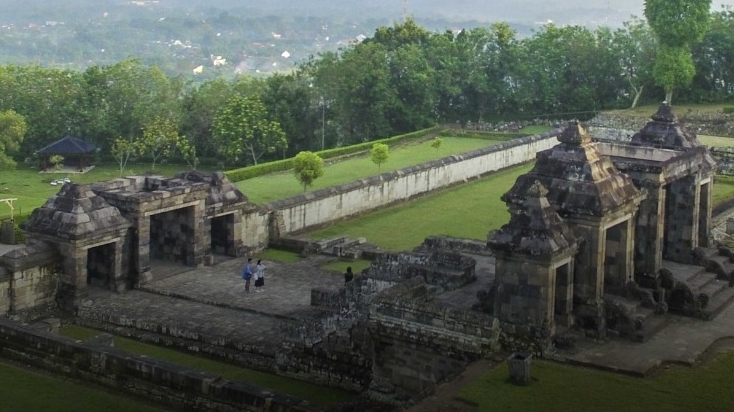
📍 Address: Jl. Ratu Boko No.2, Gatak, Bokoharjo, Kec. Prambanan, Kabupaten Sleman, Daerah Istimewa Yogyakarta 55572, Indonesia
Approximately a 15-minute drive from Prambanan Temple Compounds, spread across a hill about 200 meters above sea level, lies ‘Ratu Boko Temple (Kraton Ratu Boko)’. Although named a temple, it is actually the ruins of a magnificent palace (royal complex) built in the 8th century. The site’s blend of Buddhist and Hindu elements offers a glimpse into the religious tolerance of that era.
While most of the buildings have been lost, what remains are primarily the foundations, such as stone walls, stone gates, and reservoir remnants. With no obstructing structures, you can truly feel the vastness of the entire complex. The main reason this site garners immense popularity among travelers is that it is ‘one of Yogyakarta’s premier sunset spots’.
The sight of the orange-hued sunset slowly descending through the arch of the grand stone main gate, which faces west, is breathtakingly divine. The panoramic view of the Prambanan plain and distant Mount Merapi is guaranteed to impress not only history enthusiasts but anyone who sees it. The best time to visit is around 4 PM to 5 PM. Although a small bottle of water is provided upon entry, you’ll quickly dehydrate under the sun on the hill, so be sure to bring extra drinks.
Taman Sari
📍 Address: Patehan, Kraton, Yogyakarta City, Special Region of Yogyakarta 55133, Indonesia
Located very close to the Yogyakarta Royal Palace, ‘Taman Sari’ is a royal garden complex built by Sultan Hamengkubuwono I of the Mataram Kingdom in the 18th century. As its Indonesian name, meaning ‘Flower Garden’, suggests, it’s a very stylish space blending Javanese and European architectural styles, also known as the ‘Water Castle’.
The main beautiful water garden is said to have been a place where princesses and concubines enjoyed bathing. A romantic legend tells that the Sultan would observe them from a third-story window and choose his companion for the day, which adds another layer of enjoyment when contemplating its history. Today, the contrast between the emerald green water and the pinkish old stone walls makes it a highly popular ‘Instagrammable’ spot for travelers. Its compact size, allowing a visit in just 15 minutes, is also appealing.
For a deeper dive, the complex also features underground passages said to have once connected to the royal palace, and ‘Situs Pulo Kenanga’ (remains of an artificial island) which also served as a fortress. Beyond the labyrinthine passages, there’s a beautiful underground mosque with a circular structure and intersecting staircases, offering a unique sense of tranquility, detached from everyday life. You can easily access it directly via ride-hailing apps, making it perfect for a spontaneous stop during a city stroll.
Kalasan Temple
📍 Address: Jl. Raya Yogya – Solo, 6FMC+3WW, Suryatmajan, Danurejan, Glondong, Tirtomartani, Kec. Kalasan, Kabupaten Sleman, Daerah Istimewa Yogyakarta 55571, Indonesia
Quietly nestled very close to Yogyakarta Airport and Prambanan Temple, ‘Kalasan Temple’ is a historically profound Buddhist temple, said to have been built by a king of the Shailendra Dynasty in the 8th century for the goddess Tara. While its scale may not match Borobudur or Prambanan, it is filled with intricate artistry that is too precious to overlook.
The most distinctive features of this temple are its exquisite fusion of Hindu and Buddhist architectural styles, and its walls which were once covered with a special plaster called ‘Vajralepa’. Even today, the delicate and three-dimensional relief carvings remaining on its exterior walls attest to the high skill of the artisans of that era, captivating the hearts of ruin enthusiasts.
Although scaffolding might be up for restoration work at certain times, the admission fee is very reasonable at 10,000 Rupiah (approximately 100 JPY). Located just a short ride by motorbike or car from Prambanan, it’s highly recommended as an ‘insider’s deep-dive spot’ to visit on your way back from Prambanan or during a small gap before heading to the airport.
Tips for a 120% Successful Yogyakarta Temple Tour
When visiting Yogyakarta’s attractions, travelers must pay close attention to ‘ticket arrangements’ and ‘heatstroke prevention’.
First, regarding tickets. Ascent tickets for Borobudur Temple (Temple Structure tickets) often sell out, meaning you might be turned away if you just show up on the day. Once your itinerary is set, be sure to pre-purchase your time-slot specific ascent tickets via the official website or a travel agency. For Prambanan and Ratu Boko, same-day purchase is usually fine, but be aware that foreigner prices are in effect, and Japanese credit cards might not always work. It’s advisable to have some Rupiah cash on hand or pre-book a combined ticket online (which can be slightly cheaper) for peace of mind.
Next, concerning climate and transportation. Exploring the ruins will essentially involve walking around under a ‘scorching sun with zero shade’. Walking on stone pavements in temperatures exceeding 30°C is far more exhausting than you might imagine. Always bring a parasol, hat, sunglasses, and plenty of drinking water. Ride-hailing apps like ‘Grab’ and ‘Gojek’ are very convenient for getting around, but finding a car for your return journey from suburban sites like Borobudur or Ratu Boko might not be immediate. A smart local tip is to negotiate directly with your outbound driver to have them wait (charter them).


'%3E%3Cpath%20stroke='%23000'%20stroke-width='4'%20d='m-35-37-13%2020m5%203%2013-20m5%203-13%2020m63%2042%206-9m1-2%206-9m5%203-6%209m-1%202-6%209m5%203%206-9m1-2%206-9m-96%200%2013%2020m5-3-6-9m-1-2-6-9m5-3%2013%2020m63-42-6-9m-1-2-6-9m5-3%2013%2020m5-3-6-9m-1-2-6-9'/%3E%3Ccircle%20r='24'%20fill='%23cd2e3a'/%3E%3Cpath%20fill='%230047a0'%20d='M0%200a12%2012%200%201%201%2020%2013%2024%2024%200%201%201-40-26A12%2012%200%201%200%200%200'/%3E%3C/g%3E%3C/svg%3E)
'/%3E%3Cpath%20fill='%23b2b2b2'%20d='M241%20382q0%2016%2017%2026%2017%2011%2042%2011t42-11q16-11%2017-26V269H241'/%3E%3Cpath%20fill='%239f7e00'%20d='M241%20379q0%2014%208%2023%209%209%2021%209%2014%200%2021-9%209-9%209-23V269h-59'/%3E%3Cpath%20d='M241%20339v-70h59v110q0%2014-9%2023l-6%205v-68h-15v72q-8%200-14-4v-68zm59%2040c0%2022%2015%2032%2029%2032%2021%200%2030-18%2030-32v-40h-59'/%3E%3Cpath%20fill='%239f7e00'%20d='M266%20277v5h2v12h-3v-5h2v-5h-9v5h2v5h-4v9h3v18h-5v10h34v-10h-5v-18h3v-9h-4v-5h2v-5h-9v5h2v5h-3v-12h2v-5zm42%20101q0%2010%206%2017%206%206%2015%207%2010-1%2016-7%206-7%206-17v-29h-43'/%3E%3Ccircle%20fill='%230044ad'%20cx='329.5'%20cy='372'%20r='6'/%3E%3Cellipse%20fill='%230044ad'%20cx='300'%20cy='340'%20rx='16'%20ry='21'/%3E%3C/svg%3E)


