

Hitsujiyama Park
📍 Address: 6360 Omiya, Chichibu City, Saitama Prefecture 368-0023, Japan
Hitsujiyama Park, located on a hill overlooking Mt. Bukō—Chichibu’s symbol—is a historic public park designed by landscape architect Seiroku Honda, known as the ‘Father of Japanese Parks.’ Before the war, this site housed a prefectural sheep breeding farm, which is why it came to be called ‘Hitsujiyama’ (Sheep Mountain). Even today, adorable sheep live in the park’s ‘Fureai Bokujo’ (Petting Farm), offering a soothing rural atmosphere.
In spring, cherry blossoms (Someiyoshino and Yaezakura) and tulips bloom in profusion, making it perfect for a leisurely stroll through the expansive grounds. Many visitors who come here consistently mention the ‘warmth of the locals.’ It’s not uncommon to experience heartwarming interactions with residents, such as them kindly guiding you if you’re lost or giving candy to children.
Since there are many slopes and undulations within the park, it’s best to wear comfortable walking shoes. During peak season, a special market appears where you can enjoy local delicacies like Chichibu’s famous udon, soba, and inari sushi. Meals eaten after climbing to the ‘Miharashi-no-oka’ (Observation Hill) at the summit are exceptionally delicious.
Shibazakura Hill
📍 Address: 6360 Omiya, Chichibu City, Saitama Prefecture 368-0023, Japan
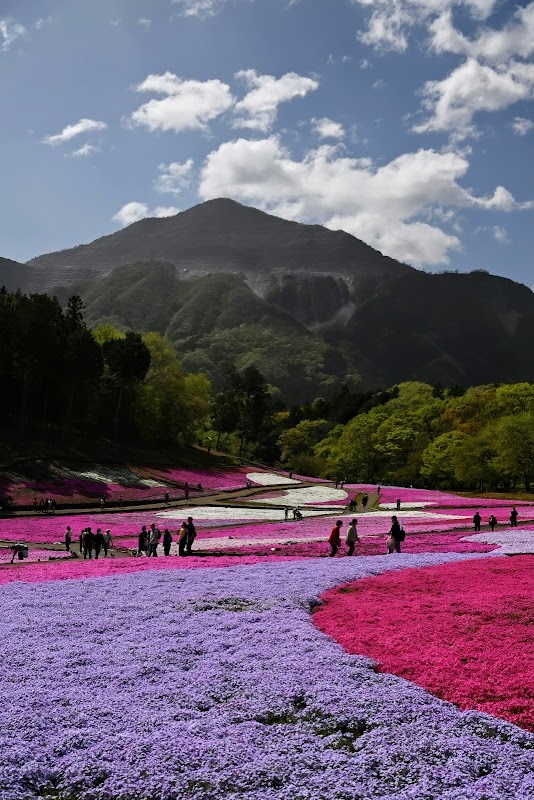
Shibazakura Hill, spreading across the southern area of Hitsujiyama Park, is an immensely popular spot representing Chichibu’s spring. Over 400,000 moss phlox plants of 10 varieties, in shades of pink, white, and pale blue, bloom across a vast hilly area of approximately 17,600 square meters. This beautiful patchwork-like design is inspired by the patterns of the ‘juban’ (undergarments) worn by the囃子手 (hayashite, musicians) on the floats of the Chichibu Night Festival, which is registered as a UNESCO Intangible Cultural Heritage.
During the ‘Shibazakura Festival’ from mid-April to early May, when the moss phlox is in full bloom, there’s an admission fee (500 yen for adults), and the surrounding roads and parking lots (700 yen for regular cars) experience severe traffic jams. Therefore, we strongly recommend a ‘dawn attack’ for travelers. In fact, if you arrive before 8 AM, admission is free, and access to the parking lot is smooth. Furthermore, if weather conditions are right, you can capture a fantastic collaboration of Mt. Bukō, appearing like a sea of clouds beyond the morning mist, and the shibazakura.
The park’s pathways are intricate and maze-like, so if you park far away, you’ll have quite a walk to get there and back. It’s safest to use the restrooms beforehand (located near Parking Lot 1, etc.). After your stroll, a classic way to enjoy yourself is to savor freshly fried Chichibu specialty ‘Miso Potato’ or gibier dishes at the market area.
Saitama Toyopet Chichibu Green Muse Park
📍 Address: 2518 Nagatoro, Ogano-machi, Chichibu-gun, Saitama Prefecture 368-0102, Japan
This vast resort park, spanning approximately 375 hectares, stretches across a hilly area covering Chichibu City and Ogano Town. In 2026, it adopted a new name, ‘Saitama Toyopet Chichibu Green Muse Park,’ through naming rights. Divided into zones for sports, music, and culture, it boasts a scale that can keep you entertained for an entire day.
Within the park, there’s a ginkgo tree-lined avenue (Sky Road, also known as ‘Yuimachi-no-Michi’) stretching for about 3 kilometers. During the autumn foliage season in November, it transforms into a breathtaking golden promenade. However, be extremely careful where you step, as fallen ginkgo nuts can cause a big mess in your car or on your shoe soles. From the observation deck called ‘Tabidachi-no-oka’ (Hill of Departure), you can enjoy a panoramic view of Chichibu city. If conditions are favorable, you can capture a breathtaking ‘sea of clouds’ and sunrise, making it a spot where photographers gather from early morning.
As it’s located in the heart of nature, insect repellent is essential, as bees may be flying around the observation deck area depending on the season. If you get tired from walking around the park, grabbing a reasonably priced ‘Chicken and Vegetable Bowl’ offered at the shop is a quietly beloved routine among local workers and residents.
Chichibu Furusato Village
📍 Address: 220 Nagatoro, Ogano-machi, Chichibu-gun, Saitama Prefecture 368-0102, Japan
Chichibu Furusato Village is an experiential comprehensive leisure facility surrounded by the nature of Chichibu Nishiyatsu. Escaping the hustle and bustle of the city, you can fully enjoy ‘agricultural experiences,’ ‘nature experiences,’ and ‘hometown experiences’ amidst the great outdoors. It features nostalgic rural scenery, allowing you to harvest seasonal vegetables, interact with goats, and collect freshly laid eggs.
Particularly popular are the outdoor BBQ, where you can grill hearty portions of meat and freshly harvested vegetables, and the ‘soba-making experience,’ where you can immerse yourself in Chichibu’s traditional food culture. The experience programs are conducted at the participants’ pace without staff rushing, making it enjoyable for families traveling with children.
There are spots for playing in the river within the grounds, making it lively with people seeking cool relief during the summer. On clear days, the sun is very strong, so UV protection items such as swimsuits, hats, and sunscreen are essential. It’s the perfect place for travelers seeking a ‘real satoyama experience,’ a bit different from sophisticated resorts, with features like nagashi somen (flowing noodles) using handcrafted bamboo flumes.
Chichibu Water
📍 Address: Omiya, Chichibu City, Saitama Prefecture 368-0023, Japan
Nestled quietly within the grounds of ‘Roadside Station Chichibu’ along National Route 140 is ‘Chichibu Water,’ a public water dispensing point. This is actually public tap water drawn from the ‘Hashidate Water Treatment Plant,’ the first of its kind constructed in Saitama Prefecture in 1924. Sourced from the Urayama River, a tributary of the Arakawa River, this water is unique for using a slow filtration method over time instead of chemical treatment.
Chichibu as a whole has a limestone terrain, including Mt. Bukō, which typically leads to hard water. However, this water is surprisingly mild and smooth, with absolutely no chlorine smell, just like natural soft water. It’s so delicious that locals come with multiple large jerrycans to collect it. There are even reviews mentioning that dogs on walks sometimes drink it continuously, captivated by its taste.
A tip for use: make sure to directly fill your bottle with fresh water by turning the tap, rather than taking water that has accumulated in the basin. When stopping by the roadside station during your Chichibu sightseeing trip, it’s a golden rule for seasoned travelers to always recharge their empty plastic bottles or canteens with this famous water to enjoy on their drive.
Tips and Tricks to Enjoy Chichibu Sightseeing to the Fullest
The Chichibu area has a unique basin topography, and its attractions are scattered over a wide area, making car travel essential. However, during peak seasons like the ‘Shibazakura at Hitsujiyama Park’ in spring, the ‘Autumn Foliage at Muse Park,’ and the ‘Chichibu Night Festival’ in winter, major traffic jams occur, especially along National Routes 140 and 299.
The ultimate trick to avoid getting caught in traffic and wasting your day is to ‘master the morning hours.’ Famous spots in Chichibu usually have empty parking lots in the early morning (around 6 AM to 8 AM), allowing you to enjoy the breathtaking scenery all to yourself in the refreshing air before the temperatures rise. Especially if you’re aiming for a sea of clouds at Muse Park or similar locations, you must start your activities before dawn.
Also, timing your meals is important. If you visit popular soba restaurants or establishments serving ‘Buta Miso Don’ (pork miso bowl) around noon, waiting 1-2 hours is common. The trick to enjoying Chichibu without stress is to grab quick bites like standing soba at ‘Roadside Station Chichibu’ or ‘Miso Potato’ at local markets within parks, and then have your main meal outside of peak hours.


'%3E%3Cpath%20stroke='%23000'%20stroke-width='4'%20d='m-35-37-13%2020m5%203%2013-20m5%203-13%2020m63%2042%206-9m1-2%206-9m5%203-6%209m-1%202-6%209m5%203%206-9m1-2%206-9m-96%200%2013%2020m5-3-6-9m-1-2-6-9m5-3%2013%2020m63-42-6-9m-1-2-6-9m5-3%2013%2020m5-3-6-9m-1-2-6-9'/%3E%3Ccircle%20r='24'%20fill='%23cd2e3a'/%3E%3Cpath%20fill='%230047a0'%20d='M0%200a12%2012%200%201%201%2020%2013%2024%2024%200%201%201-40-26A12%2012%200%201%200%200%200'/%3E%3C/g%3E%3C/svg%3E)
'/%3E%3Cpath%20fill='%23b2b2b2'%20d='M241%20382q0%2016%2017%2026%2017%2011%2042%2011t42-11q16-11%2017-26V269H241'/%3E%3Cpath%20fill='%239f7e00'%20d='M241%20379q0%2014%208%2023%209%209%2021%209%2014%200%2021-9%209-9%209-23V269h-59'/%3E%3Cpath%20d='M241%20339v-70h59v110q0%2014-9%2023l-6%205v-68h-15v72q-8%200-14-4v-68zm59%2040c0%2022%2015%2032%2029%2032%2021%200%2030-18%2030-32v-40h-59'/%3E%3Cpath%20fill='%239f7e00'%20d='M266%20277v5h2v12h-3v-5h2v-5h-9v5h2v5h-4v9h3v18h-5v10h34v-10h-5v-18h3v-9h-4v-5h2v-5h-9v5h2v5h-3v-12h2v-5zm42%20101q0%2010%206%2017%206%206%2015%207%2010-1%2016-7%206-7%206-17v-29h-43'/%3E%3Ccircle%20fill='%230044ad'%20cx='329.5'%20cy='372'%20r='6'/%3E%3Cellipse%20fill='%230044ad'%20cx='300'%20cy='340'%20rx='16'%20ry='21'/%3E%3C/svg%3E)


