

Yakushima, located in Kagoshima Prefecture, is a UNESCO World Natural Heritage site where untouched nature thrives. Its moss-covered forests, home to cedar trees thousands of years old, and numerous dynamic waterfalls continue to enchant countless travelers.
However, when we speak of ‘Yakushima tourist attractions,’ the difficulty varies greatly, from places requiring serious trekking to stunning viewpoints easily accessible by rental car or bus. In this article, we’ve carefully selected the main spots you absolutely must visit to fully experience the authentic atmosphere of Yakushima during a limited stay. We’ll also provide tips on the best times to visit and how to get around, so please use this as a reference for your trip.
Jomon Sugi
📍 Address: Miyanoura, Yakushima-cho, Kumage-gun, Kagoshima 891-4205, Japan
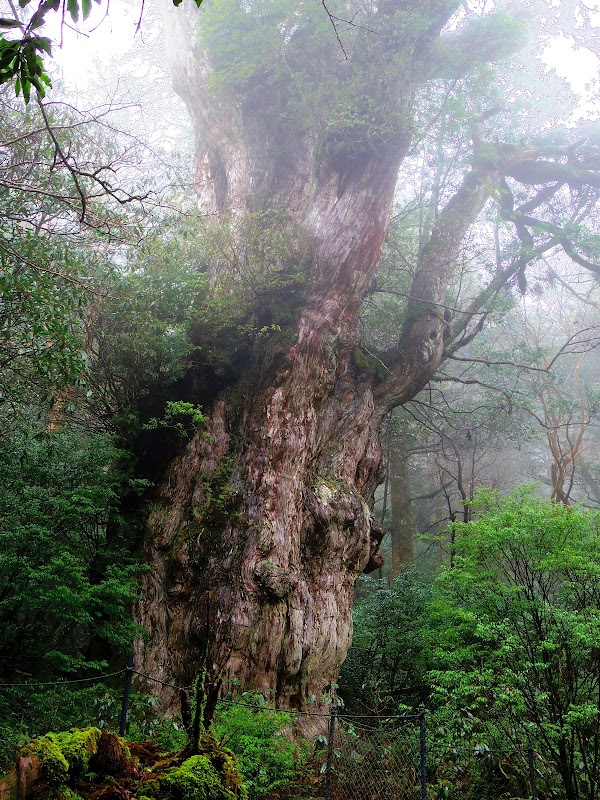
Jomon Sugi, often called the symbol of Yakushima, is the island’s largest Yakusugi cedar, with an estimated age ranging from 2,000 to 7,200 years. To witness this overwhelming vitality, a serious trekking expedition is required, covering approximately 11km one-way from Arakawa Trailhead, totaling about 10 hours round trip.
Of the entire course, the first approximately 3 hours involve walking along a relatively flat tramway path, but the latter hour transforms into a proper mountain trail with rocky sections and stairs. Although the steep ups and downs can be physically demanding, there are many highlights along the way, such as ‘Wilson’s Stump’ and ‘Daiosugi’ (Great King Cedar), and you might even spot wild Yakushima macaques and deer up close. Above all, the presence of Jomon Sugi appearing before your eyes after a 10-hour trek and the sense of accomplishment will undoubtedly be a special, unforgettable experience.
Access for private vehicles to Arakawa Trailhead is restricted, so you’ll need to use a shuttle bus from the Yakusugi Museum. A round-trip bus ticket, including the mountain entry cooperation fee, costs 3,000 yen. While it’s possible to purchase tickets on-site on the morning of your hike, pre-booking is recommended during peak season due to crowding. Furthermore, a headlamp is essential for early morning starts as it will be completely dark. There are several water sources along the path, so bring a bottle and refill it as you go[1][2].
Yakusugi Land
📍 Address: Awa, Yakushima-cho, Kumage-gun, Kagoshima 891-4311, Japan
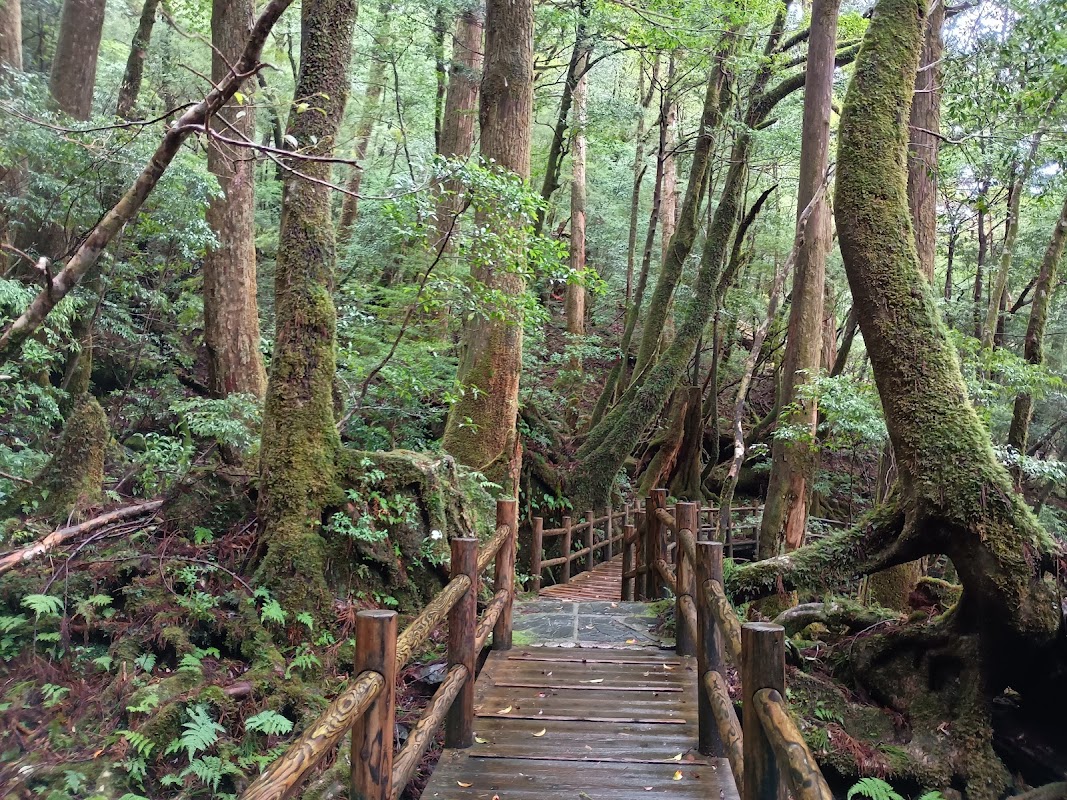
For travelers who say, ‘I’m not confident enough to trek 10 hours to Jomon Sugi, but I still want to experience Yakushima’s characteristic mossy forests and giant trees,’ the natural recreation forest ‘Yakusugi Land,’ located around 1,000m above sea level, is highly recommended.
Despite its somewhat lighthearted name ‘Land,’ once you step inside, you’ll find a world of tranquility where Yakusugi cedars over 1,000 years old stand in profusion, and the ground is covered in beautiful green moss. You can observe up close the forest’s profound history, including the phenomenon of ‘reforestation by fallen trees’ where new life sprouts on top of fallen Yakusugi, and traces of logging from the Edo period.
The entrance fee is 800 yen. Several courses are available, ranging from 30, 50, 80, 150, to 210 minutes, allowing you to choose based on your physical fitness and available time. The shortest 30- and 50-minute courses feature well-maintained boardwalks, making them safe for seniors and visitors wearing sneakers (though wheelchair and stroller access is difficult due to stairs). It’s a highly satisfying attraction where you can efficiently enjoy Yakushima’s grand nature[3].
Kigen Sugi
📍 Address: Onoaida, Yakushima-cho, Kumage-gun, Kagoshima 891-4404, Japan
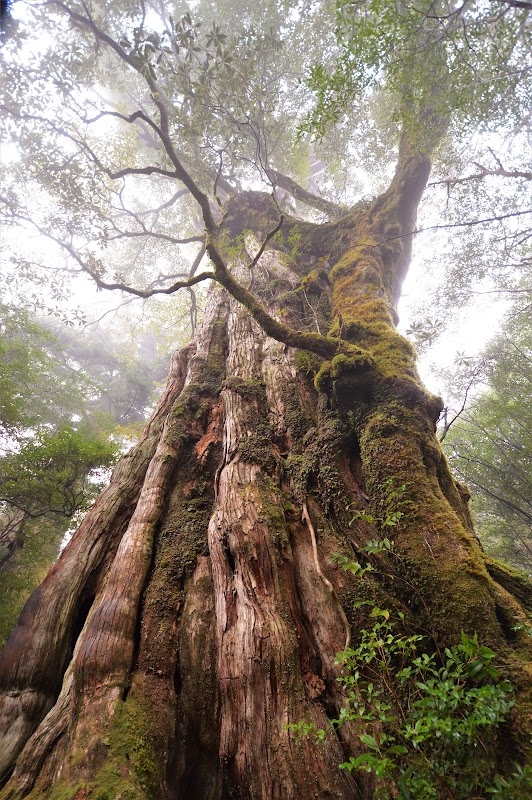
About a 15-minute drive further into the mountains from Yakusugi Land, along the Anbo Forest Road, you’ll find ‘Kigen Sugi.’ This colossal cedar, boasting an estimated age of 3,000 years, is unique in Yakushima for being the only Yakusugi that can be viewed ‘from inside your car.’ It’s a valuable spot for those with mobility concerns or travelers who had to abandon long treks due to bad weather, allowing them to admire its majestic presence without leaving their vehicle.
While it’s visible enough from the roadside, we recommend getting out of your car, descending the stairs, and looking up from the circular boardwalk built around the tree. With over a dozen types of plants, including Hinoki cypress and Yakushima rhododendron, epiphytically growing on it, you can experience a complex and mystical ecosystem that goes beyond just a giant tree. There’s also delicious, cold spring water flowing nearby, so taking a sip to feel the power of the earth is a nice idea.
Located at an elevation of 1,230m, the road can sometimes be closed due to freezing or snow in winter (especially January to February). If you’re heading there by rental car, always check the road conditions in advance[4].
Oko-no-taki Falls
📍 Address: Kurio, Yakushima-cho, Kumage-gun, Kagoshima 891-4409, Japan
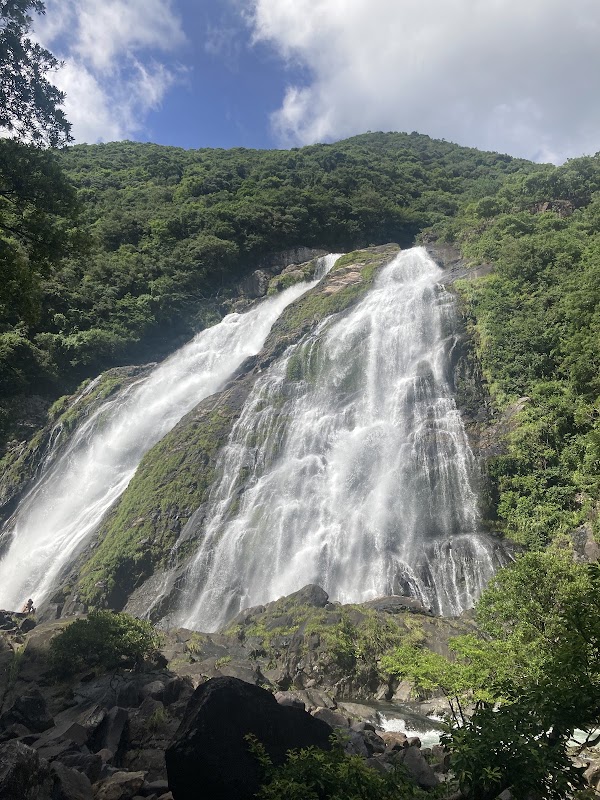
Oko-no-taki Falls, located in the southwestern part of Yakushima, is the island’s largest waterfall, boasting an 88m drop, and is selected as one of ‘Japan’s Top 100 Waterfalls.’ Its dynamic appearance, cascading down a sheer cliff of hard sedimentary rock, is simply breathtaking.
Its greatest charm is the ability to walk right up to the base of the waterfall. You can fully immerse yourself in the thunderous roar created by the vast volume of water crashing against the rock face and the refreshing spray that dances around, rejuvenating yourself with abundant negative ions. Yakushima is a rainy island, and on the day after heavy rain, the water volume can dramatically increase, sometimes transforming the usual two streams into a single massive torrent, allowing you to directly feel the raw energy of nature.
Along the path to the falls and around the parking lot, you’ll often encounter wild Yakushima macaques and deer relaxing. While these animals are often accustomed to humans, it’s important to observe them from a respectful distance. Even if it’s raining on the eastern side of the island (around Anbo), it’s not uncommon for the western area where Oko-no-taki Falls is located to have clear skies, making it an ideal flexible driving destination depending on the weather[5].
Senpiro-no-taki Falls
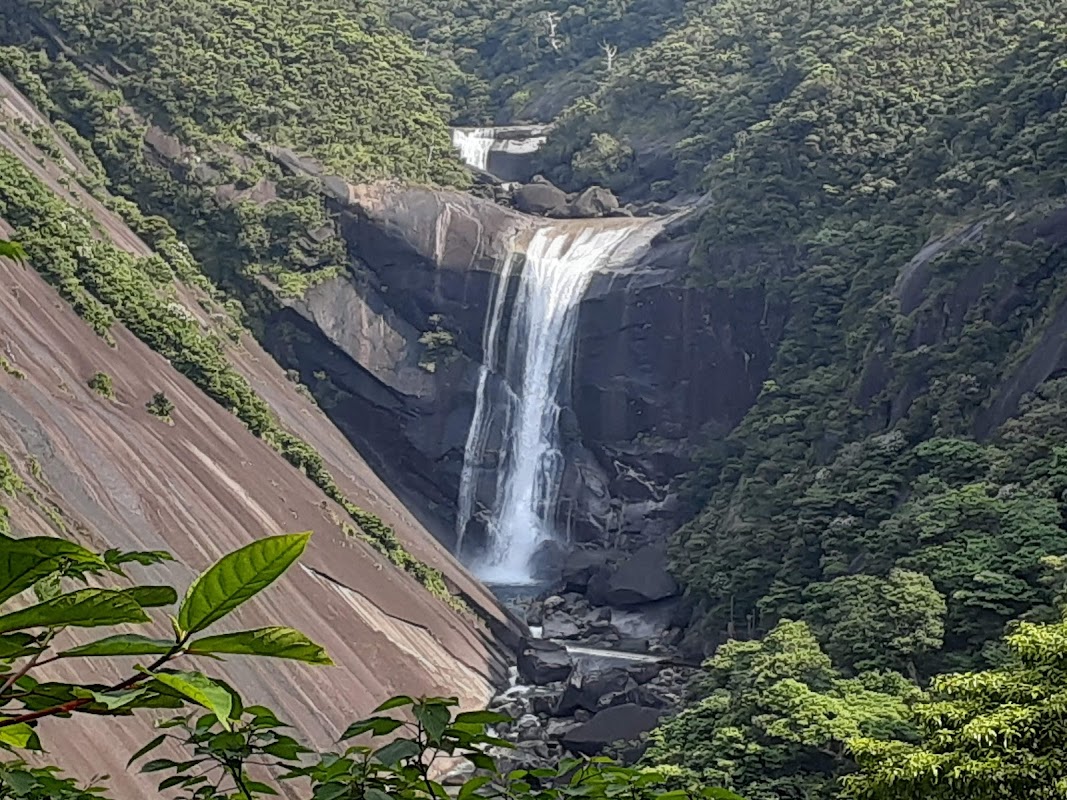
📍 Address: Mugio, Yakushima-cho, Kumage-gun, Kagoshima 891-4202, Japan
‘Senpiro-no-taki Falls,’ a representative scenic spot in southern Yakushima. It’s a grand panorama where the Taigawa River has carved out a magnificent V-shaped valley at the foot of Mount Mocchomu, and a waterfall with an approximate 60m drop cascades down a massive single granite rock face. As its name suggests, meaning ‘a rock face large enough for a thousand people to hold hands across,’ it offers a sense of scale that truly lets you feel that Yakushima is made of colossal rock formations.
Just a few minutes’ walk from the well-maintained, spacious parking lot brings you to the first observation deck, easily accessible even for wheelchairs or those wearing sandals. From here, you get a somewhat distant view, but you can see the entire massive rock face. If you have extra energy, however, try extending your walk down the steep stairs (promenade) to the suspension bridge area. You’ll work up quite a sweat round-trip, but the powerful view from closer to the waterfall basin and the sparkling ocean panorama looking back from the suspension bridge are well worth the effort.
Furthermore, if you climb to the second observation deck, located on the opposite side of the parking lot, you can enjoy a 360-degree view of the sea, mountains, and the falls. It’s also a spot where wild animals often appear, so if you’re lucky, you might encounter adorable Yakushima deer[6][7].
Essential Tips and Precautions for 100% Enjoyment of Yakushima Tourism
To efficiently and safely explore Yakushima’s attractions, understanding the ‘real local environment’ is crucial. First, Yakushima is an area with extremely high rainfall, often described as ‘raining 35 days a month.’ Beyond an umbrella, it’s essential to prepare comfortable, two-piece rain gear. However, since the entire island is covered by steep mountains, the weather can vary dramatically by area. Even if it’s raining, it’s not uncommon to find clear blue skies just a short drive away. A smart travel tip is to avoid being overly swayed by the weather forecast and to build a flexible itinerary that allows for changes.
While encountering wild animals is a highlight of Yakushima, you must never feed them or approach them too closely. They are independent beings living in a harsh natural environment.
If you’re traveling by rental car, especially on the Seibu Rindo forest road and mountain paths leading to Kigen Sugi, there are continuous narrow curves without center lines. Always drive slowly, prepared for oncoming traffic and sudden appearances of animals. With a sensible plan and thorough preparation, you can fully savor the overwhelming beauty of Yakushima’s grand nature.


'%3E%3Cpath%20stroke='%23000'%20stroke-width='4'%20d='m-35-37-13%2020m5%203%2013-20m5%203-13%2020m63%2042%206-9m1-2%206-9m5%203-6%209m-1%202-6%209m5%203%206-9m1-2%206-9m-96%200%2013%2020m5-3-6-9m-1-2-6-9m5-3%2013%2020m63-42-6-9m-1-2-6-9m5-3%2013%2020m5-3-6-9m-1-2-6-9'/%3E%3Ccircle%20r='24'%20fill='%23cd2e3a'/%3E%3Cpath%20fill='%230047a0'%20d='M0%200a12%2012%200%201%201%2020%2013%2024%2024%200%201%201-40-26A12%2012%200%201%200%200%200'/%3E%3C/g%3E%3C/svg%3E)
'/%3E%3Cpath%20fill='%23b2b2b2'%20d='M241%20382q0%2016%2017%2026%2017%2011%2042%2011t42-11q16-11%2017-26V269H241'/%3E%3Cpath%20fill='%239f7e00'%20d='M241%20379q0%2014%208%2023%209%209%2021%209%2014%200%2021-9%209-9%209-23V269h-59'/%3E%3Cpath%20d='M241%20339v-70h59v110q0%2014-9%2023l-6%205v-68h-15v72q-8%200-14-4v-68zm59%2040c0%2022%2015%2032%2029%2032%2021%200%2030-18%2030-32v-40h-59'/%3E%3Cpath%20fill='%239f7e00'%20d='M266%20277v5h2v12h-3v-5h2v-5h-9v5h2v5h-4v9h3v18h-5v10h34v-10h-5v-18h3v-9h-4v-5h2v-5h-9v5h2v5h-3v-12h2v-5zm42%20101q0%2010%206%2017%206%206%2015%207%2010-1%2016-7%206-7%206-17v-29h-43'/%3E%3Ccircle%20fill='%230044ad'%20cx='329.5'%20cy='372'%20r='6'/%3E%3Cellipse%20fill='%230044ad'%20cx='300'%20cy='340'%20rx='16'%20ry='21'/%3E%3C/svg%3E)


