

Gunma Prefecture boasts a diverse array of attractions, from Japan’s representative hot springs like Kusatsu and Ikaho, to breathtaking natural landscapes, and nostalgic historical ruins. While there are many famous tourist spots, if you’re going to visit, you’ll want to go beyond superficial sightseeing and deeply savor the hidden history and the authentic local atmosphere unique to each place.
In this article, we’ve carefully selected essential major spots for travelers visiting Gunma Prefecture. We’ll provide in-depth information that goes beyond typical guidebooks, including the best times to capture stunning photos, parking situations to avoid crowds, and smart ways to navigate the local scene.
Ikaho Onsen Stone Steps Street
📍 Address: 76-5 Ikahomachi Ikaho, Shibukawa, Gunma 377-0102, Japan
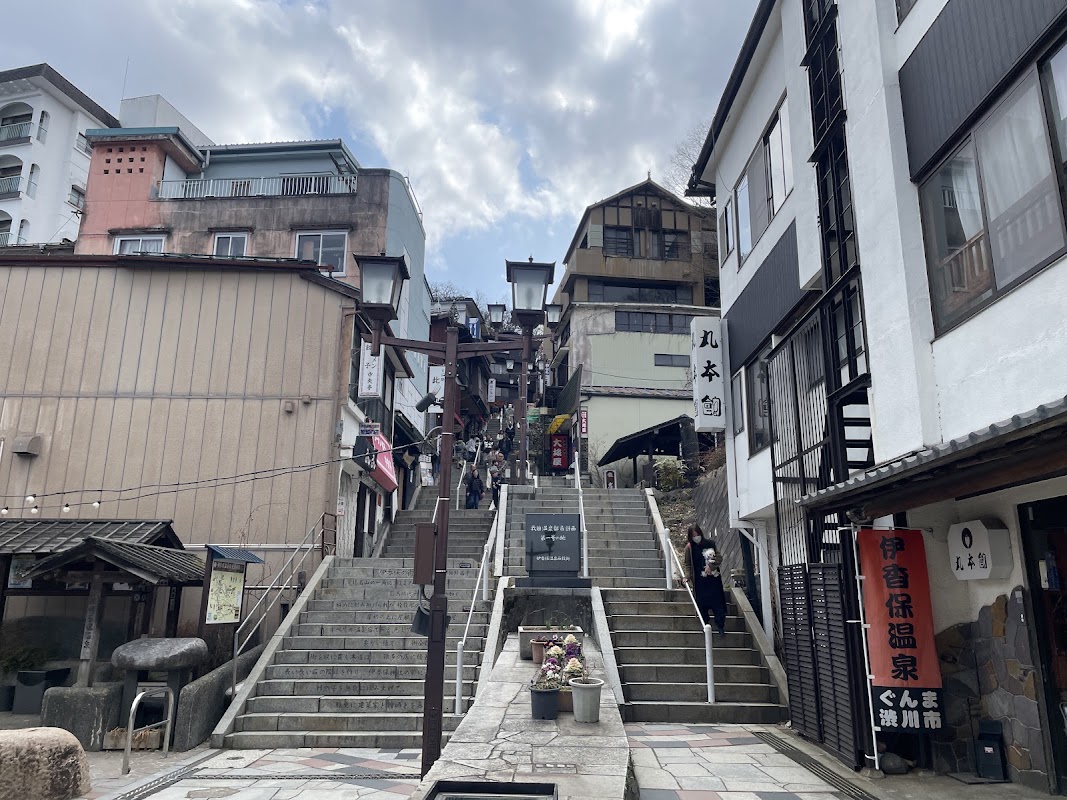
The ‘Stone Steps Street,’ a symbol of Ikaho Onsen, is a historic hot spring town dating back approximately 450 years. It is said that around 1576, Sanada Masayuki, under orders from Takeda Katsuyori, developed it as a recuperation site for soldiers wounded in the Battle of Nagashino. An innovative urban plan, considered the prototype of Japanese hot spring towns, was implemented: a ‘yudoi’ (hot water conduit) was laid down the center of the 365 steps built on a slope, with ryokans neatly arranged on either side. The winding structure of the path, designed as a defensive stronghold in case of battle, also adds to its historical allure.
Lining both sides of the stone steps are old-fashioned shooting galleries, souvenir shops, and cafes. Simply strolling in a yukata here allows you to immerse yourself in a Showa-era nostalgia, feeling as if you’ve traveled back in time. However, the 365 steps are longer than they appear, and ascending them all at once requires a fair amount of stamina. For those with mobility concerns or families with small children, the golden rule is to take your time: enjoy local delicacies like ‘Onsen Manju’ (hot spring steamed buns) and ‘Tama Konnyaku’ (ball-shaped konjac) from shops along the way, or take a break at a footbath.
In recent years, it has also gained attention as a pilgrimage site for manga and anime fans, drawing large crowds on weekends and holidays. If you wish to leisurely capture the atmospheric scenery with fewer people, aim for the quiet time around 9 AM before shops open, or after dusk when the lanterns cast a nostalgic glow. The illuminated Stone Steps Street at night, in particular, reveals a completely different, enchanting ambiance compared to the daytime.
Kusatsu Onsen Yubatake
📍 Address: Kusatsu, Kusatsu-machi, Agatsuma-gun, Gunma 377-1711, Japan
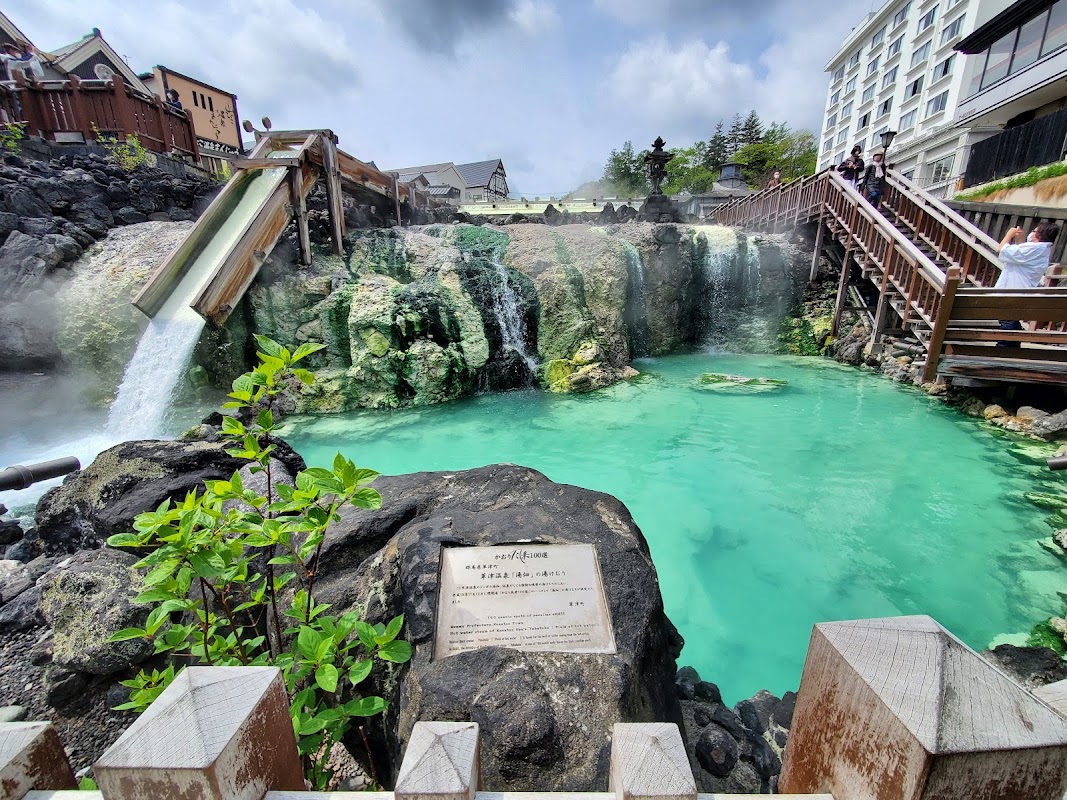
The ‘Yubatake,’ nestled in the heart of Kusatsu Onsen, one of Japan’s three most famous hot springs. The intense sulfurous scent that greets you upon arrival, the billowing steam, and the shimmering emerald green color of the hot spring water immediately transport visitors into an extraordinary realm. The wisdom of our predecessors, dating back to the Edo period, lives on today: approximately 4,000 liters of high-temperature source water, around 52°C, gush out every minute and are cooled to an appropriate temperature by passing through seven wooden conduits, without diluting it with water.
The beautiful stone fences and promenades, meticulously arranged in a rotary shape that we see today, were designed and supervised by artist Taro Okamoto in 1975. Created under the vision of ‘making Kusatsu a world-class hot spring resort,’ the gourd-shaped landscape perfectly fuses tradition and modernity. Around the Yubatake, you’ll also find free footbaths and a ‘Te-arai no Yu’ (hand-washing hot spring), while the cascading hot water, boasting an overwhelming volume, is breathtakingly powerful.
The surrounding roads are very narrow with many pedestrians, so if you’re arriving by car, the most stress-free and correct route is to park at the slightly distant ‘Yubatake Tourist Parking Lot’ (accommodating 180 cars) and explore on foot. Furthermore, the area around Yubatake completely transforms between day and night. During the day, you can enjoy the lively hot spring town with ‘onsen tamago’ (hot spring eggs) or ‘agemanju’ (fried steamed buns) in hand, while at night, you can revel in the magical illuminations created by lighting designers. If you stay in Kusatsu, make sure to witness both its daytime and nighttime beauty.
Meganebashi Bridge (Usui Third Bridge)
📍 Address: Sakamoto, Matsuida-machi, Annaka, Gunma 379-0307, Japan
The ‘Meganebashi Bridge (Usui Third Bridge),’ quietly nestled in the steep mountains of Usui Pass, is a brick-built four-arch bridge constructed in 1892 (Meiji 25). It is the former route of the Shin’etsu Main Line, which was decommissioned in 1997 with the opening of the Shinkansen. Its enduring presence, having withstood numerous earthquakes, powerfully conveys the advanced construction technology of its time and the weight of history.
Currently, this abandoned railway line has been developed into a walking trail called the ‘Apto no Michi.’ Not only can you enjoy the overwhelming scale of the bridge from below, but you can also climb the stairs and actually walk across it. The view of the valley floor from atop the bridge is dizzyingly high, but hiking through the series of tunnels that follow is truly exceptional. The route leading towards the former Kumanotaira Station, passing through nostalgically lit tunnels, is about 1.3 km one-way, taking about 50 minutes round trip. It’s the perfect distance to enjoy a sense of adventure.
For access, there is a free dedicated parking lot located 200-300 meters from the bridge, making a visit by car convenient. During the seasons of fresh greenery and autumn leaves, the contrast between the brick red and nature is breathtakingly beautiful. It has also been used as a filming location for famous TV dramas in the past. This hidden gem is a must-visit for travelers seeking to escape the everyday and immerse themselves in the romance of an abandoned railway.
Shima no Oketsu-gun (Shima River Pot Holes)
📍 Address: 3520 Shima, Nakanojo-machi, Agatsuma-gun, Gunma 377-0601, Japan
The ‘Shima no Oketsu-gun’ (Shima River Pot Holes) appear in the Shima River, which flows along National Route 353 at the entrance to Shima Onsen. A pot hole is a bowl-shaped hollow carved into the riverbed bedrock over tens of thousands of years, as stones and sand circulate in a swirling river current. This area, dotted with eight pot holes of various sizes, was designated a Gunma Prefectural Natural Monument in 1971.
The greatest highlight here is undoubtedly the crystal-clear, indigo blue stream, known as ‘Shima Blue.’ In recent years, due to safety considerations, access directly next to the river is restricted, and viewing is done from behind a fence. Nevertheless, the overwhelming power of nature conveyed even from a distance, and the mesmerizingly beautiful color of the water, are well worth seeing.
As the visit itself can be completed in a brisk 10-15 minutes, the best plan is to stop by as a break during a drive to the Shima area. A spacious free parking lot is available, and on the premises, you’ll find stylish and clean restrooms, an area to purchase local products, and even a cafe serving delicious sweets and soba noodles. Be sure to stop by as a prologue before heading to Shima Onsen or Okushimanako Lake.
Lockheart Castle
📍 Address: 5583-1 Nakayama, Takayama-mura, Agatsuma-gun, Gunma 377-0702, Japan
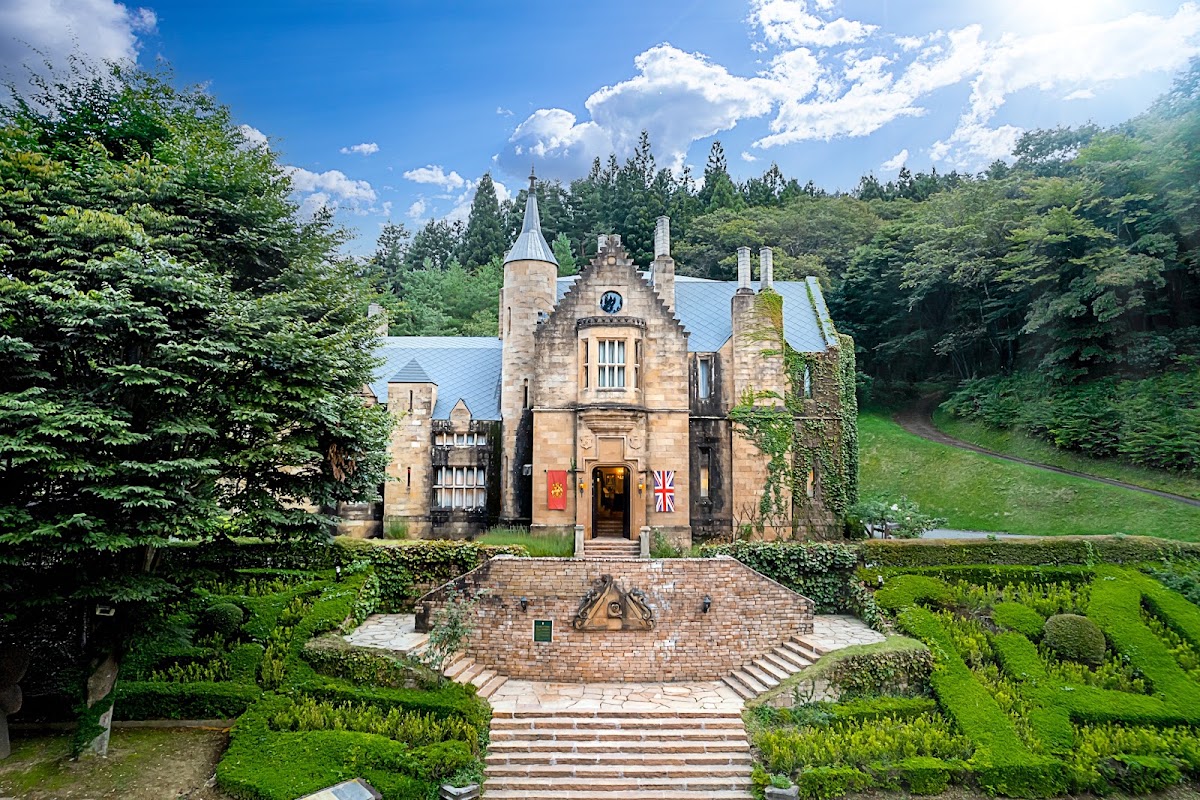
Suddenly appearing in the mountains of Gunma Prefecture is ‘Lockheart Castle,’ a world of medieval Europe. This is not a replica theme park, but an authentic ancient castle originally built in Scotland, UK, in 1829. The late actor Masahiko Tsugawa purchased it with his private funds and transported it to Japan via the Trans-Siberian Railway. It was restored in Takayama Village, Gunma Prefecture, in 1993, making it Japan’s only relocated ancient castle, born from incredible romance and passion.
Within the grounds, beautiful gardens and a stone church spread out, and it has been used as a filming location for numerous movies, dramas, and special effects productions, including ‘AIBOU: Tokyo Detective Duo’ and ‘Fly Me to the Saitama.’ Overwhelmingly popular here is the ‘Princess Experience,’ where you can choose your favorite dress from over 500 options for a photo shoot. With a wide range of sizes, it caters to adults, children, and even couples for tuxedo rentals, allowing you to experience a genuine princess feeling at a reasonable price.
Within the premises, you won’t want to miss the in-depth exhibits, such as a museum showcasing over 1,100 Santa Claus figures collected by Masahiko Tsugawa, and Princess Diana’s official car. Pets are also allowed entry, and the estimated stay time for a leisurely visit is 2-4 hours. As there are few other large tourist facilities nearby, the smart way to enjoy it is to incorporate it into your itinerary as a main event en route to Kusatsu Onsen or Ikaho Onsen.
Local Tips for Maximizing Your Gunma Travel Experience
Gunma Prefecture’s main tourist spots are spread across various distinct areas. For instance, it takes about 1 to 1.5 hours by car from Ikaho Onsen to Kusatsu Onsen, and there’s also a significant distance from the Annaka area (where Meganebashi Bridge is located) to Shima Onsen and Lockheart Castle. Therefore, for a 1-night, 2-day trip, the secret to success is to either ‘focus on a specific area’ or ‘plan a schedule with ample travel time.’
Additionally, roads in mountainous areas have many curves, and single roads are prone to traffic jams on holidays or during the autumn foliage season. The centers of hot spring towns often have narrow roads with many pedestrians, so the most comfortable approach is to park your car early at your accommodation’s parking lot or a designated large public parking lot and then move around lightly on foot. In Gunma Prefecture, where historic hot springs, magnificent nature, and nostalgic ruins coexist, be sure to experience your own unique and extraordinary journey.


'%3E%3Cpath%20stroke='%23000'%20stroke-width='4'%20d='m-35-37-13%2020m5%203%2013-20m5%203-13%2020m63%2042%206-9m1-2%206-9m5%203-6%209m-1%202-6%209m5%203%206-9m1-2%206-9m-96%200%2013%2020m5-3-6-9m-1-2-6-9m5-3%2013%2020m63-42-6-9m-1-2-6-9m5-3%2013%2020m5-3-6-9m-1-2-6-9'/%3E%3Ccircle%20r='24'%20fill='%23cd2e3a'/%3E%3Cpath%20fill='%230047a0'%20d='M0%200a12%2012%200%201%201%2020%2013%2024%2024%200%201%201-40-26A12%2012%200%201%200%200%200'/%3E%3C/g%3E%3C/svg%3E)
'/%3E%3Cpath%20fill='%23b2b2b2'%20d='M241%20382q0%2016%2017%2026%2017%2011%2042%2011t42-11q16-11%2017-26V269H241'/%3E%3Cpath%20fill='%239f7e00'%20d='M241%20379q0%2014%208%2023%209%209%2021%209%2014%200%2021-9%209-9%209-23V269h-59'/%3E%3Cpath%20d='M241%20339v-70h59v110q0%2014-9%2023l-6%205v-68h-15v72q-8%200-14-4v-68zm59%2040c0%2022%2015%2032%2029%2032%2021%200%2030-18%2030-32v-40h-59'/%3E%3Cpath%20fill='%239f7e00'%20d='M266%20277v5h2v12h-3v-5h2v-5h-9v5h2v5h-4v9h3v18h-5v10h34v-10h-5v-18h3v-9h-4v-5h2v-5h-9v5h2v5h-3v-12h2v-5zm42%20101q0%2010%206%2017%206%206%2015%207%2010-1%2016-7%206-7%206-17v-29h-43'/%3E%3Ccircle%20fill='%230044ad'%20cx='329.5'%20cy='372'%20r='6'/%3E%3Cellipse%20fill='%230044ad'%20cx='300'%20cy='340'%20rx='16'%20ry='21'/%3E%3C/svg%3E)


