

Okayama Korakuen Garden
📍 Address: 1-5 Korakuen, Kita Ward, Okayama, 703-8257, Japan
Counted among Japan’s ‘Three Great Gardens,’ Okayama Korakuen Garden is a vast strolling garden begun in 1687 by Ikeda Tsunamasa, the feudal lord of the Okayama Domain. Its elegant landscape, unchanged since the Edo period, is meticulously preserved and designated as a Special Place of Scenic Beauty. Lawns, ponds, and an artificial hill called Yuishinzan are beautifully arranged within the garden, creating a dynamic backdrop with Okayama Castle towering in the distance—a truly breathtaking sight. Beyond the seasonal flowers, visitors can also admire Japanese cranes, revealing a different charm with each visit.
A practical tip for efficiently enjoying your visit is to purchase the ‘Combined Ticket’ (800 yen for adults), which includes admission to the adjacent Okayama Castle, at the reception desk. For just a small extra charge over the Korakuen-only admission fee (500 yen for adults), you can enjoy both, making it incredibly cost-effective. Furthermore, admission is free for junior high school students and younger, making it a budget-friendly destination for families with children.
The best time to visit is on a clear weekday morning. Arriving around 9 AM ensures fewer crowds, allowing you to enjoy the vast garden’s tranquility as if you have it all to yourself. The garden is well-maintained with few steps, creating a barrier-free environment comfortable for wheelchairs and strollers. If you get tired from strolling, be sure to try the ‘Peach Soft-Serve Ice Cream’ sold at the shop immediately to your right upon entry. Its unique Okayama-style fruity sweetness will be a refreshing treat for weary legs.
Kurashiki Bikan Historical Quarter
📍 Address: 1-4 Chuo, Kurashiki, 710-0046, Japan
The Kurashiki Bikan Historical Quarter is one of Okayama Prefecture’s premier tourist destinations, boasting a rich history as a directly controlled territory (tenryo) under the shogunate during the Edo period. Along the Kurashiki River, once used as a canal for transporting goods, you’ll find white-walled storehouses and merchant houses with beautiful ‘namako-kabe’ (sea cucumber wall) patterns, creating an atmospheric scene with willow trees swaying in the breeze. Furthermore, the retro-modern townscape, where Japanese and Western styles are exquisitely harmonized – featuring Japan’s first Western art museum, the Ohara Museum, and Kurashiki Ivy Square, a renovated old spinning mill – is so beautiful that every corner is perfect for a photo.
To deeply enjoy this town, planning your meals is essential. Beyond just enjoying the scenery, there’s a fantastic array of trendy renovated cafe sweets and local gourmet food to explore. Especially around ‘Kurashiki Denim Street,’ unique denim-themed blue foods (like steamed buns and soft-serve ice cream) are available and extremely popular with tourists.
A trap travelers should be aware of is ‘parking.’ Parking lots close to the center of the Bikan Historical Quarter can be expensive or fill up quickly, so it’s a smart choice to research and park in a slightly more distant area beforehand. Also, there’s no need to be disappointed by a little rain. The sight of retro streetlights reflecting on the wet stone pavements creates an atmosphere even more nostalgic and mellow than on a sunny day, perfect for a grown-up outing.
Kibitsu Shrine
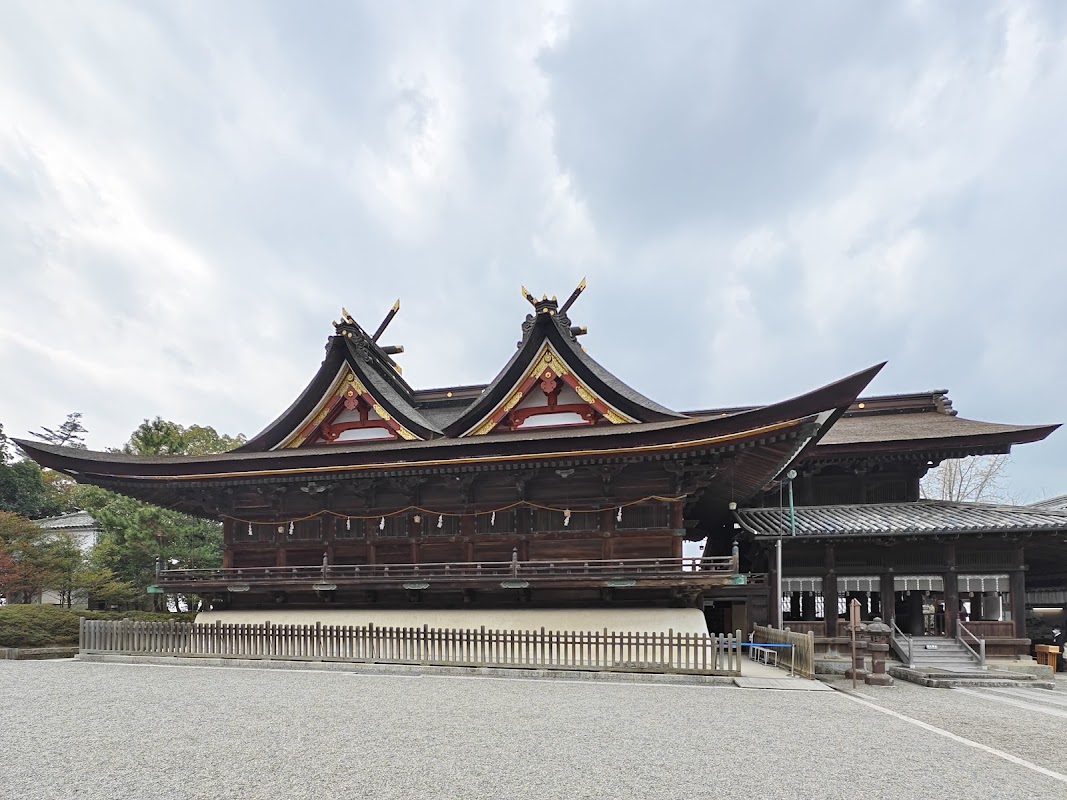
📍 Address: 931 Kibitsu, Kita Ward, Okayama, 701-1341, Japan
Nestled in the suburbs of Okayama City, Kibitsu Shrine is a historic grand shrine dedicated to Okibitsuhiko-no-mikoto, the model for ‘Momotaro’ from the well-known Japanese folktale. Its main attractions are the enormous Main Hall and Worship Hall, designated as National Treasures, and the beautiful 360-meter-long Great Corridor that extends in a straight line along the natural terrain. This corridor, also used for historical drama film shoots, creates a sacred atmosphere where the contrast between vermilion pillars and lush green trees continues endlessly in a tranquil space, cleansing the soul with every step.
For an even deeper experience, be sure to encounter the ‘Narukama Shinto Ritual.’ This ancient and unique ritual involves divining good or bad fortune from the sound of a kettle, beneath which the head of Ura (the demon defeated by Okibitsuhiko-no-mikoto) is said to be buried. The mysterious atmosphere of the soot-blackened Okama-den hall and the deep rumbling sound evoke an intense sense of historical romance found only here.
The best time to visit is in the fresh morning hours. The shrine opens as early as 5 AM, so if you visit early, there will be fewer tourists, allowing you to fully appreciate the beauty of the corridor in crisp air. Access is excellent: a scenic 15-minute ride on the local JR Kibi Line train from Okayama Station, followed by a 10-minute walk from the nearest Kibitsu Station. A large free parking lot (270 spaces) is also available, making it a highly recommended power spot for those traveling by rental car.
Kinojo Castle West Gate
📍 Address: Kuroo, Soja, 719-1105, Japan
Kinojo Castle is the ruin of an ancient mountain castle built atop Mount Kinojo, approximately 400 meters above sea level. It is believed to be one of the defensive fortifications constructed across western Japan by the Yamato Imperial Court in the late 7th century to prepare for invasions by Tang China and Silla, following their defeat in the Battle of Baekgang. Although selected as one of Japan’s 100 Finest Castles, it’s also known as ‘the mysterious mountain castle’ due to the complete absence of records in historical documents. Furthermore, a legend persists that it was the abode of Ura, the demon who appears in the aforementioned legend of Kibitsu Shrine, making it a captivating spot not only for history buffs but also for mystery enthusiasts.
Currently, the West Gate, a magnificent rammed-earth embankment, and high stone walls have been restored based on excavation surveys, allowing visitors to experience their massive scale firsthand. Walking along the well-maintained hiking trails while contemplating what ancient people felt as they built this castle is truly special. The views from around the West Gate and the observation deck are particularly stunning, offering a breathtaking panorama that, on a clear day, stretches across the Soja Plain to the Seto Inland Sea and even the distant mountains of Shikoku.
A practical tip for travelers: the road leading up to the mountain peak is quite narrow. While there are passing points along the way, please drive slowly and be very careful of oncoming traffic. Also, a stop at the ‘Visitor Center’ next to the parking lot is a must-do. Learning about Kinojo Castle’s history and the background of its restoration (free of charge) before heading to the West Gate will enhance your appreciation manifold (note: the Visitor Center may be closed on Mondays). As it’s a place rich in nature, wearing comfortable shoes like sneakers is essential.
Bitchu Kanaachi Cave
📍 Address: 8854-1 Kamisuida, Maniwa, 716-1411, Japan
Located in Maniwa City in northern Okayama Prefecture, Bitchu Kanaachi Cave is Japan’s oldest documented limestone cave, its name appearing in the ‘Nihon Sandai Jitsuroku,’ compiled in the Heian period (901). Inside the cave, a mysterious space unfolds, formed over an unfathomable 300 million years. Visitors can observe dynamic natural sculptures up close, such as ‘Donai Fuji,’ Japan’s largest stalagmite, standing about 3 meters tall and 5 meters in diameter, and the ‘Five-Storied Pagoda,’ layered in 22 tiers.
The greatest charm of this spot is that the cave’s temperature remains around 9 degrees Celsius throughout the year. As ‘the perfect summer retreat,’ the natural air conditioning that envelops you the moment you step inside is nothing short of impressive, offering a welcome escape from the sweltering heat. You might even spot bats inside the cave, adding to the fun of a small ‘Indiana Jones’-style adventure. Since it retains its natural state without excessive artificial intervention, it’s also an excellent ‘Instagrammable spot’ for taking mystical photos.
However, there’s a small trap that travelers might fall into. The cave entrance is at the bottom of a valley, so the journey in involves descending a steep slope. Naturally, after your exploration, the return trip will be ‘an uphill climb all the way.’ A subtle trickle of sweat will inevitably return to your body, now comfortably cool from the cave. So, be prepared to enjoy this as part of the overall leisure experience. It gets cold inside the cave, so bringing a light jacket and wearing non-slip shoes is highly recommended.
Real Tips for Further Enriching Your Okayama Trip
The five spots introduced here each possess unique charms, but they are also deeply intertwined by threads of history. For example, if you delve into the ‘Momotaro (Kibitsuhiko-no-mikoto) legend’ at Kibitsu Shrine and then extend your trip to Soja City to visit ‘Kinojo Castle, the abode of Ura (the demon),’ you’ll complete a profound historical journey, reliving a grand story.
Regarding transportation, access to ‘Okayama Korakuen Garden’ and ‘Kibitsu Shrine’ in Okayama City, and ‘Kurashiki Bikan Historical Quarter’ in Kurashiki City, is relatively smooth by public transport (train/bus). However, if you plan to venture to ‘Kinojo Castle,’ located on a mountain, or ‘Bitchu Kanaachi Cave’ in the northern part of the prefecture, renting a car is overwhelmingly more convenient. Okayama Prefecture generally has wide, easy-to-drive roads, but roads around mountain tourist destinations tend to narrow, so choosing a compact car can reduce the stress of passing oncoming vehicles.
Additionally, local cuisine is a major highlight of any trip. While the food stalls in Kurashiki Bikan Historical Quarter and Korakuen’s peach soft-serve ice cream are enticing, be sure to include Okayama specialties like ‘demi-katsu don’ (pork cutlet with demi-glace sauce) or ‘bara-zushi’ (scattered sushi with fresh Seto Inland Sea seafood) in your lunch plans. Enjoy a special holiday unique to you in Okayama Prefecture, where abundant nature, ancient historical romance, and delicious food await!


'%3E%3Cpath%20stroke='%23000'%20stroke-width='4'%20d='m-35-37-13%2020m5%203%2013-20m5%203-13%2020m63%2042%206-9m1-2%206-9m5%203-6%209m-1%202-6%209m5%203%206-9m1-2%206-9m-96%200%2013%2020m5-3-6-9m-1-2-6-9m5-3%2013%2020m63-42-6-9m-1-2-6-9m5-3%2013%2020m5-3-6-9m-1-2-6-9'/%3E%3Ccircle%20r='24'%20fill='%23cd2e3a'/%3E%3Cpath%20fill='%230047a0'%20d='M0%200a12%2012%200%201%201%2020%2013%2024%2024%200%201%201-40-26A12%2012%200%201%200%200%200'/%3E%3C/g%3E%3C/svg%3E)
'/%3E%3Cpath%20fill='%23b2b2b2'%20d='M241%20382q0%2016%2017%2026%2017%2011%2042%2011t42-11q16-11%2017-26V269H241'/%3E%3Cpath%20fill='%239f7e00'%20d='M241%20379q0%2014%208%2023%209%209%2021%209%2014%200%2021-9%209-9%209-23V269h-59'/%3E%3Cpath%20d='M241%20339v-70h59v110q0%2014-9%2023l-6%205v-68h-15v72q-8%200-14-4v-68zm59%2040c0%2022%2015%2032%2029%2032%2021%200%2030-18%2030-32v-40h-59'/%3E%3Cpath%20fill='%239f7e00'%20d='M266%20277v5h2v12h-3v-5h2v-5h-9v5h2v5h-4v9h3v18h-5v10h34v-10h-5v-18h3v-9h-4v-5h2v-5h-9v5h2v5h-3v-12h2v-5zm42%20101q0%2010%206%2017%206%206%2015%207%2010-1%2016-7%206-7%206-17v-29h-43'/%3E%3Ccircle%20fill='%230044ad'%20cx='329.5'%20cy='372'%20r='6'/%3E%3Cellipse%20fill='%230044ad'%20cx='300'%20cy='340'%20rx='16'%20ry='21'/%3E%3C/svg%3E)


