

Iriomote Island in Okinawa Prefecture, often called the ‘Galapagos of the East,’ is covered by subtropical primeval forest for about 90% of its area. Home to endemic species like the Iriomote wildcat and registered as a UNESCO World Natural Heritage site, this island is truly Japan’s last unexplored frontier.
This time, we’ve carefully selected and will introduce ‘must-visit tourist spots’ on Iriomote Island that you absolutely shouldn’t miss, whether you’re a short-term visitor or planning a longer stay. Beyond textbook descriptions, we’ll also explain the real atmosphere of these locations and tips for avoiding crowds. From canoeing through magnificent mangrove forests and jungle trekking through lush tropical vegetation to phantom beaches accessible only by boat, let’s embark on the ultimate adventure to feel the energy of nature with your whole body!
Pinaisara Falls
📍 Address: Uehara, Taketomi, Yaeyama District, Okinawa 907-1541, Japan
Pinaisara Falls is arguably the absolute ace of Iriomote Island’s tourist spots. Located upstream on the Hinai River, it boasts the largest drop in Okinawa Prefecture, approximately 55 meters. ‘Pinai’ means beard, and ‘Sara’ means hanging down, giving the waterfall its name because from a distance, it resembles a white beard hanging down. After rainfall the day before, the water volume doubles, transforming it into a magnificent, breathtaking cascade.
Access to the falls is a route that condenses the charm of Iriomote Island: leisurely canoeing (kayaking) through a mangrove river, then trekking through the jungle. As of March 2025, it has been designated a ‘Specific Natural Tourism Resource,’ prohibiting individual entry for environmental protection, making certified guide accompaniment mandatory. Be sure to book a tour in advance when visiting.
For those confident in their physical strength, we highly recommend choosing a full-day tour that goes all the way ‘to the top of the falls.’ After climbing a steep mountain path, a breathtaking panoramic view awaits, offering a goosebump-inducing sight of the blue ocean, Hatoma Island, and Barasu Island spread out below. The ascent might be tougher than you expect, but the taste of Yaeyama soba prepared by your guide while admiring the magnificent view is exceptional. After descending, jump into the natural pool at the basin of the falls to cool off your heated body and enjoy playing in the water.
Ida-no-Hama Beach
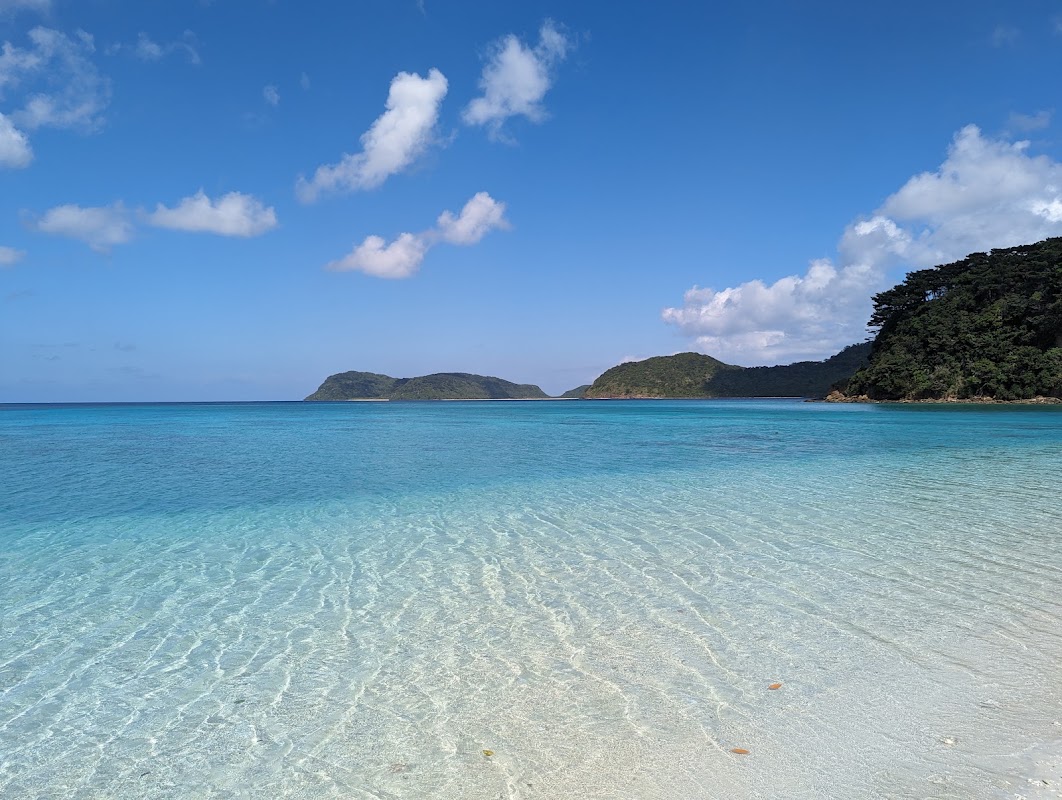
📍 Address: Iriomote, Taketomi, Yaeyama District, Okinawa 907-1542, Japan
Indispensable when talking about Iriomote Island’s seas is ‘Ida-no-Hama,’ a secluded beach praised by even locals as ‘the most beautiful on Iriomote.’ Iriomote Island’s roads do not loop around the entire island, cutting off at Shirahama Port, the westernmost point. Since there is no land access to Funauki village, where Ida-no-Hama is located, the only way to get there is by taking one of the five daily round-trip ferries from Shirahama Port.
Upon arrival at Funauki Port, you’ll walk along an unpaved mountain path for about 10-15 minutes to reach the beach. While the slope is gentle, wet rocks and tree roots can be slippery. Although Sakishima Habu snakes are nocturnal, there’s a possibility they might be lurking in shaded areas during the day, so accessing the beach with sneakers rather than sandals that expose your feet is strongly recommended.
Beyond the mountain path lies a pristine white sand beach and an emerald green sea with outstanding transparency. The boundary between shallow and deep water (the ‘drop-off’) is incredibly beautiful, and if you venture a little offshore, you can encounter colorful coral reefs, schools of tropical fish, and with high probability, sea turtles grazing on seaweed. With few tourists, especially during the off-season, you can often have this magnificent view almost entirely to yourself. It’s truly a special place where you can fully experience the atmosphere of ‘Japan’s hidden paradise known to those in the know.’
Omija Road Park
📍 Address: Takana, Taketomi, Yaeyama District, Okinawa 907-1431, Japan
For travelers moving around the island by rental car or bus, ‘Omija Road Park’ is a hidden gem definitely worth a stop. This park is located near the mouth of the Omija River, allowing you to easily experience the jungle and mangrove forest atmosphere of Iriomote Island without participating in a long tour.
The entrance from the parking lot can be a bit tricky to find, but with your back to the road, the path to the ‘far left’ leads to an observation deck overlooking the sea, while the path to the ‘far right’ leads to a wooden boardwalk (promenade) through the jungle-like mangrove forest. The best time to visit is during ‘low tide.’ When the tide recedes, you can descend to the mudflats from the observation deck side, allowing you to observe the intricate root structures of the mangroves, which are usually submerged, and unique small creatures of the mudflats such as fiddler crabs and mudskippers up close.
While not particularly large in scale, it’s perfect for spending quiet island time listening to the murmuring river. The Omija River is shallow and resembles a natural pool, so in summer, you can often see local children enjoying water play, allowing you to experience a touch of local vibrancy.
Mariyudu Falls
📍 Address: Haemi, Taketomi, Yaeyama District, Okinawa 907-1541, Japan
Mariyudu Falls is located in the mid-to-upper reaches of the Urauchi River, Okinawa Prefecture’s longest river. It is a famous waterfall selected as one of Japan’s Top 100 Waterfalls. In the local language, ‘Mari’ means round, and ‘Yudu’ means pool or eddy, and true to its name, it possesses a unique aesthetic beauty where water plunges into a large, round basin.
To reach this waterfall, you’ll take a sightseeing boat (jungle cruise) from the lower reaches of the Urauchi River, traveling for about 40 minutes upstream to the ‘Gunkan-iwa’ (Battleship Rock) pier. From there, you’ll trek along a promenade lush with subtropical plants for about 30-40 minutes. While some parts of the path are well-maintained and easy to walk, many sections are humid and slippery underfoot, requiring caution.
Due to nature conservation and safety concerns, the promenade near the waterfall basin may be closed to entry depending on the season, with viewing restricted to a distant observation deck. However, even from afar, the booming sound and the powerful sight of abundant water falling in two tiers are overwhelming. And if you’ve made it this far, you absolutely shouldn’t turn back. Walking another 15 minutes upstream will bring you to the vast ‘Kanpire Falls,’ which means ‘seat of the gods.’ Visiting Mariyudu and Kanpire Falls as a set is the classic itinerary for Iriomote Island sightseeing.
Sangara Falls
📍 Address: Uehara, Taketomi, Yaeyama District, Okinawa 907-1541, Japan
While Iriomote Island boasts many waterfalls, ‘Sangara Falls’ offers a unique charm. Although its drop isn’t particularly high, it’s wide, spanning about 30 meters horizontally. Its greatest feature is the ability to walk ‘behind the waterfall,’ entering a secret base-like space (known as a ‘Uramidaki’ or ‘behind-the-waterfall’ view).
On a tour, you’ll reach it by canoeing through the mangroves along the Nishida River from Funauki Bay, followed by a 30-minute walk through the jungle. Since there’s not much steep trekking involved, it’s a great advantage that families with small children or those less confident in their physical stamina can enjoy the jungle adventure without overexertion.
When visiting Sangara Falls, the best way to enjoy it is to wear a swimsuit under your clothes and get completely soaked. You can stand under the waterfall for a natural shower or relax to the sound of the river while eating your lunch on the large rocks above the falls. Depending on the tide, you might also get to disembark your canoe and walk across vast mudflats, allowing you to fully enjoy a raw, muddy encounter with Iriomote Island’s unique nature, including crabs and juvenile fish.
[Column] How to Maximize Your Iriomote Island Jungle Adventure
Iriomote Island’s nature is more dynamic than you might imagine, and approaching it with a city mindset can lead to unexpected difficulties. We’ve compiled real-world tips and precautions travelers should know.
1. Abandon the Idea of ‘Going on Your Own’
Iriomote Island retains untouched nature, so mobile phone signals are unavailable in the mountains. Furthermore, for environmental conservation following its World Natural Heritage registration, popular areas like Pinaisara Falls and Sangara Falls have been designated ‘Specific Natural Tourism Resources,’ prohibiting individual unauthorized entry and making guide accompaniment mandatory. To avoid being stranded, always book a guided tour before departure. Walking with an experienced local guide who can offer insights into endemic flora and fauna will result in a much more enjoyable experience.
2. Optimal Clothing and Gear
Iriomote Island is hot and humid year-round. During trekking, you’ll sweat profusely, so avoid cotton T-shirts and choose ‘quick-drying materials’ like polyester. To protect your skin from insect bites, sunburn, and poisonous plants, even in mid-summer, the rule of thumb is a ‘long-sleeved rash guard + sports leggings + shorts.’ For footwear, renting felt boots from a tour company, suitable for slippery rocks and river trekking, is the safest option.
3. Toilet Issues and Environmental Consideration
Deep in the jungle, naturally, there are no flush toilets. It’s essential to use the restroom before starting your tour or at the ferry terminal. However, in recent years, some areas have made it mandatory (and often paid) to carry and use ‘portable toilets’ during tours to reduce environmental impact. Show respect for the great outdoors you are visiting, comply with local rules such as taking all your trash with you, and enjoy the best island time possible.


'%3E%3Cpath%20stroke='%23000'%20stroke-width='4'%20d='m-35-37-13%2020m5%203%2013-20m5%203-13%2020m63%2042%206-9m1-2%206-9m5%203-6%209m-1%202-6%209m5%203%206-9m1-2%206-9m-96%200%2013%2020m5-3-6-9m-1-2-6-9m5-3%2013%2020m63-42-6-9m-1-2-6-9m5-3%2013%2020m5-3-6-9m-1-2-6-9'/%3E%3Ccircle%20r='24'%20fill='%23cd2e3a'/%3E%3Cpath%20fill='%230047a0'%20d='M0%200a12%2012%200%201%201%2020%2013%2024%2024%200%201%201-40-26A12%2012%200%201%200%200%200'/%3E%3C/g%3E%3C/svg%3E)
'/%3E%3Cpath%20fill='%23b2b2b2'%20d='M241%20382q0%2016%2017%2026%2017%2011%2042%2011t42-11q16-11%2017-26V269H241'/%3E%3Cpath%20fill='%239f7e00'%20d='M241%20379q0%2014%208%2023%209%209%2021%209%2014%200%2021-9%209-9%209-23V269h-59'/%3E%3Cpath%20d='M241%20339v-70h59v110q0%2014-9%2023l-6%205v-68h-15v72q-8%200-14-4v-68zm59%2040c0%2022%2015%2032%2029%2032%2021%200%2030-18%2030-32v-40h-59'/%3E%3Cpath%20fill='%239f7e00'%20d='M266%20277v5h2v12h-3v-5h2v-5h-9v5h2v5h-4v9h3v18h-5v10h34v-10h-5v-18h3v-9h-4v-5h2v-5h-9v5h2v5h-3v-12h2v-5zm42%20101q0%2010%206%2017%206%206%2015%207%2010-1%2016-7%206-7%206-17v-29h-43'/%3E%3Ccircle%20fill='%230044ad'%20cx='329.5'%20cy='372'%20r='6'/%3E%3Cellipse%20fill='%230044ad'%20cx='300'%20cy='340'%20rx='16'%20ry='21'/%3E%3C/svg%3E)


