

Kusatsu Onsen in Gunma Prefecture is counted among Japan’s three most famous hot springs. Boasting the largest natural hot spring water output in Japan, with over 32,000 liters per minute, this town is a longed-for destination for any hot spring enthusiast.
This time, we’ve carefully selected must-see tourist spots in Kusatsu Onsen that travelers will truly enjoy. We provide a thorough guide covering everything from the classic ‘Yubatake’ and the vibrant surrounding attractions, to its little-known deep history, and tips for avoiding crowds.
Kusatsu Onsen Yubatake
📍 Address: Kusatsu, Kusatsu-machi, Agatsuma-gun, Gunma 377-1711, Japan
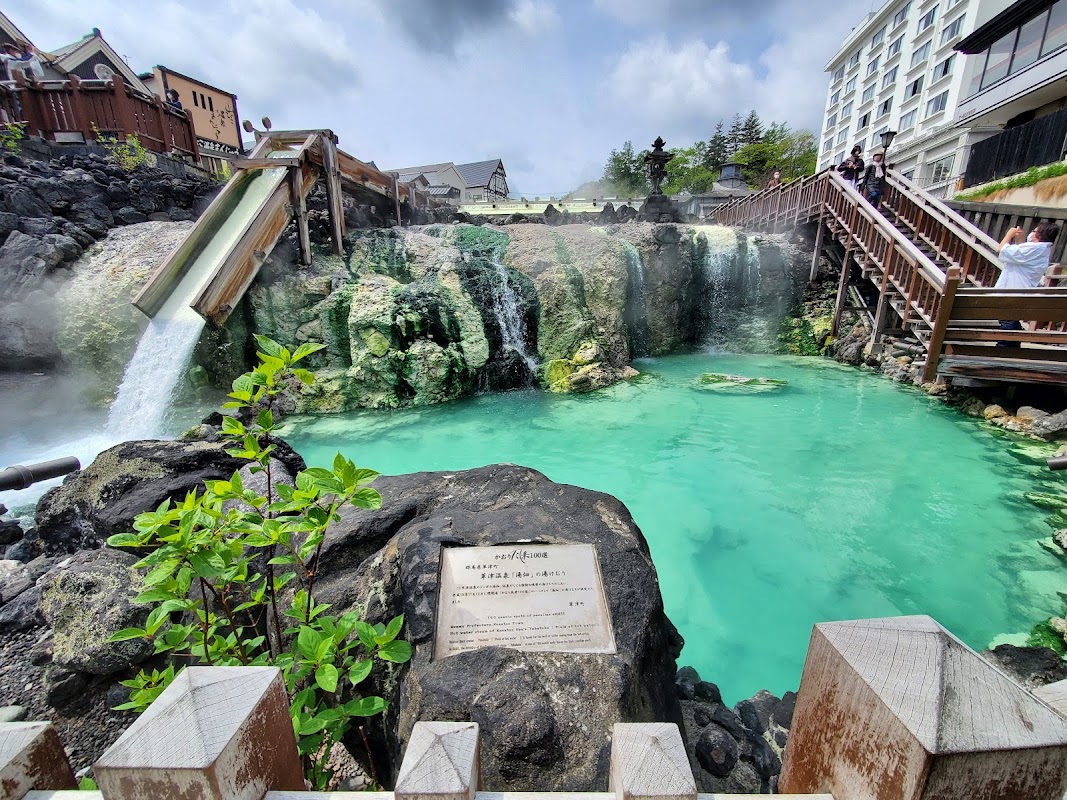
The first thing you’ll see upon arriving in Kusatsu Onsen is the ‘Yubatake’ (hot water field), a grand symbol majestically spread out in the center of the hot spring town. As the emerald green hot water vigorously flows, enveloped in swirling steam and a strong sulfurous aroma, you’ll immediately feel a rush of ‘Finally, I’m in Kusatsu!’
This Yubatake serves as a cooling facility designed to channel the highly acidic hot spring water, which gushes out at a rate of approximately 4,000 liters per minute at 50°C to 90°C, through seven wooden conduits. This allows the water to cool by exposure to the outside air without dilution, before being distributed to the ryokans. It’s a brilliant ancestral wisdom, dating back to the Edo period, that upholds the ‘source water principle’ (Gensen Shugi) by not weakening the hot spring’s properties. The sulfur crystals that precipitate in the conduits are collected several times a year as ‘Yunohana’ (hot spring flowers) and sold as precious souvenirs.
In fact, the current organic, gourd-shaped design, the surrounding stone fence, and the walkways were supervised by artist Taro Okamoto in 1975 (Showa 50). It’s not just old; the exquisite fusion of art and hot spring culture is also a major highlight.
During the day, you can enjoy the lively atmosphere of the hot spring town, but at night, it transforms completely. The entire Yubatake is illuminated with purple and blue lights, creating a mystical scene where light reflects off the rising steam. The surrounding area is also packed with food stalls for street eating; enjoying onsen manju (hot spring steamed buns) or yakitori while strolling around in a yukata is the best way to experience it.
Yudaki (Hot Water Waterfall)
📍 Address: 401 Kusatsu, Kusatsu-machi, Agatsuma-gun, Gunma 377-1711, Japan
Downstream from Yubatake, the ‘Yudaki’ (Hot Water Waterfall) is a climactic spot where the hot spring water, cooled through the wooden conduits, finally cascades down. The sight of the emerald green water vigorously plunging into the basin, creating whitecaps, powerfully conveys Kusatsu’s abundant hot spring flow visually and audibly.
This is an excellent photo spot around Yubatake, where many travelers pose with their cameras day and night. The illumination after sunset is particularly a must-see. The blue-green waterfall, illuminated in the darkness, combined with the rising steam, creates a breathtaking display of beauty and power.
Right next to the waterfall, a free footbath is also available, allowing you to warm your feet, chilled from walking, while listening to the roar of Yudaki. Feel the powerful energy of Kusatsu’s earth directly from your feet.
Toji Hiroba (Hot Spring Path Plaza)
📍 Address: 107-1 Kusatsu, Kusatsu-machi, Agatsuma-gun, Gunma 377-1711, Japan
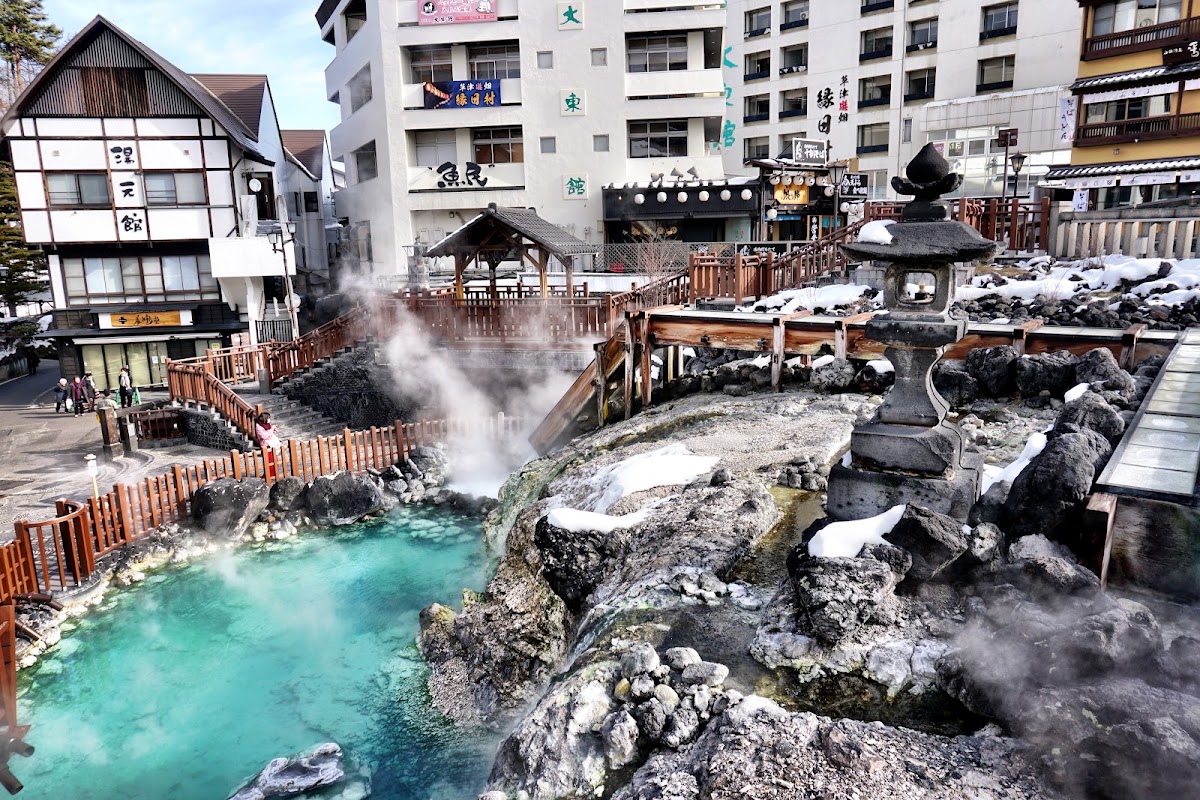
Adjacent to Yubatake, ‘Toji Hiroba’ (Hot Spring Path Plaza) is a pocket park developed in 2014 as a new recreational space in the Kusatsu Onsen town. What was once a parking lot has been transformed into a beautiful, terraced, multi-purpose plaza themed around ‘Showa Retro.’
It features a distinctive Japanese-style wooden corridor with a roof and stone paving, beautifully blending into the hot spring town’s atmosphere. The plaza is designed with steps that double as benches, making it an ideal spot to sit and enjoy onsen manju or other treats bought around Yubatake. In the early morning, you can enjoy the quiet atmosphere with fewer people, and at night, you can view the illuminated Yubatake from a slightly wider perspective.
Clean and comfortable public restrooms are also available, making it a very convenient base for travelers’ strolls. It’s a pleasant space where you can feel Japan’s hot spring culture firsthand, making you want to walk around in a yukata and geta, clanking as you go.
Netsunoyu
📍 Address: 414 Kusatsu, Kusatsu-machi, Agatsuma-gun, Gunma 377-1711, Japan
A visit to Kusatsu Onsen is incomplete without experiencing the ‘Yumomi and Dance’ show at ‘Netsunoyu,’ located right next to Yubatake. Inside the pseudo-Western style building, which evokes Taisho Romance, you can witness Kusatsu’s famous Yumomi (hot water stirring) up close.
Kusatsu’s hot spring source is extremely hot, over 50°C. Adding cold water would dilute the therapeutic effects of the hot spring, so ‘Yumomi,’ the practice of stirring the water with 180cm long wooden boards to cool it, was devised in the Edo period. The professional skill of the ‘Yumomi girls’ is truly impressive as they splash the water high in sync with the familiar Kusatsu Bushi folk song, ‘Kusatsu yoi toko ichido wa oide…’ (Kusatsu is a good place, come visit once…). The resistance of the water is surprisingly strong, and experiencing it will show you how strenuous the work is.
Shows are held six times a day (three in the morning, three in the afternoon), lasting about 20 minutes. Tickets are sold on the day, starting 30 minutes before each performance. A common ‘trap’ for travelers is the queue system. The long line extending in front of Yubatake is actually for ‘entry waiting’; you must first purchase tickets at the sales counter, and then rejoin the line. To secure good seats, such as the front of the second-floor viewing area overlooking the entire show, or the powerful first-floor front seats, it’s best to queue immediately after purchasing your ticket. Don’t forget the trick of presenting a special discount coupon from their website or a JAF membership card for a 50 yen discount.
Sainokawara Park (Nishinokawara Park)
📍 Address: Kusatsu, Kusatsu-machi, Agatsuma-gun, Gunma 377-1711, Japan
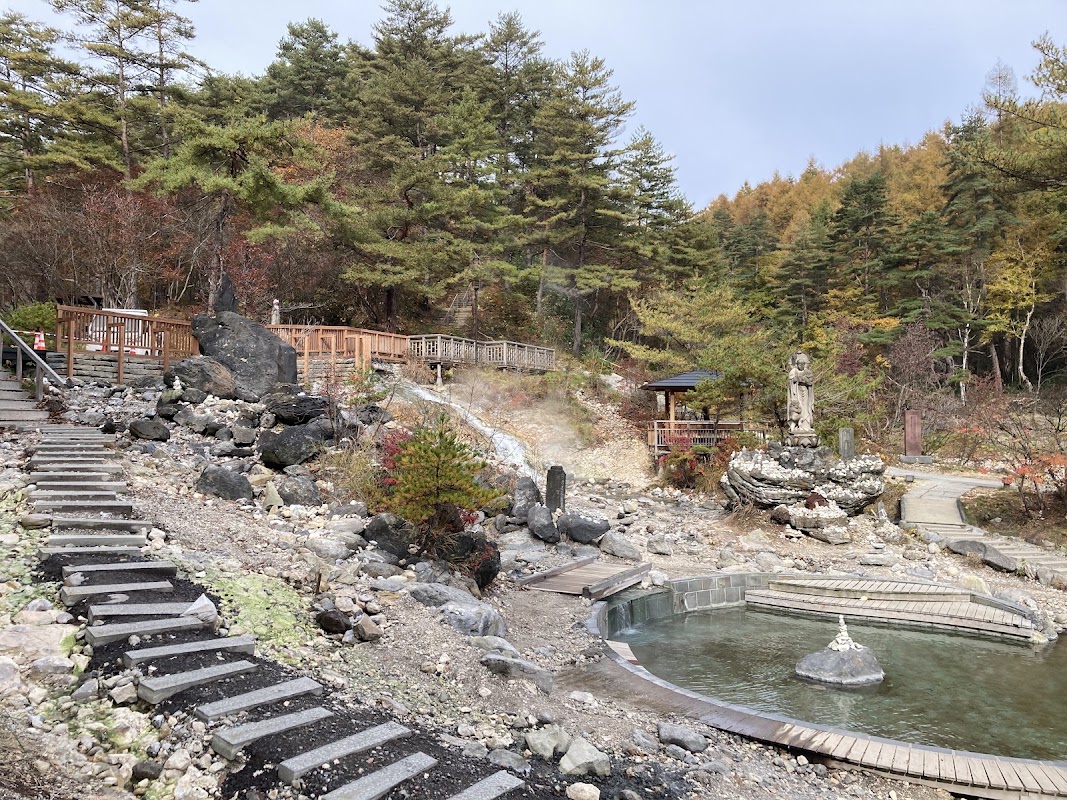
After a 15-minute walk from Yubatake, through the lively souvenir street (Nishinokawara-dori), the scenery dramatically changes, and ‘Sainokawara Park’ (also known as Nishinokawara Park) appears. This is a spectacular spot where nature and hot springs intertwine, designated as a special area within Joshin’etsu Kogen National Park.
Upon entering the park, you’ll find hot spring sources gushing out at a rate of 1,400 liters per minute from various rocky areas, creating emerald green ‘hot spring rivers’ with rising steam. Due to the highly acidic nature of the springs, vegetation struggles to grow, creating a desolate landscape that was once feared and called ‘Oni no Sensui’ (Demon’s Spring Water) or ‘Sai-no-Kawara’ (Riverbed of Lost Souls). Even today, famous spots like the legendary ‘Oni no Chagama’ (Demon’s Teapot), which was said to make eerie noises, remain within the park.
We particularly recommend visiting during the night illumination from sunset until 10 PM. The powerful natural scenery of the daytime transforms. In the darkness, steam illuminated by blue and purple lights emerges, creating a fantastical atmosphere that is both romantic and somewhat eerie, as if you’ve wandered into another world. Multiple footbaths are scattered along the promenade, but the area near the entrance tends to get crowded, so venturing deeper into the park is the key to a more relaxed experience.
At the innermost part of the park is the ‘Sainokawara Rotenburo’ (open-air bath), one of Japan’s largest, covering approximately 500m² for both men and women. We highly recommend experiencing the blissful time of soaking in the renowned hot spring amidst overwhelming openness, surrounded by a starry sky and illuminated forest.
How to Enjoy Kusatsu at Night and Important Tips
The greatest charm of Kusatsu Onsen is how dramatically the town’s atmosphere changes between day and night. It would be a great shame to leave after just a day trip; we strongly recommend staying overnight to enjoy a night stroll. The illuminations from around Yubatake to Sainokawara Park are perfect for a post-dinner walk.
As a note of caution for your stroll: Kusatsu’s hot spring source is highly acidic, so if you enter a footbath or hot spring with metal accessories (especially silver or copper), they will instantly tarnish and turn black. It’s safer to remove all accessories during your walk. Also, keep a towel in your bag so you can enjoy a footbath anytime you feel tired.
Regarding payment methods, many privately owned restaurants and souvenir shops still do not accept credit cards; cash or PayPay are the main payment options. To enjoy street food and small purchases without stress, it’s reassuring to have plenty of ¥1,000 bills and coins ready.

![[2026 Latest] 5 Must-Visit Hirosaki Tourist Spots! A Complete Guide to History, Stunning Scenery, and Deep Local Experiences for Travelers](https://images.unsplash.com/photo-1696053553512-3616c28488b3?crop=entropy&cs=tinysrgb&fit=max&fm=jpg&ixid=M3w5MDExNDh8MHwxfHNlYXJjaHw1fHxoaXJvc2FraXxlbnwwfDB8fHwxNzgzMTE2MDE4fDA&ixlib=rb-4.1.0&q=80&w=1080 "[2026 Latest] 5 Must-Visit Hirosaki Tourist Spots! A Complete Guide to History, Stunning Scenery, and Deep Local Experiences for Travelers")


'%3E%3Cpath%20stroke='%23000'%20stroke-width='4'%20d='m-35-37-13%2020m5%203%2013-20m5%203-13%2020m63%2042%206-9m1-2%206-9m5%203-6%209m-1%202-6%209m5%203%206-9m1-2%206-9m-96%200%2013%2020m5-3-6-9m-1-2-6-9m5-3%2013%2020m63-42-6-9m-1-2-6-9m5-3%2013%2020m5-3-6-9m-1-2-6-9'/%3E%3Ccircle%20r='24'%20fill='%23cd2e3a'/%3E%3Cpath%20fill='%230047a0'%20d='M0%200a12%2012%200%201%201%2020%2013%2024%2024%200%201%201-40-26A12%2012%200%201%200%200%200'/%3E%3C/g%3E%3C/svg%3E)
'/%3E%3Cpath%20fill='%23b2b2b2'%20d='M241%20382q0%2016%2017%2026%2017%2011%2042%2011t42-11q16-11%2017-26V269H241'/%3E%3Cpath%20fill='%239f7e00'%20d='M241%20379q0%2014%208%2023%209%209%2021%209%2014%200%2021-9%209-9%209-23V269h-59'/%3E%3Cpath%20d='M241%20339v-70h59v110q0%2014-9%2023l-6%205v-68h-15v72q-8%200-14-4v-68zm59%2040c0%2022%2015%2032%2029%2032%2021%200%2030-18%2030-32v-40h-59'/%3E%3Cpath%20fill='%239f7e00'%20d='M266%20277v5h2v12h-3v-5h2v-5h-9v5h2v5h-4v9h3v18h-5v10h34v-10h-5v-18h3v-9h-4v-5h2v-5h-9v5h2v5h-3v-12h2v-5zm42%20101q0%2010%206%2017%206%206%2015%207%2010-1%2016-7%206-7%206-17v-29h-43'/%3E%3Ccircle%20fill='%230044ad'%20cx='329.5'%20cy='372'%20r='6'/%3E%3Cellipse%20fill='%230044ad'%20cx='300'%20cy='340'%20rx='16'%20ry='21'/%3E%3C/svg%3E)


