

Amano Iwato Shrine, West Main Shrine
📍 Address: 1073-1 Iwato, Takachiho, Nishiusuki District, Miyazaki 882-1621, Japan
Amano Iwato Shrine, the stage for the ‘Amano-Iwato legend’—one of Japan’s most famous myths—is a highlight of Takachiho tourism. While there are both the ‘East Main Shrine’ and ‘West Main Shrine’ separated by the Iwato River, the main attraction for visitors is the ‘West Main Shrine,’ which enshrines the cave itself, Amano-Iwato, where Amaterasu Omikami is said to have hidden.
A must-do here is the free ‘Amano Iwato Yaheisho’ guided tour by a Shinto priest, offered every 30 minutes. No reservation is required; simply wait at the designated spot, and a priest will guide you when the time comes. This is a precious opportunity to hear a detailed explanation of the myth and directly worship the sacred cave from behind the main hall. However, please note that photography is strictly prohibited inside the Yaheisho, as it is a sacred place. Take the time to engrave the scene in your mind’s eye and truly feel its solemn atmosphere.
The shrine grounds are surrounded by abundant nature and filled with a divine ambiance. If you have ample time, a route that starts by visiting the ‘East Main Shrine’—believed to be where Amaterasu Omikami first resided after emerging from the cave—is highly recommended for travelers seeking to deeply experience its history.
Ama-no-Yasugawara
📍 Address: Iwato, Takachiho, Nishiusuki District, Miyazaki 882-1621, Japan
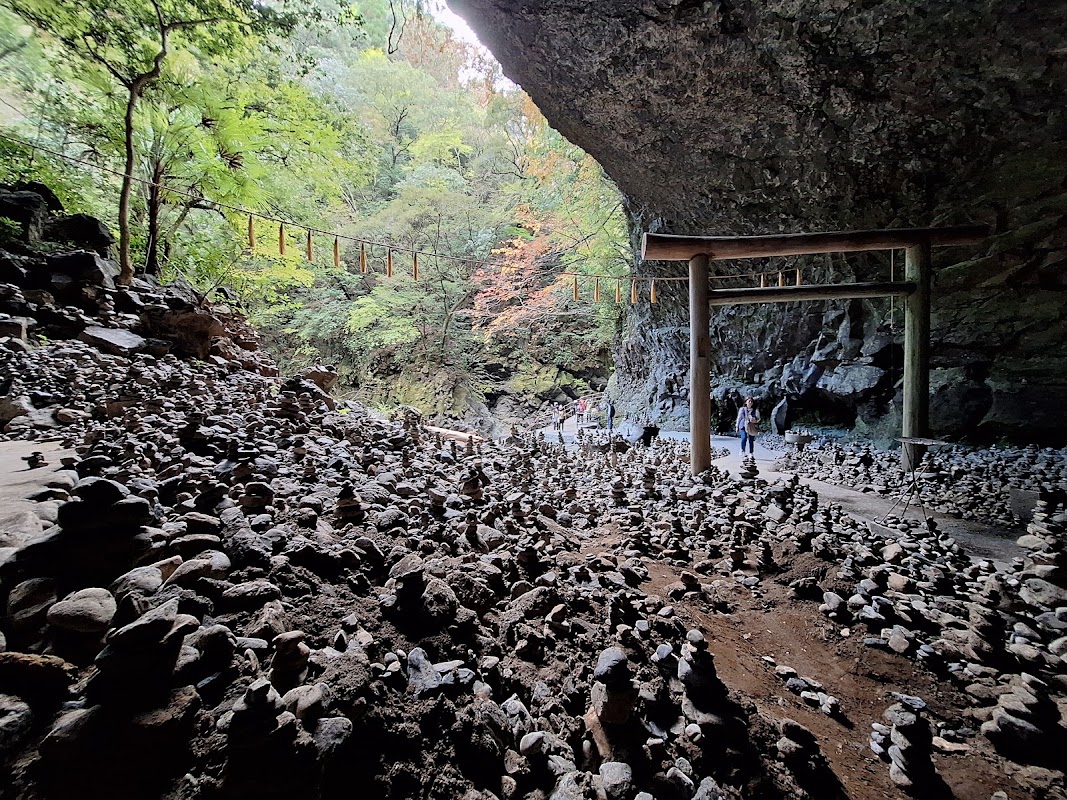
Approximately a 10-minute walk along the Iwato River path from Amano Iwato Shrine (West Main Shrine), you’ll discover Ama-no-Yasugawara, one of Japan’s foremost power spots. This legendary site is where eight million gods (Yaoyorozu no Kami) gathered to deliberate (Kamigakari) on how to entice Amaterasu Omikami out when she hid in the cave, plunging the world into darkness.
Stepping into the giant cave ‘Gyobo-ga-Iwaya,’ which measures about 40m wide and 30m deep, you’ll feel the air sharply change, accompanied by a cool chill. What further overwhelms visitors are the ‘countless piled stones’ filling the riverbed and the cave. These stones are stacked by worshippers with prayers and wishes, creating a scene where silence and mystery intertwine, making it feel as if the gods are still breathing here.
This ethereal spot is highly photogenic, but the path has some ups and downs and potentially slippery stone steps, so comfortable walking shoes like sneakers are essential. Be extra careful of your footing after rain or during high water due to heavy rainfall. Visiting early in the morning, when there are fewer people, is the best time to experience the crisp, sacred atmosphere all to yourself.
Takachiho Shrine
📍 Address: 1037 Mitai, Takachiho, Nishiusuki District, Miyazaki 882-1101, Japan
Takachiho Shrine is the head shrine of 88 shrines in the Takachiho region, said to have been founded approximately 1900 years ago. Stepping onto the grounds, you’ll be enveloped by deep history and clear air, surrounded by ancient trees, including the ‘Chichibu Sugi’ cedar, which is over 800 years old. Don’t miss the ‘Meoto Sugi’ (Couple Cedar), where two cedars are connected at their roots. It’s said that if couples hold hands and walk around it three times, their wishes for matchmaking, marital harmony, and prosperity of descendants will come true, making it a popular spot to visit with a loved one.
For travelers, the absolute must-see evening event is the ‘Takachiho Kagura,’ performed daily at 8 PM in the Kagura-den (sacred dance hall). This performance condenses four representative dances—’Tadikarao-no-Mai,’ ‘Uzume-no-Mai,’ ‘Totori-no-Mai,’ and ‘Goshintai-no-Mai’—from the ‘Takachiho Yoru Kagura,’ an Important Intangible Folk Cultural Property originally performed over three nights in winter, into a captivating one-hour show.
The authentic dances, performed in rotation by dancers from various local communities, are exotic and powerful. Seating is on a first-come, first-served basis on tatami mats, so it can get very crowded during holiday seasons. Online reservations (for up to 230 people) are available from 10 AM 30 days in advance until 5 PM on the day of the performance. If you definitely want to see it, we highly recommend booking online beforehand and arriving a little early.
Aratate Shrine
📍 Address: 667 Mitai, Takachiho, Nishiusuki District, Miyazaki 882-1101, Japan
Though a lesser-known deep spot, Aratate Shrine has been attracting significant attention recently. The unique name of this shrine comes from the legend that Sarutahiko no Mikoto, who guided the heavenly grandchild during the descent to earth, and Amenouzume no Mikoto, who performed an enchanting dance in front of Amano-Iwato, got married and hastily built their new home from freshly cut rough wood.
As Amenouzume no Mikoto, one of the enshrined deities, is considered the origin of performing arts, this shrine enjoys immense popularity as the ‘deity of performing arts.’ Many celebrities, including Ann Mika, visit in secret. Furthermore, it gained widespread fame among fans after being depicted in the hit anime and manga ‘Oshi no Ko’ as a sacred site where main characters worshipped during filming breaks.
Scattered throughout the shrine’s backyard are attractions like the ‘Seven Lucky Virtues Wooden Blocks,’ where striking a wooden板木 seven times with a mallet is said to grant wishes, offering a treasure hunt-like experience while exploring the grounds. Depending on your navigation route, you might be directed down narrow roads where passing is difficult. The trick for driving is to aim for the access road that extends straight from the torii gate.
Akimoto Shrine
📍 Address: 6781 Mukaiyama, Takachiho, Nishiusuki District, Miyazaki 882-1103, Japan
Located about a 30-minute drive from Takachiho’s town center, nestled deep within the mountains, Akimoto Shrine is a secluded and powerful hidden gem. Among Takachiho’s many tourist spots, it has a particularly high difficulty to reach, leading some to whisper that ‘only those who are called can find it.’ Enshrining Kuninotokotachi no Mikoto, a deity of creation, among others, and with its main hall facing the ‘kimon’ (northeast direction), it is said to harbor unique energy.
As you proceed along the approach, the air changes dramatically, enveloping you in a timeless silence. Within the shrine grounds, ‘Akimoto Mountain Water,’ sourced from Mt. Morotsuka, is channeled and has long been revered as sacred water. This is a place reminiscent of Japan’s original landscape, where you can cleanse your mind and body in an atmosphere rich in negative ions, and in autumn, enjoy spectacular golden ginkgo foliage.
However, accessing it requires determination. The route involves narrow, winding mountain roads, barely wide enough for one car, with continuous points where passing oncoming vehicles is challenging. If you are not confident in your driving skills, it’s safer to rent a compact car with good maneuverability or use a local taxi. Additionally, road conditions may be subject to time restrictions after heavy rain or due to road improvement works, so check the Takachiho Town Tourism Association website or similar sources for road status before heading out.
Local Tips for Enjoying Takachiho 120%
Takachiho is a mountainous town with scattered attractions. Here are some practical tips to effectively use your limited time and avoid common pitfalls for travelers.
First, regarding transportation, it’s safe to say that a ‘rental car’ is the only viable option for maximum flexibility. However, roads leading to villages around Akimoto Shrine and Aratate Shrine are extremely narrow and feature sharp curves, making a compact car overwhelmingly advantageous over larger vehicles.
For clothing, prioritize ‘ease of movement’ even when visiting shrines and temples. Comfortable, broken-in sneakers are essential for navigating the Ama-no-Yasugawara path and the long stone steps at various shrines. Also, due to its mountainous terrain, the air can feel cool even in summer when you’re by the river or in the shade. It’s wise to carry a light jacket or cardigan that you can easily put on or take off.
Finally, we highly recommend lightly reviewing the ‘Amano-Iwato legend’ of Japanese mythology (Susanoo’s rampage, Amaterasu hiding in the cave, Amenouzume’s dance, and the feast of the eight million gods) before your visit. Knowing this backstory will dramatically enhance your understanding of the priests’ guides and the Night Kagura performances, transforming a mere sightseeing trip into a journey of ‘re-experiencing the myths.’


