

Just about a 30-minute train ride from the center of Kyoto, Uji, embraced by the clear currents of the Uji River and lush greenery, offers a serene and unhurried pace, distinct from the vibrant atmosphere of central Kyoto. From World Heritage-listed sites to cherished local havens, Uji is dotted with attractions that will draw you in more with every step you take.
This article carefully selects and introduces must-visit tourist spots in Uji for everyone, from short-term visitors to those who wish to delve deep into its history. Beyond typical historical explanations, we’ll provide comprehensive insights, including practical tips for cleverly navigating to avoid crowds and uncovering often-overlooked, profound highlights.
Ujigami Shrine
📍 Address: 59 Ujiyamada, Uji, Kyoto 611-0021, Japan
Nestled quietly at the foot of Mount Butsutoku on the right bank of the Uji River, Ujigami Shrine is said to have the smallest grounds among the ‘Historic Monuments of Ancient Kyoto’ World Heritage sites. Yet, stepping inside, you are enveloped in a profound silence and sacred atmosphere, as if time itself has stood still.
The main highlights are its ‘Honden’ (main hall) and ‘Haiden’ (worship hall), both designated National Treasures. The Honden, built around 1060 during the late Heian period, has been scientifically confirmed as Japan’s oldest existing shrine architecture. The exterior building visible is called ‘Ooiya’ (covering structure), which houses three ‘Ikkensha Nagare-zukuri’ style shrine buildings inside – a truly rare architectural structure. The Haiden, built in the early Kamakura period, retains the elegant ambiance of the Shinden-zukuri style, and the curved beauty of its ‘Suga-hafu’ (gable) roof is breathtaking.
The enshrined deity, Uji no Wakiiratsuko no Mikoto, has a tragic yet noble story: he took his own life to cede the imperial throne to his elder brother (later Emperor Nintoku). Today, the shrine is believed to offer blessings for academic achievement and family safety, and its vibrant Goshuin (red stamp seals) are also popular. Within the grounds, you’ll also find ‘Kiriharasui,’ the only remaining spring water among Uji’s Seven Famous Waters. Touching its cold water will make you feel the continuous flow of over a thousand years of history. This is a perfect place of prayer for those seeking to escape the hustle and bustle of tourist sites and regain their inner tranquility.
Mimuroto-ji Temple
📍 Address: 21 Todo Shigadani, Uji, Kyoto 611-0013, Japan
Nationally renowned as the ‘Flower Temple,’ Mimuroto-ji Temple boasts a vast garden where 5,000 azaleas and 10,000 rhododendrons bloom in May, 10,000 hydrangeas in June, and lotus flowers from July to August, offering spectacular scenery regardless of the season. The hydrangea season, in particular, paints the hillside in vibrant gradients of blue, purple, and pink, making for excellent photo opportunities. However, to avoid crowds, the best time to visit is first thing in the morning, right after opening.
But Mimuroto-ji Temple’s charm isn’t limited to its beautiful flowers. The temple grounds are dotted with unique ‘blessing spots’ that invite interaction. Upon ascending the steps to the main hall, you’re greeted by the mysterious ‘Ugajin,’ a deity with an old man’s face and a snake’s body. It’s a truly luxurious deity whose blessings change depending on where you touch: touching its ears brings good fortune, stroking its beard grants health and longevity, and touching its tail boosts financial luck.
Furthermore, in front of the main hall stand the ‘Fukutoku Rabbit’ and ‘Hoshogyu’ (Victory Luck Ox). It is said that if you can stand the egg-shaped stone inside the ball held by the Fukutoku Rabbit, your luck will rise (it’s surprisingly difficult, so be sure to give it a try!). Also, touching the ball inside the Hoshogyu’s mouth is believed to bring good luck in competitions. After admiring the flowers, circling these statues to charge up your luck is a deep and unique way to enjoy Mimuroto-ji Temple.
Byodoin Temple
📍 Address: 116 Uji Renge, Uji, Kyoto 611-0021, Japan
A World Heritage site familiar to many as the design on the 10-yen coin, Byodoin Temple was established in 1052 by Fujiwara no Yorimichi, a regent. This temple was built to recreate the Pure Land where Amida Nyorai resides. The Phoenix Hall (Ho-o-do), a National Treasure, appears to float on Aji-ike Pond, resembling a bird with outstretched wings. Its elegant form, reflecting on the water on a clear day, is truly breathtaking.
A crucial insider tip you absolutely must know here is how to ‘secure tickets for internal viewing.’ Visiting the interior of the Phoenix Hall requires an additional 300 yen, separate from the regular admission fee (700 yen for adults), and tours are conducted every hour at :10, :30, and :50 past the hour, with a capacity of 50 people per tour. Advance reservations are not possible; tickets are only available for same-day purchase at the temple. Therefore, during peak tourist season or on weekends, it’s not uncommon to wait 2-3 hours or for tickets to sell out early. Once you enter Byodoin Temple, head straight to the internal viewing reception first.
Inside, you can closely admire the seated statue of Amida Nyorai, crafted by Jocho, the greatest Buddhist sculptor of the Heian period, and experience the space of the Pure Land from 1000 years ago firsthand. If you encounter a waiting period, we recommend exploring the temple’s beautiful gardens or visiting the ‘Byodoin Museum Hoshokan,’ equipped with state-of-the-art facilities. The power of the national treasures seen up close, such as the first generation gilded bronze phoenixes and the celestial bodhisattvas on clouds, is sure to overwhelm you.
Ajyrogi-no-michi Path
📍 Address: Ujitogawa, Uji, Kyoto 611-0021, Japan
The ‘Ajyrogi-no-michi’ path, stretching along the west bank of the Uji River to the east of Byodoin Temple, is a charming stone-paved promenade. With minimal vehicle traffic, you can enjoy a quiet and peaceful time, accompanied by the gentle murmuring of the river and the rustling of trees.
A unique delight of this path is the occasional glimpse of the Byodoin Phoenix Hall through gaps in the hedges. In spring, cherry blossoms burst into bloom, and in autumn, foliage turns vibrant colors, displaying seasonal beauty. It’s also known as a pilgrimage site for the popular anime ‘Sound! Euphonium,’ attracting many fans seeking to experience the beautiful scenery depicted in the series.
Along the path, you’ll find cafes and restaurants where you can enjoy Uji tea, a municipal tea ceremony room, and a tourist information center, making it ideal for a spontaneous break when you’re tired from walking. If you gaze at the river, you might even spot egrets and cormorants. It’s a small path brimming with the everyday beauty of Uji, where simply walking can lighten your heart.
Tono-shima Island (Ukishima)
📍 Address: Ujitogawa, Uji, Kyoto 611-0021, Japan
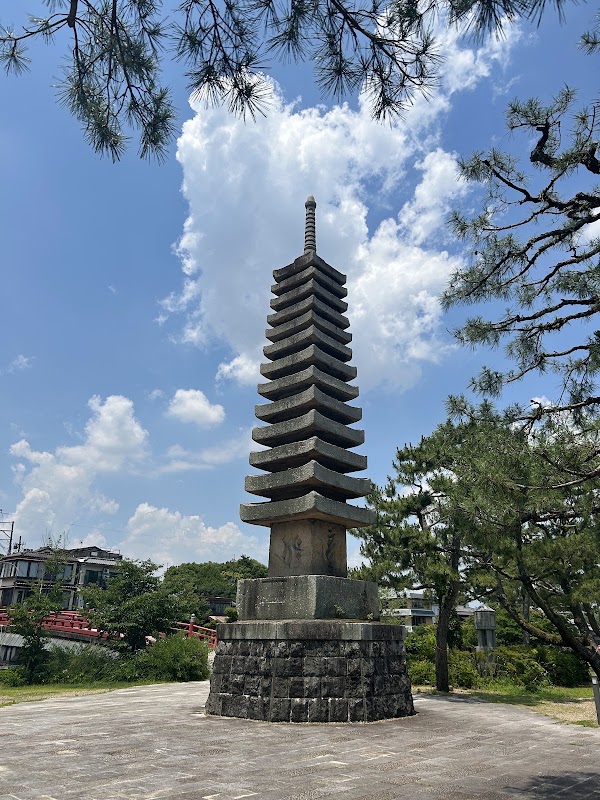
Accessible from Ajyrogi-no-michi path by crossing a picturesque bridge, ‘Tono-shima Island’ is a sandbar floating in the Uji River, maintained as part of Kyoto Prefectural Uji Park. Although very close to Byodoin Temple, it’s a hidden gem for those who want to relax away from the crowds of tourists.
Standing tall in the center of the island is the ‘Thirteen-Story Stone Pagoda’ (Jusanshu Sekito), an Important Cultural Property boasting a height of approximately 15 meters. Built in 1286 by Eison, a high priest of Saidai-ji Temple, it is one of Japan’s largest existing pre-modern stone pagodas. It carries a profound history, having been erected over buried fishing nets and gear to pray for the safety of Uji Bridge and the souls of fish caught in the river. Despite being repeatedly washed away and rebuilt by numerous floods, it continues to watch over the Uji River with an overwhelming presence.
Furthermore, this area is the stage for ‘Uji River Cormorant Fishing’ (Ukai), a summer tradition, where you might spot the charming ‘Utty’ (cormorants). Sitting on a bench, listening to the sounds of the clear stream where waterfowl rest their wings, you’re sure to forget your travel fatigue. It’s one of Uji’s premier healing spaces, where you can look up at the historic stone pagoda and feel the rhythms of nature.
Tips for Enjoying Uji Sightseeing 120%
Uji’s main tourist attractions are conveniently concentrated within walking distance around JR Nara Line ‘Uji Station’ or Keihan Uji Line ‘Uji Station,’ allowing you to efficiently visit them in half a day to a full day. The area immediately after crossing Uji Bridge from Keihan Uji Station, in particular, has many highlights, making access very convenient.
For the best sightseeing route, heading to Byodoin Temple first thing in the morning (right after opening) to secure tickets for internal viewing is the smartest approach. Afterward, stroll along Ajyrogi-no-michi path and Tono-shima Island to experience nature and history, then cross the Uji River to Ujigami Shrine. Extending your journey to Mimuroto-ji Temple will allow you to conquer the famous spots smoothly while avoiding peak crowds.
Moreover, when in Uji, you absolutely cannot miss Uji tea gourmet. The Byodoin Omotesando (front approach) is lined with long-established tea houses and sweets shops, but popular establishments can have waiting times of several hours. Ingenious use of time, such as getting a numbered ticket first before going sightseeing, will allow you to make the most of your limited stay. Create unforgettable travel memories in Uji, where you can savor history, nature, and local charm all at once.


'%3E%3Cpath%20stroke='%23000'%20stroke-width='4'%20d='m-35-37-13%2020m5%203%2013-20m5%203-13%2020m63%2042%206-9m1-2%206-9m5%203-6%209m-1%202-6%209m5%203%206-9m1-2%206-9m-96%200%2013%2020m5-3-6-9m-1-2-6-9m5-3%2013%2020m63-42-6-9m-1-2-6-9m5-3%2013%2020m5-3-6-9m-1-2-6-9'/%3E%3Ccircle%20r='24'%20fill='%23cd2e3a'/%3E%3Cpath%20fill='%230047a0'%20d='M0%200a12%2012%200%201%201%2020%2013%2024%2024%200%201%201-40-26A12%2012%200%201%200%200%200'/%3E%3C/g%3E%3C/svg%3E)
'/%3E%3Cpath%20fill='%23b2b2b2'%20d='M241%20382q0%2016%2017%2026%2017%2011%2042%2011t42-11q16-11%2017-26V269H241'/%3E%3Cpath%20fill='%239f7e00'%20d='M241%20379q0%2014%208%2023%209%209%2021%209%2014%200%2021-9%209-9%209-23V269h-59'/%3E%3Cpath%20d='M241%20339v-70h59v110q0%2014-9%2023l-6%205v-68h-15v72q-8%200-14-4v-68zm59%2040c0%2022%2015%2032%2029%2032%2021%200%2030-18%2030-32v-40h-59'/%3E%3Cpath%20fill='%239f7e00'%20d='M266%20277v5h2v12h-3v-5h2v-5h-9v5h2v5h-4v9h3v18h-5v10h34v-10h-5v-18h3v-9h-4v-5h2v-5h-9v5h2v5h-3v-12h2v-5zm42%20101q0%2010%206%2017%206%206%2015%207%2010-1%2016-7%206-7%206-17v-29h-43'/%3E%3Ccircle%20fill='%230044ad'%20cx='329.5'%20cy='372'%20r='6'/%3E%3Cellipse%20fill='%230044ad'%20cx='300'%20cy='340'%20rx='16'%20ry='21'/%3E%3C/svg%3E)


