

Among the ancient capital of Kyoto, ‘Arashiyama’ boasts a thousand-year history as a beloved villa retreat for Heian aristocrats. The natural beauty created by the majestic mountains and the Oi River (Katsura River) has captivated visitors throughout the ages. This area, showcasing different expressions in each season, is packed with attractions, from venerable World Heritage sites to Instagram-worthy art spots. This article thoroughly explains Arashiyama’s essential tourist attractions and provides practical information for avoiding crowds and enjoying a deeper experience.
Arashiyama
📍 Address: Arashiyama Genrokuzancho, Ukyo Ward, Kyoto, 616-0007, Japan
The entire ‘Arashiyama’ area has long been renowned as Kyoto’s premier scenic spot. Its history dates back to the Heian period when Emperor Saga built a detached palace here, leading it to flourish as an elegant villa retreat for imperial family members and nobles. The pristine flow of the Oi River and the magnificent nature of Arashiyama and Mt. Ogura towering behind it create a perfectly harmonious landscape that has captivated modern travelers for over a millennium.
The symbol of Arashiyama is the ‘Togetsukyo Bridge’ spanning the Oi River. It’s said that during the Kamakura period, Emperor Kameyama composed a poem upon seeing the moon moving across the bridge, saying, ‘Like the unclouded moon crossing over’ (kumanaki tsuki no wataru ni niru), which became the origin of its name. In spring, the mountains are adorned with full-blooming cherry blossoms, and in autumn, with fiery autumn leaves, creating a view with the bridge as a backdrop that resembles a masterpiece painting.
While it gets very crowded with tourists during the day, gazing at the river from Togetsukyo Bridge in the cool morning air offers a moment of pure bliss, making you forget the everyday hustle and bustle. The surrounding area also boasts a variety of long-established Japanese confectionary shops and modern cafes where you can enjoy street food, allowing you to leisurely stroll and savor the ambiance of the ancient capital.
Arashiyama Bamboo Grove
📍 Address: Saga Ogurayamadabuchi-cho, Ukyo Ward, Kyoto, 616-8394, Japan
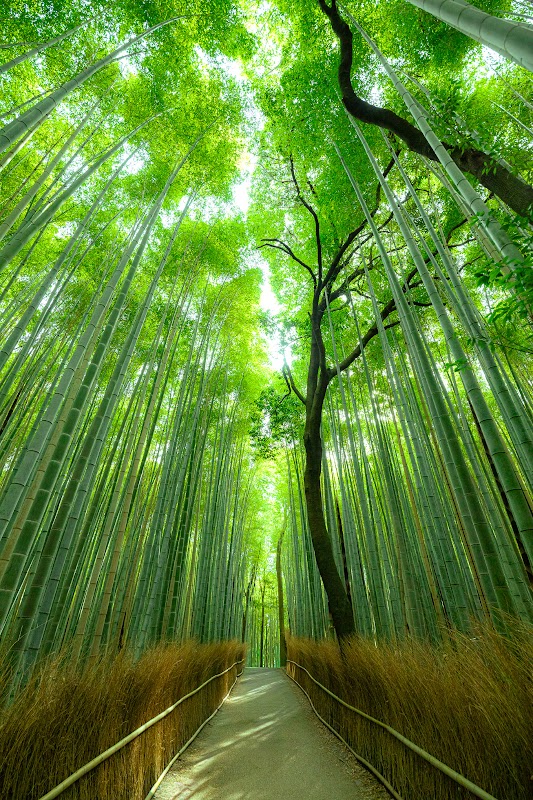
Alongside Togetsukyo Bridge, a major highlight of Arashiyama tourism is the ‘Bamboo Grove’. This approximately 400-meter path, stretching from Nonomiya Shrine through the north side of Tenryu-ji Temple to Okochi Sanso Villa, is densely packed with tens of thousands of bamboo stalks that reach high enough to obscure the sky. The moment you step in, you are enveloped in cool air and silence, with the pleasant rustling sound of bamboo leaves echoing with every breeze.
While this bamboo grove offers a beautiful verdant landscape year-round, it is a world-famous tourist spot, so it’s often bustling with many visitors during the day, sometimes even creating pedestrian ‘traffic jams’. If you want to capture the ethereal, quiet photos without people, like those seen in brochures, visiting early in the morning (preferably between 7 and 8 AM) is an absolute must.
Additionally, the density of bamboo increases as you go deeper into the path, allowing you to fully immerse yourself in the otherworldly atmosphere, as utility poles and other distractions are more visible near the entrance. Strolling in a rented kimono or taking a rickshaw to gaze down at the bamboo forest from a slightly elevated perspective are also elegant ways to enjoy this unique location.
Tenryu-ji Temple
📍 Address: 68 Sagatenryuji Susukinobabacho, Ukyo Ward, Kyoto, 616-8385, Japan
Registered as a World Heritage site, ‘Tenryu-ji Temple’ is a prestigious temple you absolutely must visit when in Arashiyama. Founded in 1339 by Ashikaga Takauji, the first shogun of the Muromachi Shogunate, to mourn Emperor Go-Daigo, it is a Rinzai Zen temple boasting the highest rank among Kyoto’s Five Great Zen Temples.
Its greatest highlight is the ‘Sogenchi Teien (Sogen Pond Garden)’, designated as Japan’s first historical site and special scenic spot. This garden, created by the Zen monk Muso Soseki, also renowned as a master landscape designer, brilliantly utilizes the ‘borrowed scenery’ technique, incorporating the majestic Arashiyama and Mt. Ogura in the background as if they were part of the garden itself. Sitting on the veranda of the main hall and gazing at it, you’ll be awestruck by the magnificent scale where trees reflect on the pond’s surface, a perfect fusion of nature’s grandeur and the spirit of Zen.
Also, the ‘Cloud Dragon Painting’ on the ceiling of the Hatto (Dharma Hall) is a must-see. It employs the ‘Hasso-nirami’ technique, where the dragon seems to glare at you from any angle, and its dynamism and power are breathtaking. Exiting Tenryu-ji’s grounds provides smooth access to the ‘Bamboo Grove’, making it an excellent key spot in your sightseeing itinerary.
Kimono Forest
📍 Address: 20-2 Sagatenryujitsukemichicho, Ukyo Ward, Kyoto, 616-8384, Japan
Located within ‘Arashiyama Station’ of the Randen (Keifuku Electric Railroad), one of Arashiyama’s gateways, the ‘Kimono Forest’ is a highly popular photo spot where tradition and modern art beautifully merge. Approximately 600 poles, about 2 meters high, encasing vibrant Kyo-Yuzen kimono fabrics in acrylic, stand in rows on the station premises, creating a magical sensation as if you’ve wandered into a forest of splendid kimonos.
Since this station has no ticket gates, anyone can freely enter the platforms and premises without taking a train, which is a great bonus. During the day, the colorful and beautiful Japanese patterns gleam in the sunlight, but its true charm emerges at night. As sunset approaches, LED lights embedded within the poles illuminate, transforming the entire area into a fantastic and romantic corridor of light.
Within the premises, there’s also the ‘Ryuo no Atago Pond’, a power spot where underground water springs, and a ‘footbath’ (paid) on the station platform to soothe tired feet. The best recommendation is to visit at dusk as a conclusion to your Arashiyama sightseeing, immersing yourself in the lingering memories of your trip while enjoying the illuminated Japanese-style lights.
Arashiyama Park Kameyama Area
📍 Address: 6 Saga Kamenoocho, Ukyo Ward, Kyoto, 616-8386, Japan
‘Arashiyama Park Kameyama Area’ (commonly known as Kameyama Park) is a nature-rich park spread across the southeastern part of Mt. Ogura, beyond the Bamboo Grove. Located on a slightly elevated hill away from the crowded areas around Togetsukyo Bridge and the center of the bamboo forest, it’s known as a ‘hidden gem’ where you can enjoy Arashiyama’s peaceful side, relatively free from crowds.
The main attraction here is the observation deck near the top of the mountain within the park. While it requires a 10-15 minute climb up somewhat steep stairs and slopes, the reward for your effort is a breathtaking panoramic view of the emerald green Hozugawa River (Hozukyo Gorge) flowing below and the surrounding mountains. If timed right, you might even glimpse the boats of the Hozugawa River boat ride or the Sagano Romantic Train chugging along the mountainside on the opposite bank.
The autumn foliage season, in particular, is exceptional, with the valley’s beauty, dyed in fiery reds and yellows, being absolutely spectacular. Scattered throughout the park are the cremation mounds of Emperor Go-Saga and Emperor Kameyama, as well as monuments inscribed with Waka poems from the Hyakunin Isshu, making it an ideal place to enjoy a leisurely stroll in nature while appreciating its deep history.
How to Make the Most of Your Arashiyama Visit and Avoid Crowds
Arashiyama is one of Kyoto’s most popular areas, attracting visitors from around the globe, so managing crowds significantly impacts your trip satisfaction. The most crucial factor is your ‘activity timing’. Classic spots like Togetsukyo Bridge, the Bamboo Grove, and Tenryu-ji Temple get incredibly busy after 10 AM. Therefore, the best strategy is to arrive in Arashiyama between 7-8 AM, savor the breathtaking scenery in tranquility, and finish taking your photos before the crowds arrive.
Furthermore, restaurants during lunchtime also get very crowded. It’s advisable to flexibly plan your meal schedule, either by having lunch right when establishments open at 11 AM or by enjoying street food at a different time. After walking through the bamboo forest, take a break at Kameyama Park’s observation deck to relax amidst nature, and then, from dusk into the evening, aim for the magical light-up of the Kimono Forest. This route allows you to efficiently cover Arashiyama’s diverse attractions.
Arashiyama, where historical charm, rich nature, and modern art harmoniously blend. With attractions spread over a wide area, be sure to wear comfortable sneakers to fully enjoy this oasis of the ancient capital.


