

Barcelona, the vibrant capital of Catalonia, Spain, is a city where passion and art intertwine. The greatest charm of this city, which attracts countless travelers from around the world, is undoubtedly its collection of Modernista architectural masterpieces (the Catalan version of Art Nouveau) scattered throughout the urban landscape.
Especially with 2026 marking the 100th anniversary of the death of the genius architect Antoni Gaudí, landmarks like the Sagrada Familia are attracting unprecedented global attention. However, Barcelona’s tourist spots are rarely places you can ‘just walk right into.’ Many facilities require complete advance reservations, and their vastness can be physically exhausting, making strategic planning key to a successful visit.
This guide highlights four of Barcelona’s ‘absolutely unmissable’ World Heritage sites. Beyond mere historical explanations, we delve deep into practical tips for avoiding crowds, revealing overlooked hidden charms, and offering real-world strategies for navigating these iconic locations.
Sagrada Familia
📍 Address: Carrer de Mallorca, 401, Eixample, 08013 Barcelona, Spain
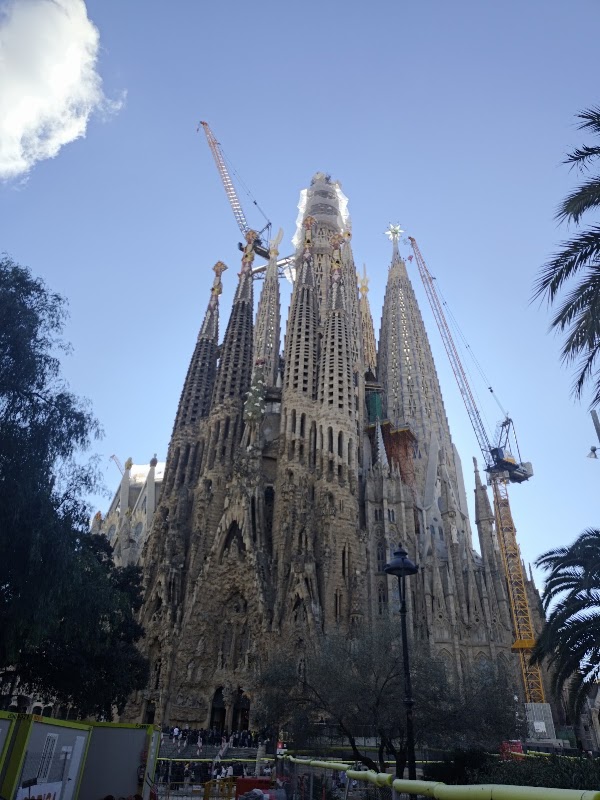
The Sagrada Familia, Barcelona’s iconic symbol, draws an immense number of tourists daily from around the globe. Long known as the ‘unfinished church’ since its groundbreaking in 1882, it is now entering a special period where one can truly feel its completion drawing near, aiming for Gaudí’s centenary in 2026.
The first thing that overwhelms visitors is the ‘Nativity Façade,’ with its intricate sculptures seemingly cascading from above. This façade includes angelic sculptures and beautiful doors crafted by Japanese sculptor Etsuro Sotoo, exuding a vitality that makes you lose track of time. In contrast, the ‘Passion Façade’ on the opposite side expresses Christ’s suffering through stark, heavy forms, the contrast between the two narrating the profound message of this architecture.
Stepping inside, a breathtaking ‘forest of light’ unfolds. Gaudí once said, ‘Architecture is the arrangement of light,’ designing the ceiling and pillars like trees to mimic dappled sunlight filtering through a forest. Particularly noteworthy is the stained-glass artistry. The Nativity Façade side (east) features cool-toned blue and green glass symbolizing hope and the birth of life, while the Passion Façade side (west) boasts warm-toned red and orange glass symbolizing Christ’s blood and passion. If possible, visiting in the late afternoon, when the western sun bathes the interior in a fiery crimson, is highly recommended.
Practical Tips for Your Visit:
Advance booking through the official website is essential. If you download the official app when booking, you can manage everything from displaying your ticket to playing the excellent audio guide on your smartphone. However, battery consumption is high, so carrying a mobile charger is strongly recommended. Upon entry, there are strict airport-level security checks, and large bags are not permitted, so travel light. Also, if you purchase a tower access ticket, the descent involves a very steep and narrow spiral staircase, so be sure to wear comfortable sneakers. The free international mass held on Sunday mornings is fiercely competitive, often reaching full capacity before 7 AM, so if you plan to attend, prepare for cold weather and wake up early.
Park Güell
📍 Address: Gràcia, 08024 Barcelona, Spain
Park Güell, famous for its colorful salamander fountain and undulating benches offering panoramic views of Barcelona and the Mediterranean, feels like stepping into a fairytale. However, this place was not originally conceived as a ‘park.’ It was, in fact, an ‘English-style garden city’ planned by Gaudí’s greatest patron, Count Eusebi Güell, influenced by the English garden city movement.
At the time, poor access from the city center, combined with overly strict landscape rules such as ‘building area limitations’ and ‘prohibition of tree felling’ within the grounds, led to a colossal failure: only two of the 60 planned plots were sold (and only to Gaudí himself and Count Güell). Subsequently, the Barcelona city council purchased and opened it as a park, and it is now a beloved World Heritage site. As you walk through the vast grounds, the natural slopes and stone corridors, which utilize the existing topography, powerfully convey Gaudí’s desire to harmonize with nature.
Practical Tips for Your Visit:
Park Güell’s biggest challenge is its ‘overwhelming slopes and elevation changes.’ Located in the hilly eastern part of the city, taking the usual metro access (e.g., Lesseps station) straight to the park will involve a heart-pounding uphill walk, exhausting you before you even begin your visit. Therefore, two alternative routes are highly recommended.
One option is to get off at Lesseps station, walk along ‘AVINCUDA DE VALLCARCA Street,’ and use the outdoor escalators to ascend directly to the upper entrance of the park. The other is to take the ‘number 24 bus’ from a bus stop north of Plaça Catalunya and get off at the highest bus stop within the park (it’s crucial to catch it from the first stop, as it often gets full mid-route).
Both methods allow you to ‘enter from the top and explore while descending,’ dramatically reducing physical exertion and time loss. The park has many cobblestone and dirt paths, so wear comfortable shoes. Also, remember that there are no ticket sales at the park’s entrance, so make sure to book online in advance before you arrive in Japan.
Casa Batlló
📍 Address: Pg. de Gràcia, 43, Eixample, 08007 Barcelona, Spain
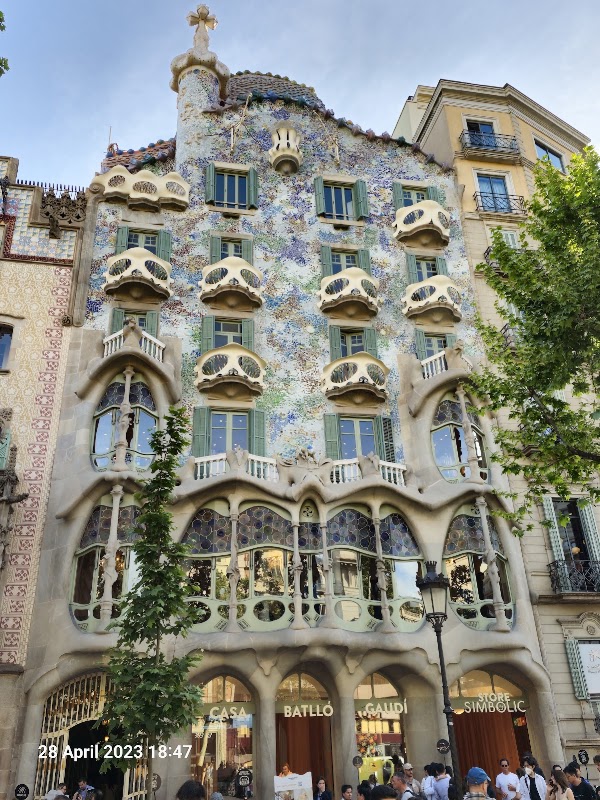
Casa Batlló, a strikingly peculiar building, suddenly appears on Barcelona’s main thoroughfare, Passeig de Gràcia. Locally known as the ‘House of Bones,’ its balconies resemble skulls and its columns animal bones, startling first-time viewers with its unsettling yet beautiful exterior.
The unique design is said to be inspired by the Catalan legend of Saint George. This tale tells of the patron saint Saint George defeating a ferocious dragon that demanded sacrifices and rescuing the princess. It is widely believed that the building’s roof represents the dragon’s scaly back, the cross piercing the roof symbolizes Saint George’s sword, and the bone-like façade depicts the bones of the dragon’s victims.
However, once you step inside, the intensity of the exterior gives way to a serene ‘underwater world.’ The central light well (patio) is a true masterpiece of Gaudí’s light calculations. By gradually lightening the blue tiles as they descend and varying the size of the windows, he ensured uniform light distribution on every floor, creating a fantastical sensation as if looking up at the water’s surface from the seabed. The organic curves, completely devoid of straight lines, embody the very breath of life.
Practical Tips for Your Visit:
Casa Batlló currently features a state-of-the-art ’10D Experience’ which has received rave reviews from travelers. When you hold an AR tablet audio guide, period furniture and swimming sea turtles appear on the screen, while the ‘Gaudí Cube’ in the basement offers an overwhelming immersive experience with 360-degree LED projection mapping, as if traveling inside Gaudí’s mind.
This is also a highly popular spot, so timed-entry reservations via the official website are essential. If you book for the evening, you can enjoy the beautiful interior, then sip local beer or wine on the rooftop terrace while watching the Barcelona sunset, and finally witness the magical exterior illumination on your way out—a truly luxurious experience.
Palau de la Música Catalana
📍 Address: C/ Palau de la Música, 4-6, Ciutat Vella, 08003 Barcelona, Spain
While Barcelona often brings Gaudí to mind, we must not forget another genius architect who was his contemporary: Lluís Domènech i Montaner. His greatest masterpiece, also a World Heritage site, is the Palau de la Música Catalana. Emerging from narrow streets, this magnificent building of red brick and mosaic tiles is truly a ‘hidden gem’ of Barcelona.
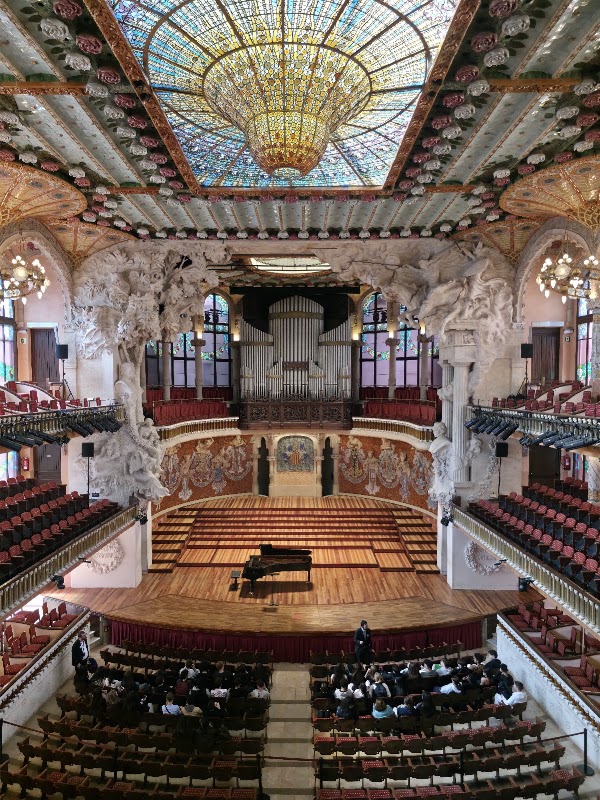
The moment you step into the concert hall, everyone is bound to gasp. Hanging from the center of the ceiling is a colossal stained-glass chandelier shaped like a giant teardrop. Its gold and blue gradients, mimicking the sun, shimmer like a kaleidoscope when natural light passes through, enveloping the entire hall in a magical, soft glow. From walls to pillars, countless rose sculptures and mosaic tiles adorn the space, and despite using cold modern materials like steel and glass, there is no other space in the world that conveys such warmth and overwhelming splendor.
If Gaudí’s architecture pursued ‘natural forms’ to the extreme, Domènech’s architecture represents the ‘pinnacle of human artistic ornamentation.’ Comparing these two completely different approaches to World Heritage sites provides a profound understanding of how artistically rich Barcelona was at the time.
Practical Tips for Your Visit:
The Palau de la Música Catalana is not merely a historic building but an active concert hall with daily performances. To explore the interior thoroughly, advance booking for an official guided tour (or a self-guided visit ticket) is essential. However, if your schedule permits, purchasing tickets for an evening classical or flamenco concert is highly recommended. The experience of feeling live music and artistic space merge, accompanied by excellent acoustics, is guaranteed to be a lifelong memory. The stylish café on the ground floor is also a perfect spot for a break before or after your visit.
Practical Strategies for a Successful Barcelona Trip
Finally, we’ll share essential mindsets for navigating Barcelona’s attractions stress-free. The most crucial point is to ‘plan all your activities in advance and complete all web bookings before departing Japan.’ Barcelona’s overtourism is severe, and for popular spots like Sagrada Familia and Park Güell, simply showing up on the day often means ticket offices are closed (or tickets are sold out).
Furthermore, a smartphone is an indispensable tool for modern Barcelona tourism. You’ll frequently use your phone during your visit for things like displaying QR code tickets, official facility apps for audio guides, and AR experiences. Therefore, always carry a high-capacity portable charger.
And sadly, don’t forget about pickpocketing prevention. While inside facilities, it’s generally safe, you need to be constantly aware of your surroundings on the metro heading there or in crowded areas like Plaça Catalunya. Keep valuables in front of your body, and carry backpacks on your front—this is standard practice for travelers.
With these preparations in place, Barcelona will undoubtedly be a city that offers you the greatest感動 (deep emotion). Be sure to witness the unparalleled artistry left by Gaudí and Domènech with your own eyes.


'%3E%3Cpath%20stroke='%23000'%20stroke-width='4'%20d='m-35-37-13%2020m5%203%2013-20m5%203-13%2020m63%2042%206-9m1-2%206-9m5%203-6%209m-1%202-6%209m5%203%206-9m1-2%206-9m-96%200%2013%2020m5-3-6-9m-1-2-6-9m5-3%2013%2020m63-42-6-9m-1-2-6-9m5-3%2013%2020m5-3-6-9m-1-2-6-9'/%3E%3Ccircle%20r='24'%20fill='%23cd2e3a'/%3E%3Cpath%20fill='%230047a0'%20d='M0%200a12%2012%200%201%201%2020%2013%2024%2024%200%201%201-40-26A12%2012%200%201%200%200%200'/%3E%3C/g%3E%3C/svg%3E)
'/%3E%3Cpath%20fill='%23b2b2b2'%20d='M241%20382q0%2016%2017%2026%2017%2011%2042%2011t42-11q16-11%2017-26V269H241'/%3E%3Cpath%20fill='%239f7e00'%20d='M241%20379q0%2014%208%2023%209%209%2021%209%2014%200%2021-9%209-9%209-23V269h-59'/%3E%3Cpath%20d='M241%20339v-70h59v110q0%2014-9%2023l-6%205v-68h-15v72q-8%200-14-4v-68zm59%2040c0%2022%2015%2032%2029%2032%2021%200%2030-18%2030-32v-40h-59'/%3E%3Cpath%20fill='%239f7e00'%20d='M266%20277v5h2v12h-3v-5h2v-5h-9v5h2v5h-4v9h3v18h-5v10h34v-10h-5v-18h3v-9h-4v-5h2v-5h-9v5h2v5h-3v-12h2v-5zm42%20101q0%2010%206%2017%206%206%2015%207%2010-1%2016-7%206-7%206-17v-29h-43'/%3E%3Ccircle%20fill='%230044ad'%20cx='329.5'%20cy='372'%20r='6'/%3E%3Cellipse%20fill='%230044ad'%20cx='300'%20cy='340'%20rx='16'%20ry='21'/%3E%3C/svg%3E)


