

Beppu Jigoku Meguri (Beppu Hell Tours)
📍 Address: 559-1 Kannawa, Beppu, Oita 874-0000, Japan
‘Beppu Jigoku Meguri’ (Beppu Hell Tours) is an absolute must-do classic course, a true highlight of sightseeing in Beppu, Oita Prefecture. You can visit seven ‘hells’ – Umi (Sea), Chinoike (Blood Pond), Tatsumaki (Spout), Shiraike (White Pond), Onishi Bozu (Monk’s Head), Kamado (Cooking Pot), and Oniyama (Demon Mountain) – and experience the living energy of the earth with all five senses. The somewhat ominous name ‘Jigoku’ (Hell) comes from the history of this land, where nearly 100-degree Celsius hot springs and mud bubbled up, making it an avoided and abhorred place where people couldn’t approach.
For travelers, the most pressing question is likely ‘what’s the most efficient way to get around?’ Our recommended strategy is to first purchase the ‘Common Admission Ticket,’ which grants access to all facilities. It’s definitely more economical if you plan to visit five or more ‘hells.’ The area is broadly divided into two parts; since ‘Tatsumaki Jigoku’ (Spout Hell), with its geysers, and the vivid red ‘Chinoike Jigoku’ (Blood Pond Hell) are a little distance apart, it’s best to drive there first. The remaining five ‘hells’ can be easily visited on foot after parking your car near ‘Umi Jigoku’ (Sea Hell).
If you follow the route downhill from Onishi Bozu Jigoku along Miyuki-zaka Slope, you can also enjoy street food along the way, killing two birds with one stone. Each ‘hell’ offers completely different attractions, and leisurely touring them while completing a stamp rally takes about 2.5 to 3.5 hours. It promises to be a highly satisfying hot spring theme park experience, where you can feel the mystery and heat of nature.
Umi Jigoku (Sea Hell)
📍 Address: 559-1 Kannawa, Beppu, Oita 874-0045, Japan
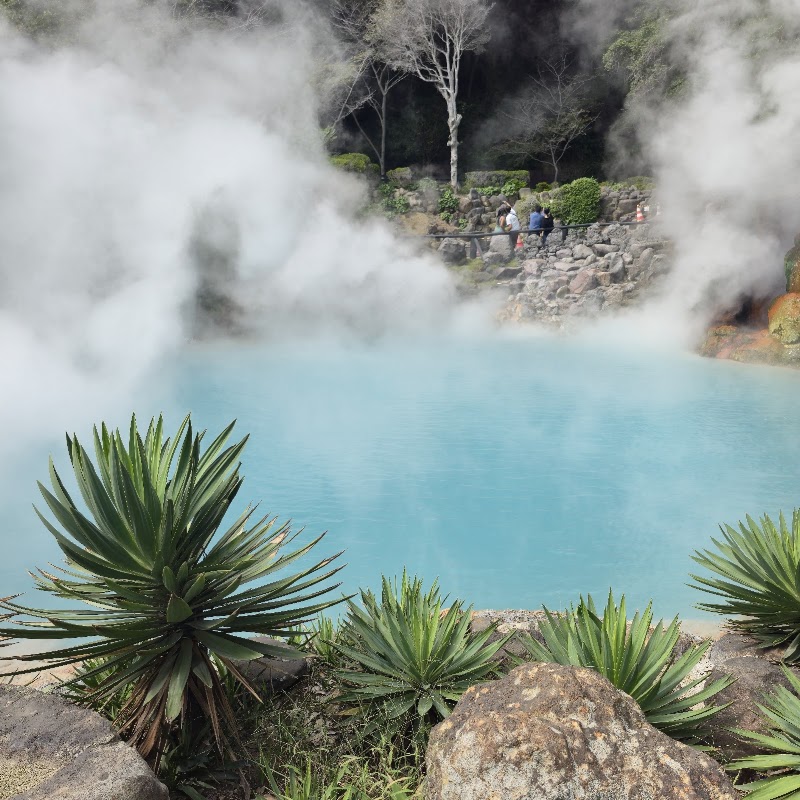
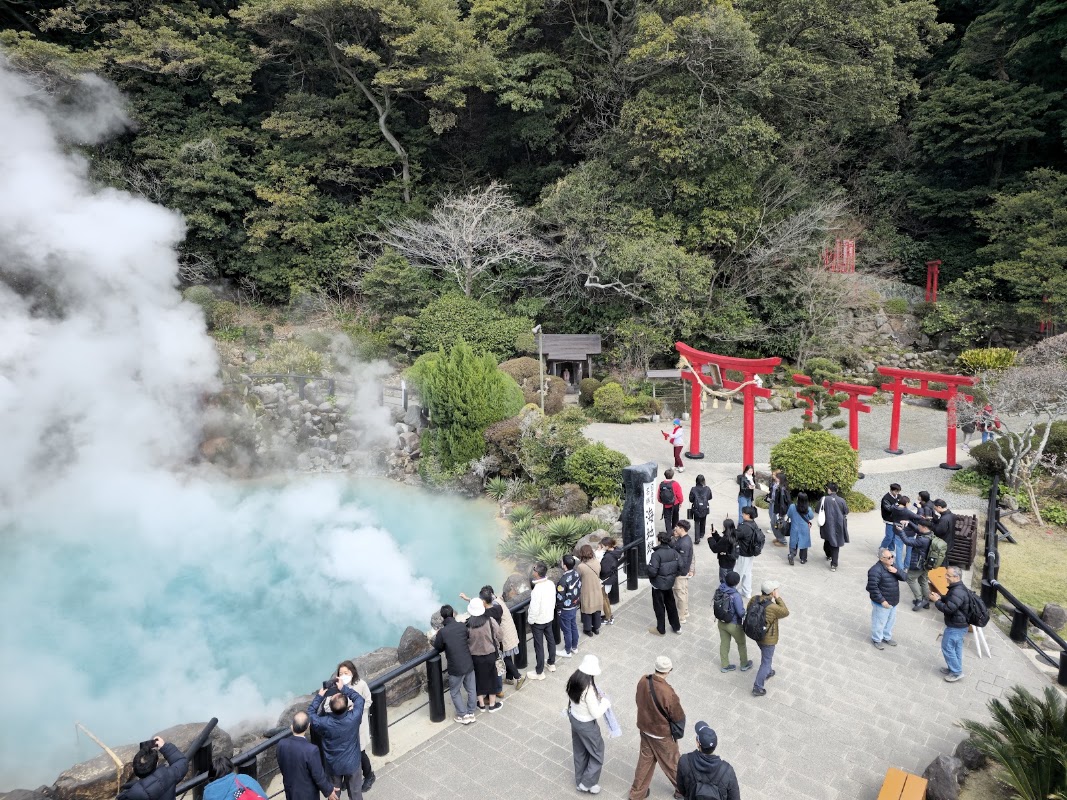
‘Umi Jigoku’ (Sea Hell) boasts the largest area and overwhelming popularity among Beppu’s Hell Tours. Stepping onto the grounds, beyond the thick white steam rising, a beautiful cobalt blue pond appears, resembling a tropical sea. While it looks cool and ethereal, the surprising fact that 98-degree Celsius hot water bubbles up beneath is captivating. This vivid blue color is a natural miracle, created by the dissolved iron sulfate components in the hot spring water.
Umi Jigoku began its journey as a tourist attraction in 1910. At that time, the founder purchased the land, which had been left abandoned as an ominous hot spring pond, and developed it into a beautiful garden. As people passing by were so captivated by its beauty, they began to offer coins as a blessing, and thus it developed into a famous spot – a fascinating piece of history.
Beyond the stunning scenery, there are plenty of other highlights. The greenhouse cultivating giant Amazonian water lilies (Victoria amazonica), using geothermal heat, offers a rich tropical atmosphere. There’s also a spacious footbath within the garden, where you can relax your tired feet while gazing at the blue water (bringing your own towel is recommended, but you can also purchase one on-site). And you absolutely must try the ‘Gokuraku Manju’ (Hell Steamed Buns) and ‘Jigoku Mushi Pudding’ (Hell-Steamed Pudding), which are deliciously steamed to perfection using the hot spring’s vapor. It’s a spot guaranteed to satisfy both your eyes and your taste buds.
Oniyama Jigoku (Demon Mountain Hell)
📍 Address: 625 Kannawa, Beppu, Oita 874-0041, Japan
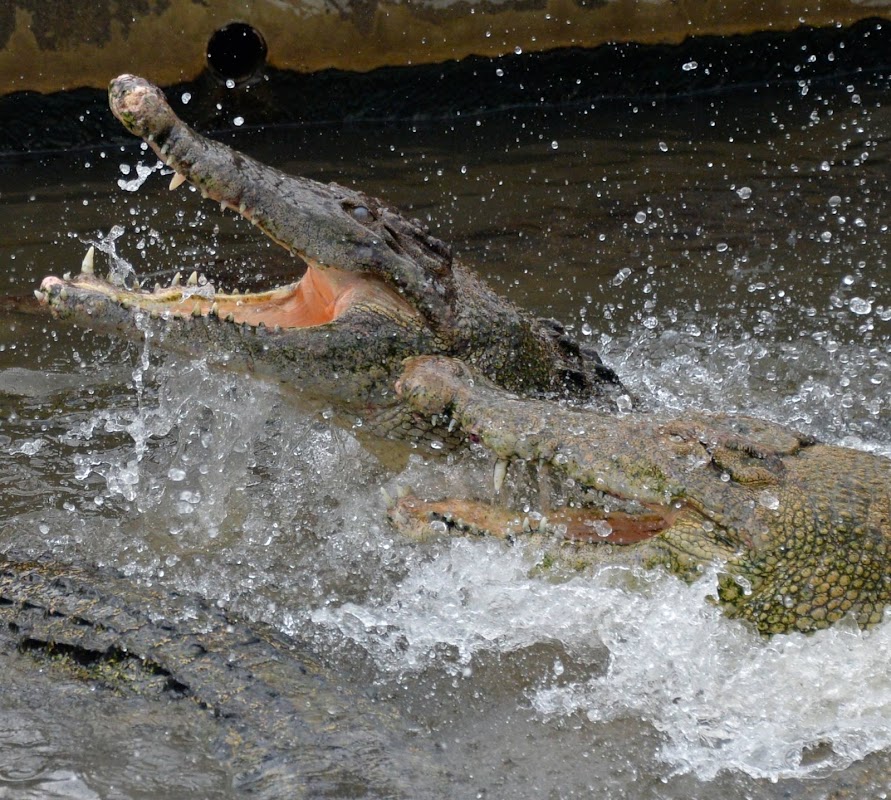
‘Oniyama Jigoku’ (Demon Mountain Hell) is a unique spot, also known as ‘Crocodile Hell,’ that stands out among the other Hell Tours. Upon entering the park, amidst the intense steam, countless crocodiles silently lurk in vast pools utilizing the hot spring water. There are approximately 80 crocodiles in total. Why are there crocodiles in a hot spring town? Because in 1923, this was the first place in Japan to start ‘crocodile breeding using hot spring heat.’ This idea, conceived by the founder who transported crocodiles all the way from Osaka to differentiate it from other ‘hells,’ successfully became a Beppu specialty.
Ordinarily, the crocodiles leisurely bask in the sun, hardly moving as they surrender to the warmth of the hot spring. But seen up close, their sheer size and sharp gaze are overwhelming. It is absolutely forbidden to put your smartphone, camera, or hands into the enclosure. Please observe safely and follow the rules.
Furthermore, feeding times, held on weekends and other occasions, are incredibly powerful. The crocodiles, usually calm, suddenly leap towards chunks of meat, creating a theme park-level spectacle. The facility also exhibits a massive taxidermy specimen of ‘First Ichiro,’ a crocodile that once lived here, holding the world record for longevity at 73 years old with a body length of approximately 4.8 meters. It’s a perfect place for travelers seeking a slightly unusual experience.
Kokonoe ‘Yume’ Grand Suspension Bridge
📍 Address: 1208 Tano, Kokonoe-machi, Kusu-gun, Oita 879-4911, Japan
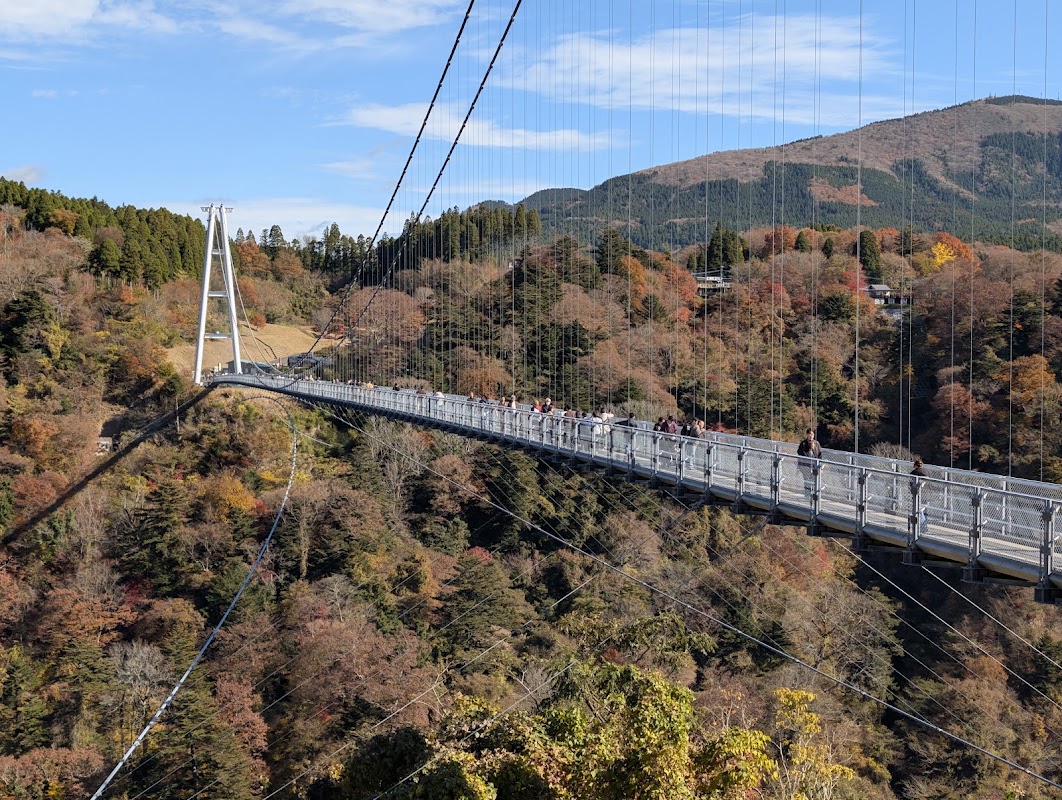
For travelers eager to fully experience Oita’s vast nature and thrill, we highly recommend the ‘Kokonoe ‘Yume’ Grand Suspension Bridge,’ a pedestrian-only suspension bridge suspended at an altitude of 777m. Its impressive scale, 390m long and 173m high, is truly breathtaking. The middle section of the bridge has a mesh floor, and looking down, you can see the primeval forest of the Narukogawa Valley flowing far below. While the bridge itself is sturdy and doesn’t sway, it is fully exposed to strong winds, which might be a heart-stopping experience for those with acrophobia.
However, beyond that thrill awaits a 360-degree panoramic vista. Below, the majestic ‘Shindo Falls’ (Male and Female Falls), selected as one of Japan’s Top 100 Waterfalls, cascades powerfully, and in the distance, you can gaze upon the magnificent ‘Kuju Mountain Range.’ The scenery changes with the seasons; the brilliance of fresh greenery and the fiery colors of autumn foliage are especially beautiful, offering new and deep impressions with every visit.
As a point of caution, the bridge’s width is just enough for people to pass each other, so generally keep to the left. Also, on rainy days, umbrellas are not permitted for safety, so raincoats must be worn (available for purchase at shops nearby). Strong winds or bad weather might obscure the view, so it’s best to aim for a clear day. After crossing the bridge, there’s a small shrine dedicated to a white snake and other attractions, making it a special place where you can take a deep breath amidst grand nature.
Harajiri Falls
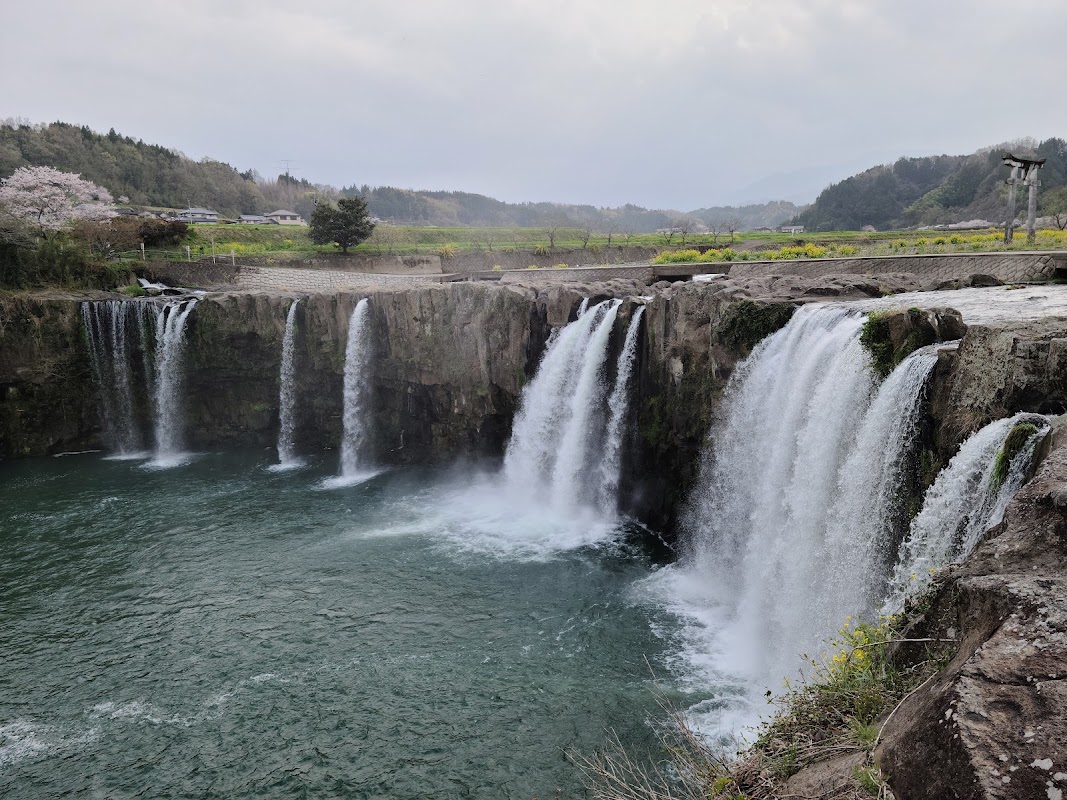
📍 Address: 410 Harajiri, Ogata-machi, Bungoono, Oita 879-6631, Japan
‘Harajiri Falls’ is a mysteriously grand waterfall that suddenly appears in a serene rural landscape. With a width of 120m and a drop of 20m, its spectacular view, where water powerfully cascades in an arc, has earned it titles like the ‘Niagara of the East’ and ‘Oita’s Niagara,’ and it is also selected as one of Japan’s Top 100 Waterfalls. This unique topography was formed over an unimaginably long period by river erosion of ‘welded tuff,’ which solidified from a massive pyroclastic flow caused by the great eruption of Mt. Aso approximately 90,000 years ago.
The greatest charm of this waterfall lies in its ‘excellent accessibility’ and ‘approachability,’ which are surprising for what seems like a remote waterfall. You don’t need to hike for hours through the mountains; simply park your car in the spacious parking lot of the adjacent ‘Michi-no-Eki Harajiri no Taki’ (Harajiri Falls Roadside Station), and you’ll encounter the stunning view almost immediately. A wooden suspension bridge called ‘Takimi Bridge’ (Waterfall Viewing Bridge) downstream and a submersible bridge upstream allow for a circular route around the falls. You can look down on the moment the water plunges from directly above, or descend right next to the basin to be fully enveloped by spray and negative ions.
After your stroll, it’s recommended to savor Oita’s famous local cuisine at the roadside station or browse for souvenirs. The water volume changes with the weather, so after rain, you might witness an even more powerful display. It’s a highly satisfying scenic spot where you can feel the dynamic history of nature.
Local Tips to Enjoy Oita Sightseeing 120%
Oita Prefecture’s tourist attractions are broadly divided into lively urban areas like Beppu Onsen and mountainous areas with vast nature such as Kokonoe and Bungoono. To efficiently visit these famous spots within a limited travel schedule, utilizing a rental car is overwhelmingly convenient. While Beppu’s Hell Tours themselves can be fully enjoyed by local bus and on foot, extending your trip to the Grand Suspension Bridge or Harajiri Falls makes car travel the key to minimizing time loss.
Also, a little preparation for clothing and belongings is necessary. Around the Hell Tours, temptations of footbaths await at various spots, so it’s a rule of thumb to carry easy-to-remove shoes and a hand towel in your bag. On the other hand, areas around the Grand Suspension Bridge and waterfalls are often at higher altitudes than urban areas or are more susceptible to splashes and strong winds, so it’s reassuring to bring a light jacket that can be worn even in summer. By pondering a little about the local history and the formation of the land as you walk, your Oita trip will gain much more depth, leading to more profound memories.


'%3E%3Cpath%20stroke='%23000'%20stroke-width='4'%20d='m-35-37-13%2020m5%203%2013-20m5%203-13%2020m63%2042%206-9m1-2%206-9m5%203-6%209m-1%202-6%209m5%203%206-9m1-2%206-9m-96%200%2013%2020m5-3-6-9m-1-2-6-9m5-3%2013%2020m63-42-6-9m-1-2-6-9m5-3%2013%2020m5-3-6-9m-1-2-6-9'/%3E%3Ccircle%20r='24'%20fill='%23cd2e3a'/%3E%3Cpath%20fill='%230047a0'%20d='M0%200a12%2012%200%201%201%2020%2013%2024%2024%200%201%201-40-26A12%2012%200%201%200%200%200'/%3E%3C/g%3E%3C/svg%3E)
'/%3E%3Cpath%20fill='%23b2b2b2'%20d='M241%20382q0%2016%2017%2026%2017%2011%2042%2011t42-11q16-11%2017-26V269H241'/%3E%3Cpath%20fill='%239f7e00'%20d='M241%20379q0%2014%208%2023%209%209%2021%209%2014%200%2021-9%209-9%209-23V269h-59'/%3E%3Cpath%20d='M241%20339v-70h59v110q0%2014-9%2023l-6%205v-68h-15v72q-8%200-14-4v-68zm59%2040c0%2022%2015%2032%2029%2032%2021%200%2030-18%2030-32v-40h-59'/%3E%3Cpath%20fill='%239f7e00'%20d='M266%20277v5h2v12h-3v-5h2v-5h-9v5h2v5h-4v9h3v18h-5v10h34v-10h-5v-18h3v-9h-4v-5h2v-5h-9v5h2v5h-3v-12h2v-5zm42%20101q0%2010%206%2017%206%206%2015%207%2010-1%2016-7%206-7%206-17v-29h-43'/%3E%3Ccircle%20fill='%230044ad'%20cx='329.5'%20cy='372'%20r='6'/%3E%3Cellipse%20fill='%230044ad'%20cx='300'%20cy='340'%20rx='16'%20ry='21'/%3E%3C/svg%3E)


