

Fukuoka Prefecture is a tourist area brimming with diverse attractions, from historical landmarks to modern scenic spots and exotic port towns.
This article provides real, ‘truly wanted’ information for all visitors, whether you’re on a short trip or looking to explore in depth. Even for classic tourist spots, knowing the best times to visit, the deep insights only found there, and local gourmet specialties can significantly elevate your travel satisfaction.
This time, we’ve carefully selected some of the most highly recommended spots among Fukuoka Prefecture’s leading tourist attractions. Let’s embark on the ultimate Fukuoka journey, fully immersing ourselves in the local atmosphere!
Dazaifu Tenmangu Shrine
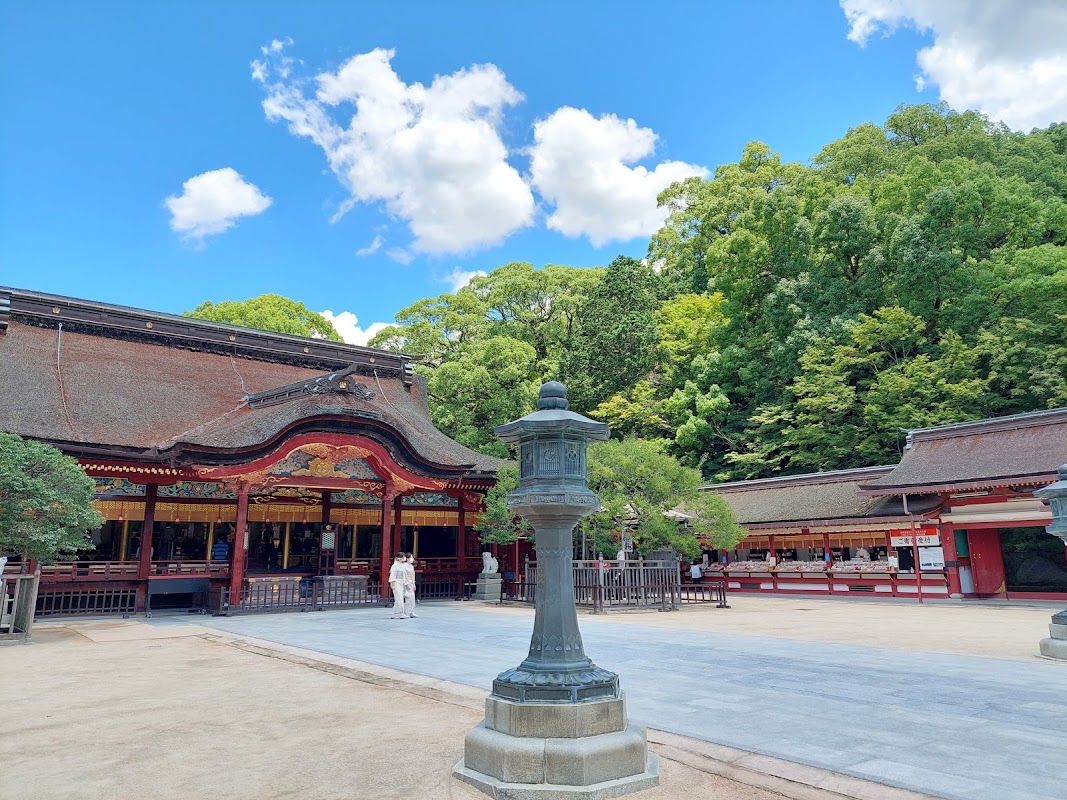
📍 Address: 4 Chome-7-1 Saifu, Dazaifu, Fukuoka 818-0117, Japan
Dazaifu Tenmangu Shrine is the head shrine of approximately 12,000 Tenmangu shrines nationwide, dedicated to Sugawara no Michizane (Tenjin-sama), the deity of scholarship. It’s not only a sacred place for students taking exams but also one of Kyushu’s premier power spots, attracting many travelers throughout the year.
Currently, the main hall, a National Important Cultural Property, is undergoing its ‘Great Heisei Restoration,’ the first in 124 years, and is covered by a curtain. However, there’s no need to be disappointed. The temporary sanctuary, ‘Kari-den,’ erected in front of the main hall for approximately three years, is breathtakingly magnificent. Designed by architect Sou Fujimoto, this temporary hall features real plants and trees planted on its roof, creating an unprecedented beauty that resembles a small forest floating in the sky. Inspired by the ‘Flying Plum Legend,’ where Michizane’s beloved plum tree flew overnight from Kyoto, its divine appearance, a perfect harmony of traditional shrine architecture and contemporary art, is a miraculous sight that can only be seen now.
Before and after your visit, a gourmet stroll along the lively approach is a must. The savory aroma of the famous ‘Umegae Mochi’ fills the air, and freshly baked mochi enjoyed with matcha at an old teahouse has a crispy exterior and a hot, chewy red bean paste filling. Its elegant sweetness will soothe your tired body. Since the baking method and sweetness subtly vary by shop, a connoisseur’s way to enjoy it is to try several and find your favorite. Also, it’s said that wisdom is bestowed upon those who stroke the head of the ‘Goshinyu’ (Sacred Ox) statue on the shrine grounds, and the smooth, gleaming ox statue, polished by countless hands, is also a must-see.
As one of Japan’s top tourist destinations, the key to a comfortable visit lies in ‘time management.’ After 11 AM, school trip students and inbound tour buses start arriving one after another, leading to heavy crowds on the approach and within the shrine grounds. If you wish to experience a quiet, sacred atmosphere and take photos leisurely, we strongly recommend arriving at the shrine grounds ‘before 10 AM,’ when parking is still readily available. If you can stay overnight in Dazaifu, visiting right after the gates open at 6:30 AM or for a formal nighttime visit enveloped in silence would be a supremely deep experience.
Fukuoka Tower
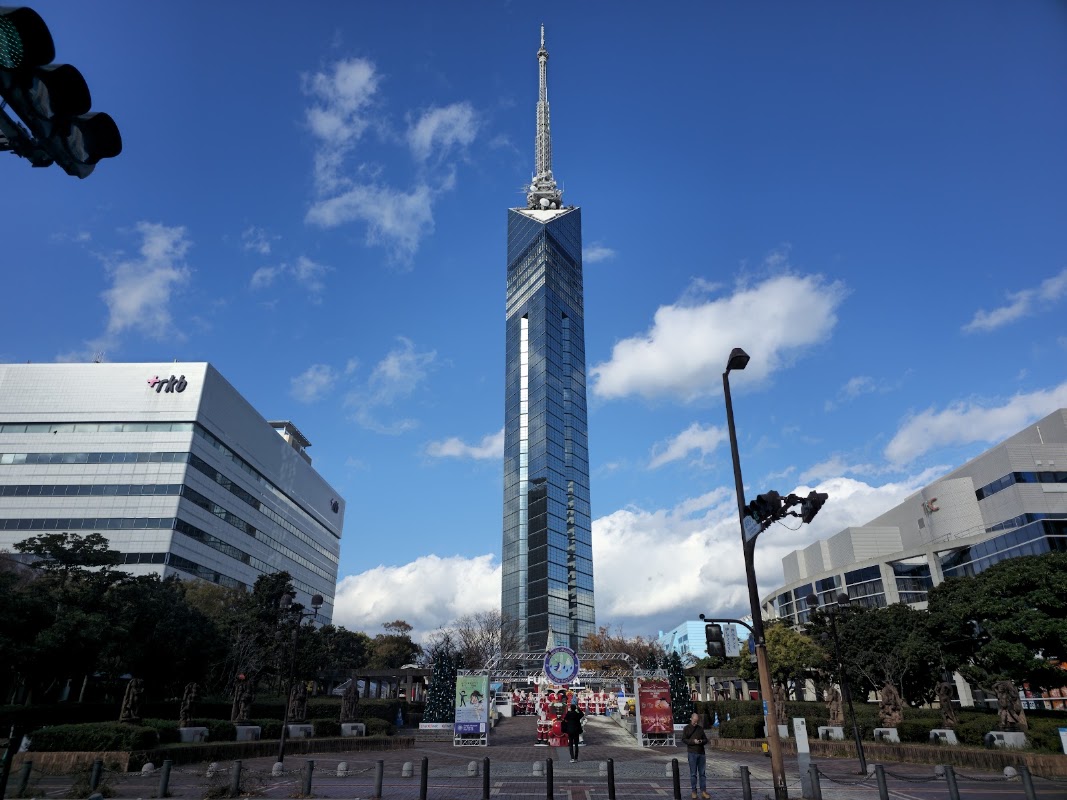
📍 Address: 2 Chome-3-26 Momochihama, Sawara Ward, Fukuoka 814-0001, Japan
Soaring in Fukuoka City’s sub-center, the Seaside Momochi area, Fukuoka Tower boasts Japan’s tallest seaside tower at 234 meters. Its exterior is a sharp, triangular design covered by 8,000 half-mirrors, affectionately known as the ‘Mirror Sail’ (a shining mirror sail). On clear days, it brilliantly pierces the blue sky, and at night, it displays seasonal illuminations (like the Milky Way or Christmas trees) like a giant screen, exuding an overwhelming presence even from the outside.
Take an elevator straight up to ‘SKY View 123,’ the top observation deck at 123 meters above ground. The moment the doors open, a breathtaking 360-degree panorama of blue sky and sea merging into one unfolds before your eyes. To the north, you’ll see Nokonoshima and Shikanoshima islands floating in Hakata Bay; to the east, the urban areas of Tenjin and Hakata; and to the south, the lush green Sefuri Mountains. You’ll truly feel that Fukuoka is a beautiful place where ‘sea, mountains, and city are compactly integrated.’ Both adults and children are sure to be thrilled by the view, which resembles an elaborate diorama.
The observation floor is a three-tiered structure. After enjoying the scenery, you can relax at a scenic cafe on the floor below. The floor below that (Observation Floor 1) is recognized as a ‘Lover’s Sanctuary,’ filled with romantic and Instagrammable photo spots, including a heart-shaped flower arch and a ‘Fence of Vows’ where couples can attach padlocks to pledge eternal love.
As advice for travelers, if you want to leisurely enjoy the scenery and take photos, aim for the early hours, around 9:30 AM, right after opening. International tourists tend to increase towards noon. Also, the twilight hours, when Hakata Bay is dyed in an evening glow before transforming into the sparkling city nightscape, selected as one of Japan’s ‘Top 100 Night Views,’ offer a truly breathtaking experience. While it’s a bit of a distance from the subway station, there are plenty of bus routes from the base of the tower to various parts of the city, so enjoying a unique Fukuoka bus ride to access it is also a good option.
Mojiko Retro
📍 Address: 9 Minatomachi, Moji Ward, Kitakyushu, Fukuoka 801-0852, Japan
Facing the Kanmon Strait, which separates Honshu and Kyushu, ‘Mojiko Retro’ is a highly popular area brimming with exotic charm, preserving the vestiges of its prosperity as an international trading port from the Meiji to early Showa periods. As you walk through the town, historical buildings evoking Taisho Roman, such as the brick-built Old Mojiko Customs House and the Old Moji Mitsui Club, where Albert Einstein once stayed, continuously catch your eye. Many places don’t charge an admission fee, and the scenery, as if you’ve time-slipped, is picturesque from every angle.
One local delicacy that travelers to Mojiko absolutely must not miss is ‘Yakicurry’ (baked curry). This soul food originated here, where Western culinary culture quickly took root due to the area’s prosperity as a trading port. It’s a dish of hot curry topped with cheese and egg, then baked until golden in an oven. Dozens of yakicurry restaurants cluster around the station and Kaikyo Plaza, offering a rich variety from authentic spicy versions to those topped with seafood. Many popular eateries have long queues during lunchtime, so if you have a specific restaurant in mind, it’s advisable to make a reservation or visit slightly outside peak hours.
One of the highlights is the ‘Blue Wing Moji,’ a rare pedestrian drawbridge in Japan, stretching 108 meters. Six times a day, the bridge slowly opens and closes to music, offering a must-see spectacle. There’s also a romantic superstition that ‘the first couple to cross the bridge immediately after it closes will be bound together forever,’ making it a popular spot for lovers.
To enjoy the area more deeply, we highly recommend accessing it by ‘train.’ JR Mojiko Station, built in the Neo-Renaissance style, is Japan’s first active station building to be designated a National Important Cultural Property. The moment you step onto the platform, a retro atmosphere permeates the air, heightening your travel mood. Furthermore, from dusk into night, the Western-style buildings are illuminated in orange, and combined with the lights from the opposite shore of the Kanmon Strait (Shimonoseki), an unbelievably fantastical night view unfolds. You can enjoy a sophisticated, adult atmosphere, a stark contrast to the daytime bustle.
Akizuki Castle Town Important Preservation District for Groups of Historic Buildings
📍 Address: Akizuki, Asakura, Fukuoka 838-0011, Japan
About an hour’s drive from central Fukuoka City, nestled amidst rich nature and mountains in Asakura City, ‘Akizuki Castle Town’ is an ultimate healing spot dubbed ‘Chikuzen’s Little Kyoto.’ It is Fukuoka Prefecture’s only area designated as a National ‘Important Preservation District for Groups of Historic Buildings,’ where moss-covered stone walls, waterways, samurai residences, and abundant trees beautifully harmonize, enveloping you in a tranquility and charm as if time has stopped since the Edo period.
The heart of your stroll will be ‘Suginobaba Street,’ where samurai once practiced horsemanship. Teahouses, souvenir shops, and antique stores line both sides of the road, making every step exciting. A must-try here are sweets made from Akizuki’s famous ‘Kuzu’ (arrowroot starch). At long-established teahouses, some operating for over half a century, you can enjoy exquisitely clear Kuzumochi and Kuzukiri made with pristine water; their smooth texture and refined sweetness will melt away your travel fatigue. Furthermore, local dishes made with ‘Kawatake’ (freshwater nori), a precious freshwater seaweed found only around Asakura, are deep local gourmet experiences unique to this area.
This town reveals entirely different expressions with each passing season. In spring, approximately 200 cherry trees planted along Suginobaba burst into bloom simultaneously, creating a breathtaking ‘cherry blossom tunnel’ stretching about 500 meters. Summer offers a refreshing coolness, with freshwater crabs appearing in the waterways, and autumn paints the entire town in fiery crimson foliage. This space, allowing you to completely forget the hustle and bustle of the city, is strongly recommended for adult travelers who enjoy leisurely strolls with a camera in hand.
Akizuki Castle Ruins
📍 Address: 663 Akizukinocho, Asakura, Fukuoka 838-0011, Japan
Further along Suginobaba in Akizuki Castle Town lies the ‘Akizuki Castle Ruins.’ This is the site of a small jinya-style castle built in the early Edo period by Nagahisa, the third son of Kuroda Nagamasa, the lord of the Fukuoka Domain. The remaining stone walls and nagaya-mon (long gatehouse) quietly tell the story of the former domain’s rule.
The most profound and ’emotional’ aspect of the Akizuki Castle Ruins is the fact that Akizuki Junior High School, still active today, stands on the site of the former Omote-goten (main palace/government office). The retro wooden school building, visible beyond the ‘Kawarasaka’ (tile slope) laid with tiles to prevent landslides, is perfectly integrated into the historical landscape, evoking such nostalgia that one might envy the students who get to study in such a place.
A symbol of the castle ruins is the ‘Kuromon’ (Black Gate), located on the approach to Suiyo Shrine, which enshrines Kuroda Nagahisa. Originally the main gate of Akizuki Castle, it was relocated and is now a Prefecturally Designated Tangible Cultural Property. The contrast between the lustrous black, imposing gate and the surrounding nature is breathtakingly beautiful. Especially during the autumn foliage season from late November to early December, the maple leaves around the Kuromon turn crimson, making it Akizuki’s number one photo spot, enjoying immense popularity.
For travelers, here’s important practical information regarding parking and crowd management. The public parking lot (400 yen for regular cars) along Suginobaba offers excellent access, but during peak seasons for cherry blossoms or autumn leaves, the narrow, single-lane roads in the vicinity can become heavily congested, leading to considerable time spent just reaching the parking lot. In such cases, a smart trick to save time is to actively aim for private or temporary parking lots (around 300 yen) located slightly off the main street. Also, public restrooms can get crowded, so it’s advisable to use clean facilities like the Akizuki Museum before your stroll, or explore the castle ruins after learning about its history at the museum to gain a deeper appreciation for each stone wall and experience a more profound sense of wonder.
How to Enjoy Your Fukuoka Trip 120%
Fukuoka Prefecture’s tourist attractions are characterized by their vastly different atmospheres in each area. Feel the power of history and mystery in the Dazaifu area, enjoy modern scenic beauty at Momochihama (Fukuoka Tower) in Fukuoka City, savor Taisho Roman and port town gourmet in Kitakyushu (Mojiko), and immerse yourself in the tranquility of nature-rich ‘Little Kyoto’ in Asakura (Akizuki). Each boasts its own strong, independent charm.
To navigate efficiently, it’s crucial to calculate travel times between areas. While Fukuoka Prefecture has a highly developed public transportation system, if you plan to extend your trip to mountain-ringed attractions like Akizuki, renting a car offers greater freedom and makes it easier to visit hidden gems and hot springs in the surrounding areas.
Furthermore, since all these spots are nationally renowned and popular tourist destinations, avoiding peak hour crowds will significantly impact the comfort of your trip. Simply adhering to basic rules like ‘starting your activities early in the morning’ and ‘visiting popular restaurants outside of peak hours’ will allow you to more deeply engrave the sacred atmosphere and retro charm of the locations as a personal experience. Please use this article as a guide to enjoy your own special Fukuoka journey to the fullest.


'%3E%3Cpath%20stroke='%23000'%20stroke-width='4'%20d='m-35-37-13%2020m5%203%2013-20m5%203-13%2020m63%2042%206-9m1-2%206-9m5%203-6%209m-1%202-6%209m5%203%206-9m1-2%206-9m-96%200%2013%2020m5-3-6-9m-1-2-6-9m5-3%2013%2020m63-42-6-9m-1-2-6-9m5-3%2013%2020m5-3-6-9m-1-2-6-9'/%3E%3Ccircle%20r='24'%20fill='%23cd2e3a'/%3E%3Cpath%20fill='%230047a0'%20d='M0%200a12%2012%200%201%201%2020%2013%2024%2024%200%201%201-40-26A12%2012%200%201%200%200%200'/%3E%3C/g%3E%3C/svg%3E)
'/%3E%3Cpath%20fill='%23b2b2b2'%20d='M241%20382q0%2016%2017%2026%2017%2011%2042%2011t42-11q16-11%2017-26V269H241'/%3E%3Cpath%20fill='%239f7e00'%20d='M241%20379q0%2014%208%2023%209%209%2021%209%2014%200%2021-9%209-9%209-23V269h-59'/%3E%3Cpath%20d='M241%20339v-70h59v110q0%2014-9%2023l-6%205v-68h-15v72q-8%200-14-4v-68zm59%2040c0%2022%2015%2032%2029%2032%2021%200%2030-18%2030-32v-40h-59'/%3E%3Cpath%20fill='%239f7e00'%20d='M266%20277v5h2v12h-3v-5h2v-5h-9v5h2v5h-4v9h3v18h-5v10h34v-10h-5v-18h3v-9h-4v-5h2v-5h-9v5h2v5h-3v-12h2v-5zm42%20101q0%2010%206%2017%206%206%2015%207%2010-1%2016-7%206-7%206-17v-29h-43'/%3E%3Ccircle%20fill='%230044ad'%20cx='329.5'%20cy='372'%20r='6'/%3E%3Cellipse%20fill='%230044ad'%20cx='300'%20cy='340'%20rx='16'%20ry='21'/%3E%3C/svg%3E)


