

Special Historic Site Ritsurin Garden
📍 Address: 1-20-16 Ritsurincho, Takamatsu, Kagawa 760-0073, Japan
Located in Takamatsu, Kagawa Prefecture, ‘Ritsurin Garden’ boasts the largest area among cultural property gardens in Japan. It’s a daimyo garden that earned a top three-star rating from the Michelin Green Guide Japan, signifying it’s ‘worth a special journey.’ Completed over nearly a century by the feudal lords of the Takamatsu Matsudaira family in the early Edo period, the garden’s charm lies in its ‘Issho Ikkei’ beauty, where the scenery changes with every step you take. Its varied terrain, meticulously designed waterscapes, and the borrowed scenery of the majestic Mt. Shiun in the background are harmoniously blended, captivating travelers worldwide.
To experience the garden more deeply, the ‘Southern Lake Cruise on a Japanese Boat’ is an absolute must. Listening to the witty commentary of the boatman while admiring the garden from the lake for about 30 minutes will surely make you feel like a feudal lord. As this is very popular, we highly recommend making a reservation in advance on the official website or similar channels once your visit date is decided (if there are vacancies, tickets can also be purchased on the day from 8:30 AM at the boarding ticket counter).
Furthermore, a useful insider tip for travelers is to ‘visit in the early morning.’ Ritsurin Garden opens as early as 5:30 AM during summer (June-August). The tranquil morning garden, free from crowds, is filled with refreshing air and is perfect for a leisurely stroll and taking photos in the cooler hours. The ponds in the garden are home to many friendly koi, and it’s also fun to buy puffed wheat at the shop and feed them. Despite being a garden of immense value, the admission fee is less than one coin (410 yen for adults), an incredible cost-performance that speaks to Kagawa Prefecture’s generosity.
Kotohira-gu Shrine (Konpira-san)
📍 Address: 892-1 Kotohira, Nakatado District, Kagawa 766-8501, Japan
Kotohira-gu Shrine, affectionately known as ‘Konpira-san,’ has long been revered as the guardian deity of the sea, attracting worshippers from all over Japan with the saying, ‘One must visit Konpira-san at least once in their lifetime.’ For travelers, the main highlight and challenge is its exceedingly long stone stairway. The journey involves 785 steps to the main sanctuary (Hongu), and a total of 1,368 steps if you continue further to the inner sanctuary (Okusha).
The initial ascent is enjoyable, with souvenir shops and udon restaurants lining both sides of the path, but the incline becomes steeper in the latter half, with the final 100 steps being particularly challenging. This makes the sense of accomplishment all the more special when you reach the Hongu and behold the magnificent panoramic view of the Sanuki Plain and the charming silhouette of Mt. Sanuki Fuji. For those confident in their physical stamina, we recommend extending your journey to the tranquil Okusha to obtain a unique amulet available only there. It’s worth noting that the descent can be harder on the knees than the ascent, so renting a walking stick (around 100 yen) from a shop at the approach entrance is a smart move to enjoy your trip with a smile until the very end.
And the ultimate motivation for climbing Konpira-san is the ‘Cafe & Restaurant Kamitsubaki,’ operated by Shiseido Parlour, located exactly at the 500th step. Offered on an open terrace surrounded by the sacred greenery, the ‘Kamitsubaki Parfait’ is an exquisite Japanese parfait topped with Kagawa’s colorful celebratory sweets ‘Oiri,’ matcha ice cream, and warabimochi. Its refined sweetness, permeating your tired body, is truly the best reward for those who’ve conquered the stone steps. Setting this as your goal should make your steps naturally lighter.
Angel Road
📍 Address: 24-92 Ko, Tonosho, Shodo-gun, Kagawa 761-4101, Japan
Angel Road is a romantic and spectacular spot representing Shodoshima Island in the Seto Inland Sea. It’s a mysterious place where, twice a day, a sandy path emerges from the sea for about two hours around low tide, allowing you to walk across to the opposite island of Yoshima. There’s a romantic saying that ‘if you cross holding hands with a loved one, your wishes will come true,’ making it a popular spot for photo weddings.
A crucial tip for visiting is to always check the ‘tide chart’ in advance. Since you’ll only see the sea at high tide, your travel schedule needs to be planned around the low tide times. Also, as you’ll be walking on sand saturated with seawater, it’s best to bring sandals or slippers that can get wet and are easy to rinse off. Visiting in sneakers might lead to regret.
If the weather is good, not only is the contrast of the blue sea and sky beautiful during the day, but the beauty of the sunset, dyed in orange, is also breathtaking. From the ‘Yakusoku no Oka Observatory’ (Promise Hill Observatory) nearby, you can take photos of Angel Road from a splendid vantage point overlooking it. Regarding parking, the nearest Parking Lot No. 1 is paid, but there are free parking lots a little further away, so arriving with ample time and using a free parking lot is a smart choice.
Marugame Castle
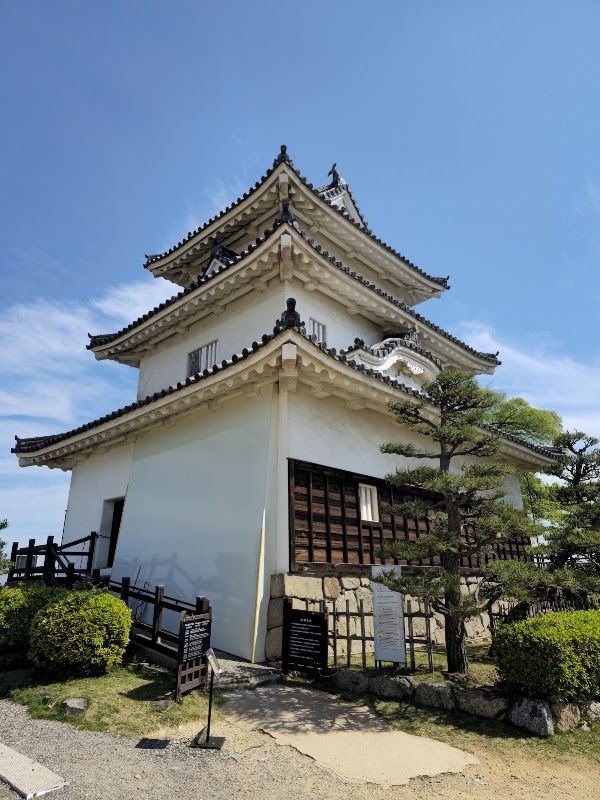
📍 Address: Ichibancho, Marugame, Kagawa 763-0025, Japan
Built on Mt. Kameyama, 66 meters above sea level, in the middle of the Marugame Plain, ‘Marugame Castle’ is a magnificent fortress boasting two ‘Japan’s Best’ features that impress even those not typically keen on castles. First is its ‘tallest stone walls in Japan.’ Reaching a total height of approximately 60 meters, these stone walls exhibit elegant curves known as ‘Ogi-no-Kobai’ (fan slope), becoming steeper towards the top. Their overwhelming scale is so powerful that looking up from below can make your legs tremble. The other ‘Japan’s Best’ is the ‘smallest existing wooden keep in Japan,’ perched atop the huge, sturdy stone wall fortress. This imbalance, with a charming keep of about 15 meters in height sitting on such massive foundations, gives it a unique charm not found in other castles.
The biggest challenge to enjoying Marugame Castle is the steep slope called ‘Mikaeri-zaka’ (Looking Back Slope). Named because ‘the slope is so steep it makes you involuntarily stop and look back,’ this path is so challenging that local high school students use it for training. When visiting, be sure to wear comfortable sneakers and take breaks as you ascend. Along the way, contemplating the slightly eerie legend of the Ninomaru Well, said to be ‘Japan’s deepest’ at approximately 65 meters, adds to the thrill of exploring history.
The reward for conquering the steep slope and reaching the main bailey (Honmaru) is a grand panorama overlooking Marugame city, the Seto Inland Sea, the magnificent Seto Ohashi Bridge, and even Mt. Sanuki Fuji. It is one of Kagawa’s premier scenic spots, where a refreshing breeze blows through, beautiful in any season, not just during spring cherry blossoms or fresh greenery.
Zenigata Sunae (Kan’ei Tsūhō Coin Sand Art)
📍 Address: 14 Ariakecho, Kanonji, Kagawa 768-0062, Japan
The enormous ‘Zenigata Sunae (Kan’ei Tsūhō)’ sand art drawn on Ariakehama Beach in Kanonji City is Kagawa Prefecture’s strongest power spot for financial fortune, with a legend that ‘seeing this sand art grants health, longevity, and freedom from financial worries.’ Believed to have been created overnight by the local populace to welcome their feudal lord during the Edo period, this sand art boasts an incredible scale of 122m east-west, 90m north-south, and a circumference of 345m. Its beautiful form is maintained to this day through ‘suna-zarae’ (sand sweeping) by citizen volunteers.
While its immense size can be felt from the ground, the absolute best way to clearly see the entire picture is from the ‘Zenigata Observatory’ at the summit of the adjacent Kotohiki Park. It’s astonishing to learn that this sand art was actually designed in an elliptical shape to appear as a ‘perfect circle’ when viewed from the observatory. If you want to capture the sand art’s undulations (shading) more distinctly in photos, a visit from afternoon to evening, as the sun begins to set, is recommended.
As a further deep attraction, there’s a daily illumination from sunset until 10 PM. The giant Kan’ei Tsūhō coin, softly glowing with green light in the darkness, emits a completely different, fantastic, and mysterious atmosphere from during the day. The road to the observatory by car has steep, one-way hairpin turns, so please drive with caution. Taking a chance on its blessings and buying a lottery ticket after your visit could also become a fun memory of your trip.


'%3E%3Cpath%20stroke='%23000'%20stroke-width='4'%20d='m-35-37-13%2020m5%203%2013-20m5%203-13%2020m63%2042%206-9m1-2%206-9m5%203-6%209m-1%202-6%209m5%203%206-9m1-2%206-9m-96%200%2013%2020m5-3-6-9m-1-2-6-9m5-3%2013%2020m63-42-6-9m-1-2-6-9m5-3%2013%2020m5-3-6-9m-1-2-6-9'/%3E%3Ccircle%20r='24'%20fill='%23cd2e3a'/%3E%3Cpath%20fill='%230047a0'%20d='M0%200a12%2012%200%201%201%2020%2013%2024%2024%200%201%201-40-26A12%2012%200%201%200%200%200'/%3E%3C/g%3E%3C/svg%3E)
'/%3E%3Cpath%20fill='%23b2b2b2'%20d='M241%20382q0%2016%2017%2026%2017%2011%2042%2011t42-11q16-11%2017-26V269H241'/%3E%3Cpath%20fill='%239f7e00'%20d='M241%20379q0%2014%208%2023%209%209%2021%209%2014%200%2021-9%209-9%209-23V269h-59'/%3E%3Cpath%20d='M241%20339v-70h59v110q0%2014-9%2023l-6%205v-68h-15v72q-8%200-14-4v-68zm59%2040c0%2022%2015%2032%2029%2032%2021%200%2030-18%2030-32v-40h-59'/%3E%3Cpath%20fill='%239f7e00'%20d='M266%20277v5h2v12h-3v-5h2v-5h-9v5h2v5h-4v9h3v18h-5v10h34v-10h-5v-18h3v-9h-4v-5h2v-5h-9v5h2v5h-3v-12h2v-5zm42%20101q0%2010%206%2017%206%206%2015%207%2010-1%2016-7%206-7%206-17v-29h-43'/%3E%3Ccircle%20fill='%230044ad'%20cx='329.5'%20cy='372'%20r='6'/%3E%3Cellipse%20fill='%230044ad'%20cx='300'%20cy='340'%20rx='16'%20ry='21'/%3E%3C/svg%3E)


