

Naruto Whirlpools
📍 Address: Japan, 〒772-0000 Tokushima Prefecture, Naruto City
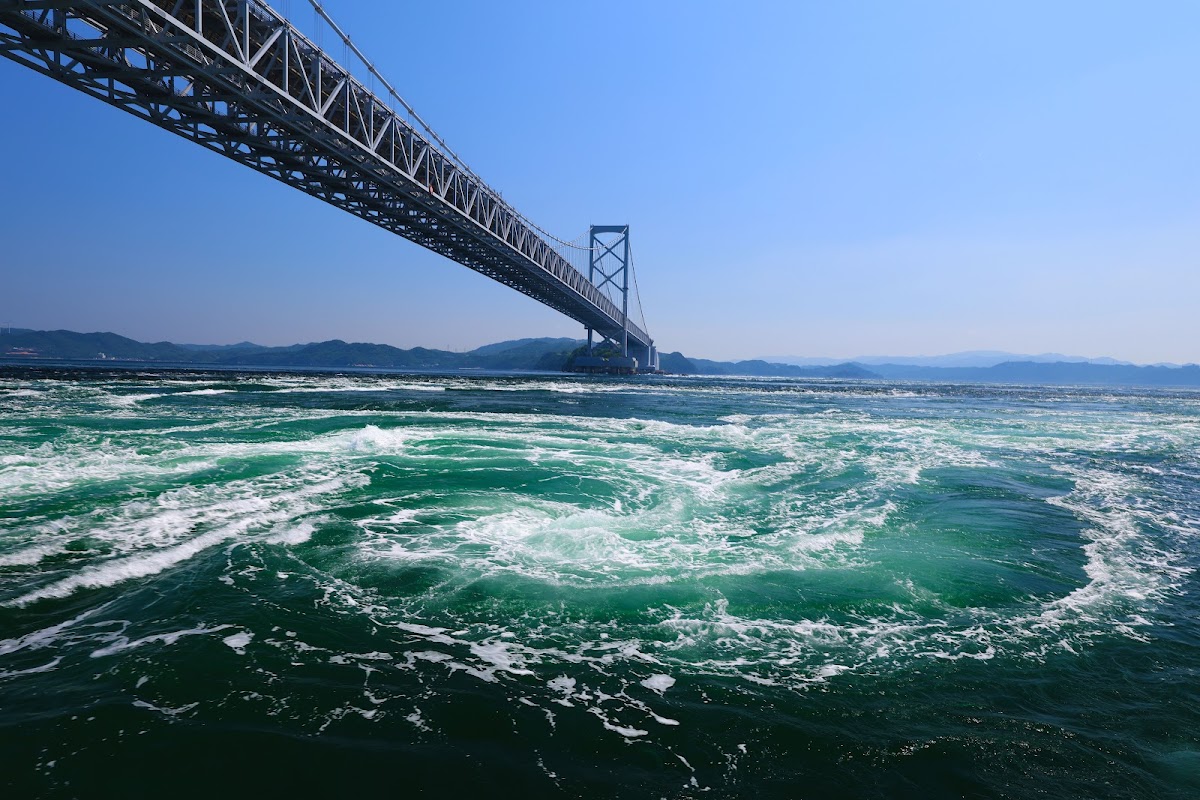
The undisputed highlight of Tokushima tourism is the ‘Naruto Whirlpools,’ boasting some of the largest whirlpools in the world. Formed by the intense tidal currents between the Seto Inland Sea and the Kii Channel, these colossal whirlpools can reach up to 20 meters in diameter during peak spring tides. Recognized as one of the ‘World’s Three Great Tidal Currents,’ alongside Italy’s Messina Strait and Canada’s Seymour Narrows, this natural phenomenon is breathtakingly powerful.
The biggest trap travelers often fall into is assuming they can see the whirlpools anytime they visit the sea. Since the whirlpools are generated by the ebb and flow of tides, you’ll only find a fast-flowing current if you miss the peak times of high or low tide. The most dramatic views occur 1 to 2 hours before and after the peak of a spring tide, but conditions vary daily due to nature’s unpredictability. It’s absolutely essential to check the tidal current table beforehand and aim for the best viewing window.
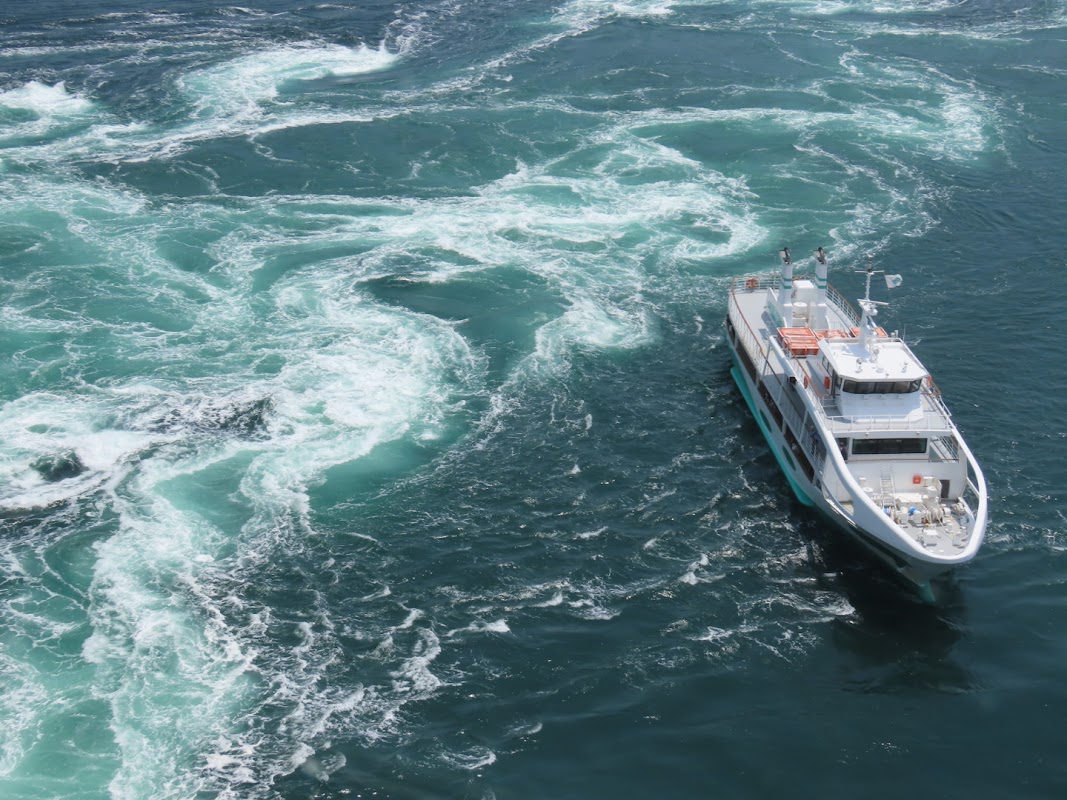
Furthermore, sightseeing boats that offer an up-close experience of the overwhelming power from sea level are extremely popular. During long holidays and peak spring tide seasons, it’s not uncommon for bookings to be full a month in advance. If you’re determined to take a ride, it’s wise to secure your tickets early once your travel dates are set, or consider booking a tour. Note that the walk from parking areas around Naruto Park to the sea can be surprisingly long, with many stairs and slopes, so we strongly recommend arriving at the parking lot at least 30 minutes before your target peak viewing time.
Onaruto Bridge Walkway Uzunomichi
📍 Address: Japan, 〒772-0053 Tokushima Prefecture, Naruto City, Naruto-cho, Tosadomariura, Fukuike, within Naruto Park
For a different perspective on the Naruto Whirlpools, explore the ‘Uzunomichi’ – a marine promenade built into the girders of the Onaruto Bridge. Standing approximately 45 meters above the sea, looking down at the raging currents through a glass floor is an exhilarating experience. It might be a bit daunting for those with a fear of heights, but the opportunity to gaze directly down at the sea from a bridge is quite rare in Japan, making it a highly valuable experience.
This space was originally intended for the Shikoku Shinkansen, an unfinished railway line. However, with the Akashi Kaikyo Bridge being built as a road-only bridge, the Shinkansen plan became a pipe dream. This deep history of utilizing such a relic as a tourist walkway is fascinating. The exposed giant steel frames and the linear structural beauty extending endlessly make it an irresistible spot for civil engineering enthusiasts and infrastructure tourism lovers. You’ll also appreciate the volunteer guides in the observation room who kindly explain the facility’s history and the mechanics of the whirlpools.
A word of caution: the walkway’s walls are fence-like, allowing sea winds to blow through relentlessly. While pleasant in summer, it can get very cold in winter or on stormy days, so be sure to dress warmly with thick outerwear. Also, whenever large vehicles pass on the highway above, the bridge shakes with a loud thud, adding to the realistic sense of being there.
Mt. Bizan Park
📍 Address: Japan, 〒770-0908 Tokushima Prefecture, Tokushima City, Bizancho, Mosukegahara
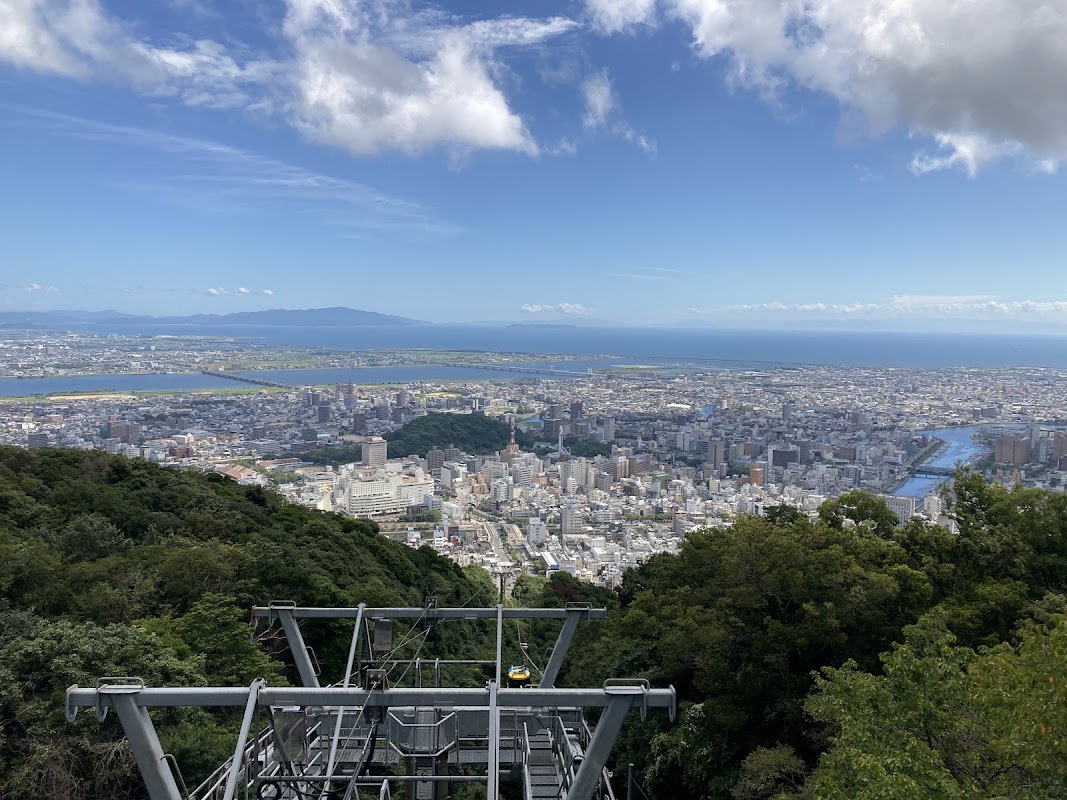
Mt. Bizan is a historic mountain, the landmark of Tokushima City, famously immortalized in the Man’yoshu anthology as ‘The Awa Mountain, seen like an eyebrow in the clouds.’ Mt. Bizan Park, located atop this mountain, offers unparalleled panoramic views of the Tokushima Plain, the Yoshino River, and on clear days, even Awaji Island and the Kii Channel, all from an ideal elevation of approximately 290 meters. It’s the prefecture’s premier viewpoint.
While the expansive daytime scenery is magnificent, Mt. Bizan Park truly shines from dusk to night. Its night view, recognized as a Japan Night View Heritage site, is hailed as the most beautiful in Shikoku. The city lights twinkle like a jewel box, creating a romantic atmosphere. Accessible by car, with a spacious free parking lot just a 5-minute walk up stairs to the observatory, its ease of access to such a spectacular view is a major draw.
Beyond the scenery, there are other attractions within the park. Don’t miss the pagoda (Peace Memorial Tower) dedicated to those who died in WWII, the memorial hall for Portuguese writer Wenceslau de Moraes who loved Tokushima, and ‘Bikakyo,’ one of Japan’s largest LED kaleidoscopes. At night, over 4,100 LEDs create a magical, photogenic space. A cafe (Machi★Asobi Cafe) associated with local Tokushima anime studio ‘ufotable’ is also located here, making it a unique spot where pop culture merges with nature.
Awagin Mt. Bizan Ropeway

📍 Address: Japan, 〒770-0904 Tokushima Prefecture, Tokushima City, Shinmachibashi 2-chome 20-20
While you can reach the summit of Mt. Bizan by car or on foot (via hiking trails), the ‘Awagin Mt. Bizan Ropeway’ is the route we most highly recommend for travelers. The boarding station is conveniently located on the 5th floor of the ‘Awa Odori Kaikan,’ about a 10-minute walk from Tokushima Station, making it a seamless addition to your city sightseeing itinerary.
Stepping into a cute, circular gondola, your approximately 6-minute elegant aerial stroll begins. As you gradually ascend, the city of Tokushima spreading beneath you shrinks into a diorama, and the exhilarating moment when distant seas and mountains come into view is unforgettable. Unique announcements narrating the history of Mt. Bizan and Tokushima’s culture play inside the cabin, keeping the short ride engaging.
The ropeway operates every 15 minutes, which is a welcome convenience for travelers, minimizing wait times. Especially if you ride around dusk, you can enjoy the magical hour from the sky as the city glows orange, gradually transforming into a sparkling nightscape. This facility is a classic tourist route to combine with a visit to the Awa Odori Kaikan, efficiently experiencing both Tokushima’s culture and its spectacular views.
Todoroqi Kyujuku Waterfalls
📍 Address: Japan, 〒775-0411 Tokushima Prefecture, Kaifu District, Kaiyo Town, Hiraiōyagyōdani, Ōyagyōdani
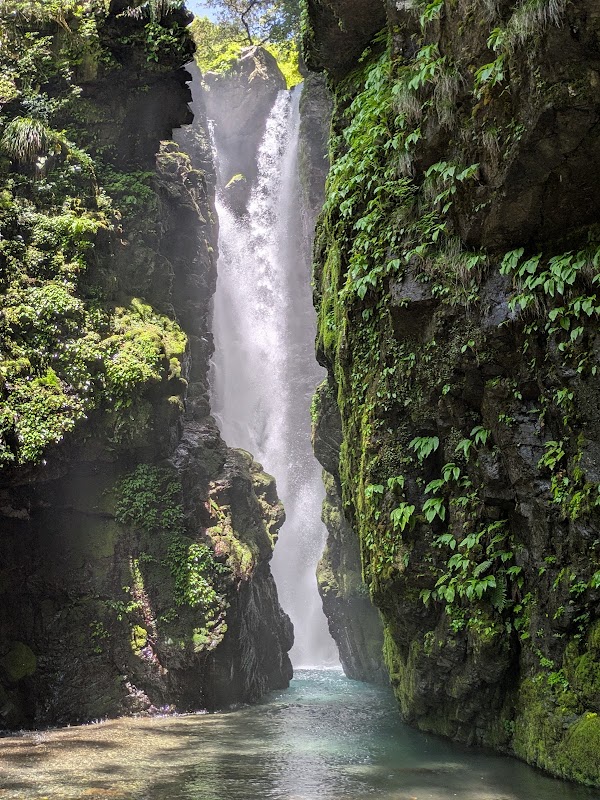
Tucked away in the southern part of Tokushima Prefecture, further upstream from the clear Kaifu River, lies the secluded ‘Todoroqi Kyujuku Waterfalls.’ This is one of Shikoku’s most renowned waterfalls, selected as one of ‘Japan’s Top 100 Waterfalls,’ and a dynamic scenic spot featuring a series of large and small waterfalls starting from Todoroqi Shrine.
After a 10-minute walk from the parking lot along a promenade, passing through the torii gate of Todoroqi Shrine, you’ll arrive at the ‘Main Falls,’ boasting the greatest drop. These main falls have a very mysterious structure; the rock face in front of it is layered like a curtain, so you cannot see its full grandeur unless you approach directly in front of the basin. The overwhelming sight of water crashing down with a roaring sound creates a sacred atmosphere, truly a power spot. Be extremely careful of slippery, wet rocks underfoot.
Further upstream from the Main Falls, you’ll find other impressive waterfalls such as Niju-no-taki (Double Falls) and Nabewari-taki. Exploring all the waterfalls to the furthest one requires a serious mountain hike of about 2 hours round trip. With steep ascents and descents in some areas, comfortable shoes like sneakers or trekking shoes and preparation for hydration are essential. Note that the access road (Prefectural Road 148) to the site, while paved, is a narrow mountain road, often 1 to 1.5 lanes wide. Passing points are available, but drivers unfamiliar with mountain roads should be extra cautious of oncoming traffic and allow ample time for a safe journey.
Tips for a Smooth Trip in Tokushima
Tokushima Prefecture offers a wide array of attractions, scattered across different regions: the sea in the Naruto area, the city and mountains around Tokushima City, and the secluded areas in the southern part of the prefecture. If you underestimate travel times between these spots, your schedule can easily fall apart. It’s crucial to plan a relaxed itinerary, focusing on ‘1 to 2 areas’ per day.
Especially around the Naruto Whirlpools, traffic jams can occur when entering parking lots during holidays. Account for a walk of over 10 minutes from the ‘Uzunomichi’ or sightseeing boat ticket counters to the parking area, and plan to arrive well in advance of the peak tidal current times. Also, even in summer, areas near the sea, mountain summits, and waterfalls can feel surprisingly cool (or chilly), so bringing layers of clothing that can be easily put on or taken off for temperature adjustment is a golden rule for your trip.
Regarding dining, local specialties like Tokushima Ramen, Naruto Sea Bream, and Naruto Wakame are must-tries. However, popular restaurants often have long queues during lunchtime. Aim to visit right after opening or slightly outside peak hours to make efficient use of your precious sightseeing time.


'%3E%3Cpath%20stroke='%23000'%20stroke-width='4'%20d='m-35-37-13%2020m5%203%2013-20m5%203-13%2020m63%2042%206-9m1-2%206-9m5%203-6%209m-1%202-6%209m5%203%206-9m1-2%206-9m-96%200%2013%2020m5-3-6-9m-1-2-6-9m5-3%2013%2020m63-42-6-9m-1-2-6-9m5-3%2013%2020m5-3-6-9m-1-2-6-9'/%3E%3Ccircle%20r='24'%20fill='%23cd2e3a'/%3E%3Cpath%20fill='%230047a0'%20d='M0%200a12%2012%200%201%201%2020%2013%2024%2024%200%201%201-40-26A12%2012%200%201%200%200%200'/%3E%3C/g%3E%3C/svg%3E)
'/%3E%3Cpath%20fill='%23b2b2b2'%20d='M241%20382q0%2016%2017%2026%2017%2011%2042%2011t42-11q16-11%2017-26V269H241'/%3E%3Cpath%20fill='%239f7e00'%20d='M241%20379q0%2014%208%2023%209%209%2021%209%2014%200%2021-9%209-9%209-23V269h-59'/%3E%3Cpath%20d='M241%20339v-70h59v110q0%2014-9%2023l-6%205v-68h-15v72q-8%200-14-4v-68zm59%2040c0%2022%2015%2032%2029%2032%2021%200%2030-18%2030-32v-40h-59'/%3E%3Cpath%20fill='%239f7e00'%20d='M266%20277v5h2v12h-3v-5h2v-5h-9v5h2v5h-4v9h3v18h-5v10h34v-10h-5v-18h3v-9h-4v-5h2v-5h-9v5h2v5h-3v-12h2v-5zm42%20101q0%2010%206%2017%206%206%2015%207%2010-1%2016-7%206-7%206-17v-29h-43'/%3E%3Ccircle%20fill='%230044ad'%20cx='329.5'%20cy='372'%20r='6'/%3E%3Cellipse%20fill='%230044ad'%20cx='300'%20cy='340'%20rx='16'%20ry='21'/%3E%3C/svg%3E)


