

What is the Charm of Arima Onsen? A Town Where History and Earth’s Mystery Intersect
Arima Onsen, located in Hyogo Prefecture, is renowned as one of Japan’s three oldest hot springs and one of its three most famous. Mentioned in the ancient *Nihon Shoki* chronicles, it served as a secluded retreat in Kansai, famously visited countless times by the feudal lord Toyotomi Hideyoshi during the Sengoku period for its therapeutic waters.
While Arima Onsen is famous for its cloudy reddish-brown ‘Kin-sen’ (Gold Spring) and clear ‘Gin-sen’ (Silver Spring), it surprisingly lacks an active volcano. How then do such high-temperature, high-quality hot springs emerge in the Kinki region, which is devoid of volcanoes? It is believed that ancient seawater, dragged deep beneath the Japanese archipelago as the Philippine Sea Plate subducts, is heated by subterranean geothermal energy. This water then seeps back to the surface after approximately 6 million years. In essence, Arima’s waters are ‘ancient Pacific seawater generated by the world’s newest plate.’
This article will introduce carefully selected, must-visit tourist spots in Arima Onsen, where you can feel this magnificent geological wonder and trace the footsteps of historical figures like Hideyoshi. Beyond textbook explanations, we’ll provide real, useful information for travelers, including tips for exploring the town and deep insights into its attractions.
‘Nene’s Statue’ by Eiko Shintani
📍 Address: Nene Bridge, 1400 Arimacho, Kita Ward, Kobe, Hyogo 651-1401, Japan
In the central area, often considered the gateway to Arima Onsen, stands the striking red-railed ‘Nene Bridge.’ Elegantly situated at its base is the statue of Nene (Kita-no-Mandokoro), the principal wife of Toyotomi Hideyoshi. Hideyoshi, who deeply loved Arima Onsen, visited the area countless times with Nene, working tirelessly to restore the hot spring town after it was devastated by wars and fires. This statue, symbolizing Arima’s rich history, is a highly popular photo spot, often seeing queues on holidays.
The sculptor is Eiko Shintani, an artist from Kobe. Interestingly, in the plaza by Taiko-bashi Bridge downstream along the Arima River, there is also a ‘Tea Master Taiko Statue’ (Hideyoshi’s statue), also created by Shintani. If you follow the gaze of Nene’s statue, you’ll realize it’s intentionally positioned to look towards Hideyoshi on the distant Taiko-bashi Bridge. Capturing a commemorative photo with the red bridge in the background, while feeling the deep bond between the two, is a classic Arima sightseeing route.
The surrounding area connects to the main street of the hot spring town, making it an ideal starting point for a food tour or a stroll. During autumn, the surrounding trees turn vibrant colors, offering an even more beautiful vista.
Gosho Sengen (Gosho Spring Source)
📍 Address: Arimacho, Kita Ward, Kobe, Hyogo 651-1401, Japan
Several spring sources are scattered throughout Arima Onsen, but ‘Gosho Sengen’ is particularly impressive. Located behind the historic ryokan ‘Tosen Goshoboh,’ it is where Arima’s famous ‘Kin-sen’ (Gold Spring), a high-sodium chloride hot spring rich in salt and iron, gushes forth.
The spring emerges from a depth of 165 meters at an ultra-high temperature of approximately 97°C, constantly enveloped in a dense cloud of steam. While colorless and transparent at the moment of gushing, it transforms into its distinctive reddish-brown hue upon exposure to air, as the iron content oxidizes. The salinity is said to be about twice that of seawater, making it a spot where you can truly feel the richness of its mineral composition.
A promenade has been built around the mortar-shaped spring source, allowing visitors to peer down into it. During the day, it offers a dynamic landscape that conveys the Earth’s raw power. At night, however, it’s eerily lit up, transforming into a fantastical atmosphere as if you’ve stumbled into a Ghibli film. It’s a deep, must-visit spot when strolling through the hot spring town after dinner.
Arima Onsen Spring Source (General)
📍 Address: 1163 Arimacho, Kita Ward, Kobe, Hyogo 651-1401, Japan
As you wander through the narrow alleyways of Arima Onsen, you might suddenly encounter a steel tower (yagura) soaring high into the sky. Tourists often wonder, ‘Why is there a scaffold-like tower in the middle of a hot spring town?’ But this is, in fact, a crucial facility for protecting Arima Onsen’s ‘spring sources.’
As mentioned earlier, Arima’s Kin-sen (Gold Spring) is extremely rich in minerals, containing large amounts of calcium carbonate. Consequently, its components quickly crystallize upon exposure to air, destined to rapidly clog the pipes that draw up the hot spring water. This necessitates frequent pipe maintenance and replacement, sometimes as often as every few days. Such sturdy towers are erected to hoist the heavy equipment required for these tasks.
Far from being mere visual noise, these towers are proof that ‘authentic hot spring water, so highly concentrated, is gushing forth right beneath your feet.’ Take in the raw, wild energy: the hissing steam erupting and the cracks in the concrete whitened by mineral deposits.
Zuihoji Park
📍 Address: 500-19 Arimacho, Kita Ward, Kobe, Hyogo 651-1401, Japan
‘Zuihoji Park,’ nestled on a hillside slightly removed from the bustling hot spring town, is renowned as one of Kansai’s premier autumn foliage viewing spots. The park was developed on the former grounds of Zuihoji Temple, a Obaku Zen sect temple that was abandoned in the early Meiji period. Within the park, a magnificent temple gate, said to have been relocated from Fushimi Castle, still remains.
In autumn, approximately 2,500 maple trees simultaneously burst into vibrant colors, creating breathtaking scenery. There’s an anecdote that Toyotomi Hideyoshi, upon visiting this spot, praised its beauty by saying he ‘could never tire of looking at it,’ earning it the nickname ‘Higurashi no Niwa’ (Day-long Garden). Quietly preserved within the park is a ‘stone Go board’ said to have been used by Hideyoshi, stirring up historical romanticism. During the autumn foliage season, the limited-time ‘Momiji Chaya’ (Maple Teahouse) opens, where you can enjoy dango (sweet dumplings) and amazake (sweet fermented rice drink) while admiring the beautiful views, promising a blissful experience.
A note of caution: the park does not have its own dedicated parking lot. Private paid parking near the entrance can become very crowded and expensive during the autumn foliage season, so it’s recommended to park in the central hot spring town and walk to the park. However, the path to the park involves a considerable steep climb, so comfortable walking shoes (such as sneakers) are essential. Beyond autumn, the ‘ao-momiji’ (green maple leaves) in early summer are also refreshing, making it an enjoyable forest bathing spot year-round.
Tsutsumigataki Waterfall
📍 Address: 1230 Arimacho, Kita Ward, Kobe, Hyogo 651-1401, Japan
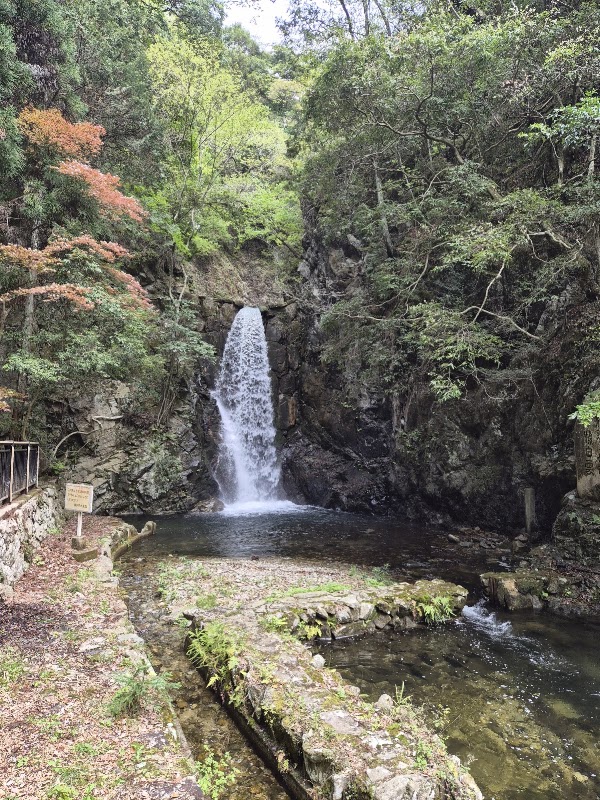
South of Arima Onsen town, walking along the upstream of the Arima River, you will discover ‘Tsutsumigataki Waterfall.’ This beautiful direct waterfall, approximately 8 meters high, is surrounded by lush trees, allowing you to experience astonishingly rich nature and negative ions by extending your walk just a short distance from the hot spring town.
This scenic spot was once counted among the ‘Six Views of Arima’ in the Edo period, but its name carries a somewhat poignant history. This waterfall used to be a two-tiered cascade, and the sound of water falling into the basin reverberated off the surrounding rocks, creating a pleasant ‘pon-pon’ sound, as if a *tsuzumi* (hand drum) were being played. It even became the setting for the legendary Noh play ‘Tsutsumi no Taki.’ However, due to the collapse of the rock face during the 1938 Hanshin Flood, and its subsequent repair into the current single-drop waterfall, the drum-like sound of old disappeared. Nevertheless, the beautifully flowing, clear water and the powerful sound of the waterfall itself remain.
Visiting early in the morning makes it a perfect healing spot where you can enjoy the birdsong and the murmuring of the river all to yourself. In early summer, fireflies dance and the refreshing calls of kajika frogs echo. Inside the park, there’s the ‘Takimi Chaya’ (Waterfall Viewing Teahouse) where you can relax while gazing at the waterfall. A local’s tip is to enjoy oden with a beer, or warm up with oshiruko (sweet red bean soup) on a chilly day. Google Maps might sometimes direct you towards the ropeway station, causing confusion; the correct route is to aim for ‘Tsutsumigataki Park’ and walk straight along the riverside promenade (Taki-michi).
Summary: Tips for Enjoying Arima Onsen 120% by Walking the Town
Arima Onsen is a charming town where history, nature, and the Earth’s energy are condensed into a compact area. Since the entire town is built along a mountain slope, there are many atmospheric narrow alleys and stairs, and the inclines are steeper than imagined. When strolling through the hot spring town, avoid uncomfortable shoes like heels; it’s a golden rule to choose comfortable sneakers or similar footwear.
Furthermore, with narrow roads and numerous pedestrians, getting around by car is extremely difficult. If visiting for a day trip, it’s best to secure parking around the hot spring town early and then explore everything on foot for the most stress-free experience.
Warm your chilled body in ‘Kin-sen,’ explore historical temples and shrines and nature-rich parks, and savor delicious carbonated rice crackers and Arima Cider amidst the steamy atmosphere. Come and experience the blissful time that even Taiko Hideyoshi cherished, with your own feet.


'%3E%3Cpath%20stroke='%23000'%20stroke-width='4'%20d='m-35-37-13%2020m5%203%2013-20m5%203-13%2020m63%2042%206-9m1-2%206-9m5%203-6%209m-1%202-6%209m5%203%206-9m1-2%206-9m-96%200%2013%2020m5-3-6-9m-1-2-6-9m5-3%2013%2020m63-42-6-9m-1-2-6-9m5-3%2013%2020m5-3-6-9m-1-2-6-9'/%3E%3Ccircle%20r='24'%20fill='%23cd2e3a'/%3E%3Cpath%20fill='%230047a0'%20d='M0%200a12%2012%200%201%201%2020%2013%2024%2024%200%201%201-40-26A12%2012%200%201%200%200%200'/%3E%3C/g%3E%3C/svg%3E)
'/%3E%3Cpath%20fill='%23b2b2b2'%20d='M241%20382q0%2016%2017%2026%2017%2011%2042%2011t42-11q16-11%2017-26V269H241'/%3E%3Cpath%20fill='%239f7e00'%20d='M241%20379q0%2014%208%2023%209%209%2021%209%2014%200%2021-9%209-9%209-23V269h-59'/%3E%3Cpath%20d='M241%20339v-70h59v110q0%2014-9%2023l-6%205v-68h-15v72q-8%200-14-4v-68zm59%2040c0%2022%2015%2032%2029%2032%2021%200%2030-18%2030-32v-40h-59'/%3E%3Cpath%20fill='%239f7e00'%20d='M266%20277v5h2v12h-3v-5h2v-5h-9v5h2v5h-4v9h3v18h-5v10h34v-10h-5v-18h3v-9h-4v-5h2v-5h-9v5h2v5h-3v-12h2v-5zm42%20101q0%2010%206%2017%206%206%2015%207%2010-1%2016-7%206-7%206-17v-29h-43'/%3E%3Ccircle%20fill='%230044ad'%20cx='329.5'%20cy='372'%20r='6'/%3E%3Cellipse%20fill='%230044ad'%20cx='300'%20cy='340'%20rx='16'%20ry='21'/%3E%3C/svg%3E)


